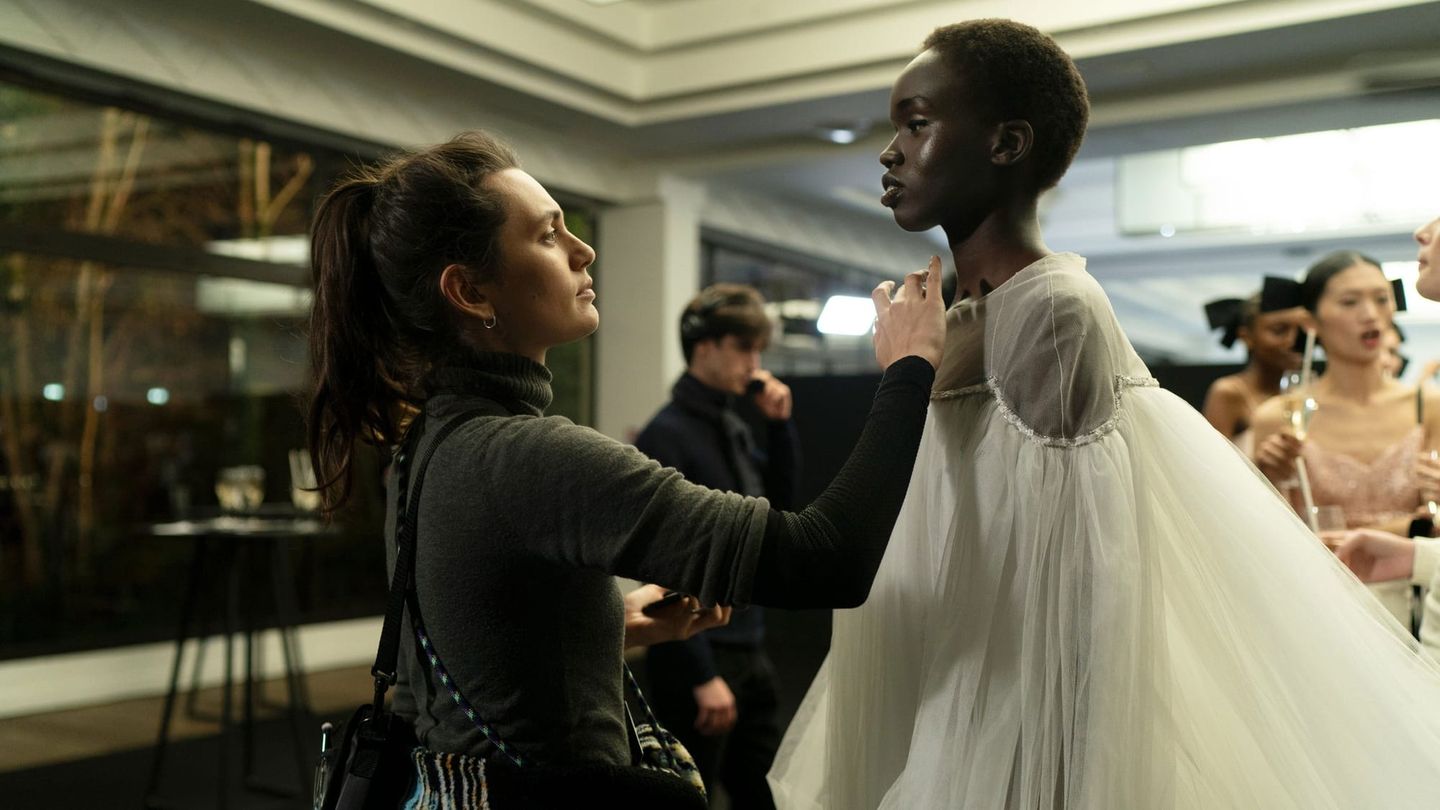
In Alice Winocour’s Couture, Maxine Walker (Angelina Jolie) is an American filmmaker hired to direct a short that will play in the background of a luxury fashion house’s latest runway show. Walker has been struggling to secure financing for her next indie horror project, and this short will help fund it.
As real-life directors - Sofia Coppola, Kathryn Bigelow, Martin Scorsese, Steve McQueen, and, most recently, Alfonso Cuarón - who have collaborated with fashion houses likely discovered before her, Walker finds that commercial work in Paris is very different from her usual creative process.
Here, the client’s vision, not Walker’s own, is paramount. And from the moment she walks off the plane and is asked if she plans to wear her leather jacket for a social media interview (yes), Walker and her client are at odds. They can’t agree on the look and feel of the short, or even the significance of fashion as a cultural medium. Asked to describe to camera how she feels about fashion, Walker says it’s “useless and necessary.” Things get tenser when she starts disappearing from set to attend appointments about her unexpected breast cancer diagnosis.
Creativity under capitalism is a recurring theme of the movie. Aside from Walker, we follow Angèle (Ella Rumpf), a make-up artist writing a novel inspired by the models she meets. Her work is unreliable as her bookings get cancelled at the last minute, and she is left scrambling for jobs. Forced to do overtime, she turns up late for a call with a writing coach, who seems nonplussed with her wide-eyed hope. He is one of many male characters who feel like they are treading on the main cast’s dreams.
Ada (Anyier Anei) is the third main character, a model from South Sudan whose shivering arrival in Paris ticks many boxes of the new model trope. She took the job to send money back home, is housed in an overcrowded apartment and sprains her ankle as she learns to walk in heels.
Couture is more fly-on-the-wall than full-blown commentary of the fashion industry, but Ada’s story is the thread where it gets closest. Hers is the latest skinny Black body chosen to open a show, one in competition with her Ukrainian flatmate, who doesn’t want to become last season’s flavour. The petite main sewing Ada’s dress works so hard to demonstrate her skills that she forgets to eat. Fashion clothes women’s bodies, but it also chews them up and disregards them. The red lines on a bust in the atelier match the ones a doctor (Vincent Lindon) draws on Walker to prepare her mastectomy. The title plays on the multiple meanings of the word “couture” in French, from high-fashion to surgical stitches to the seams barely holding the dresses – let alone the main characters’ lives – together.
This is a movie that mostly works because we, the audience, know Jolie’s personal and family history of gynaecological cancers, and know that she herself went through a double mastectomy, so it’s easy to link the actress and her character. Like Walker, Jolie has a specific sense of identity through her clothing, developing over the past decade a recognisable silhouette made of muted-colour shapeless dresses.
As a native French speaker, I was impressed with all the dialogue Jolie has in French, including emotional scenes with her doctor and her artistic director (Louis Garrel), and it always sounds as if Jolie genuinely understands what she is saying.
If you know fashion, Couture is full of fun winks – the monochromatic show palette (by Pascaline Chavanne), the iconic mirrored staircase, and the general show budget hint at Chanel. Like the 1998 Luc Besson Chanel No. 5 ad, Walker’s spot features a wolf running alongside Ada. Chanel, one of many fashion brands investing in cinema as part of their marketing, allowed Winocour to film in their ateliers. She is the first fiction director to do so.
Yet the house is never name-checked in the film. Although Winocour has been very complimentary of Chanel in interviews, this might have been a way for her, like Walker, to retain creative independence.