FLINT, a surrealist cycle | Sweet and Short
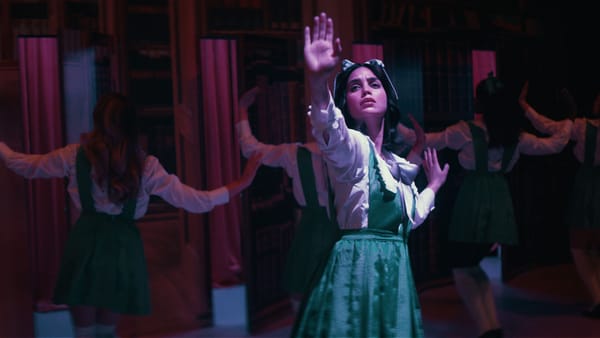
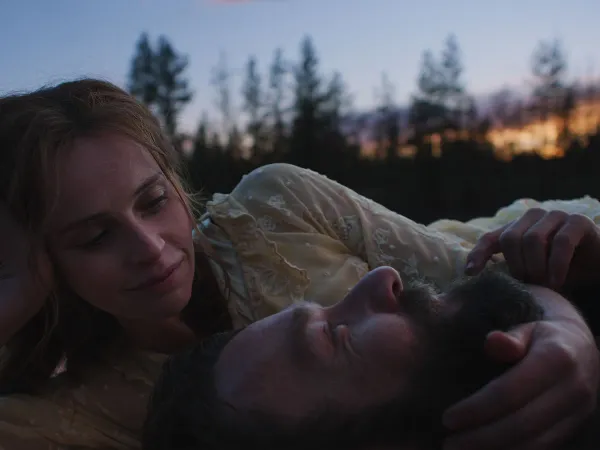
Out on iPlayer today, short film FLINT unfolds with patterns, connections, repetition, and surreal sequences [that] are becoming a signature in Khalid’s storytelling style. It’s what pulled me in while watching his first feature film “In Camera” and has me coming back to new projects.

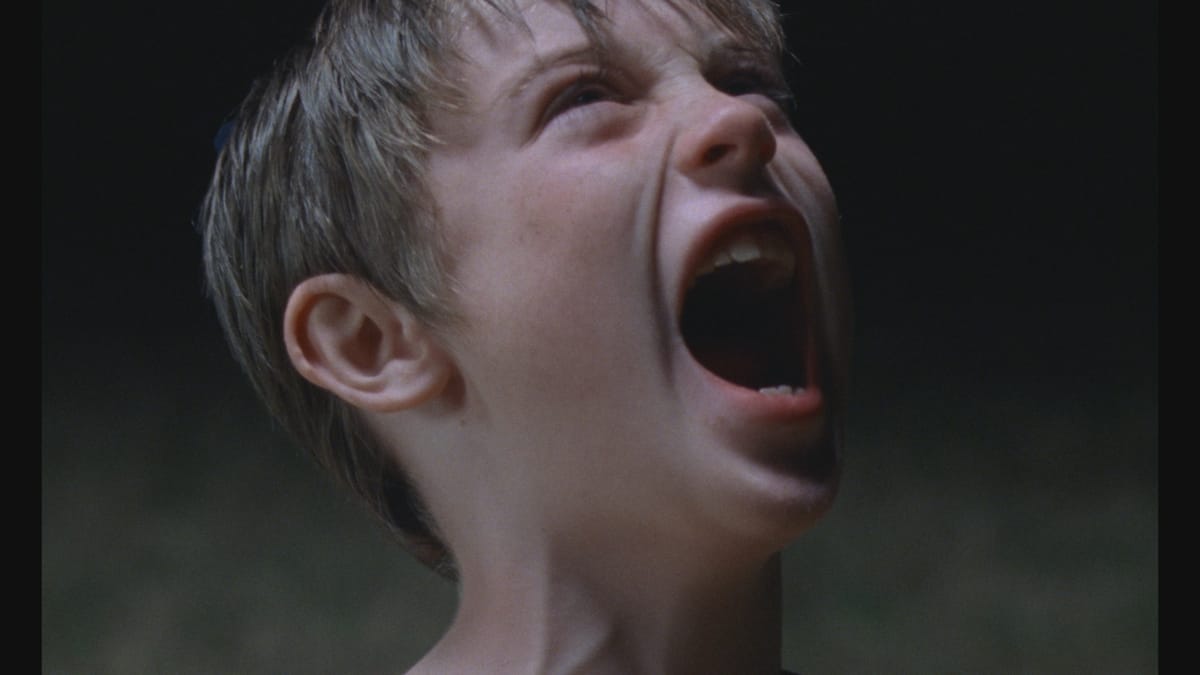
Here at OBSCURAE, we've always championed short storytelling as the hunting ground for your next favourite filmmaker – and encouraged you not to skip the shorts programme! Welcome back to our Short film review series, Sweet and Short.
Exploring complex feelings with beautiful, surreal visuals, uncanny movements, and immersive sound, the audience is taken on an internal journey with FLINT. We see a man come home to heal after a time away, only for things to unravel and slowly descend into violence. FLINT is Writer and Director Naqqash Khalid’s third short film, and an idea he just couldn’t shake after his first feature film “In Camera”.
This feeling of coming back to a home you haven’t been to in a long time is familiar to a lot of us, especially those in the diaspora. This dichotomy of being in a place you know so well and stepping back into a version of yourself that doesn’t exist anymore. There’s a dissonance, an unfamiliar tension, a disconnect that quietly happens below the surface. Our subconscious trying to make sense of these conflicting feelings which keep trying to crawl out. FLINT captures it all beautifully. We’re taken along with the main character (portrayed by Rory Fleck Byrne) as he tries to understand and reconcile the past with his current self.
Khalid blends so many elements together in his storytelling, which create an immersive experience for these emotions. The way the internal world is captured evokes emotions in a way that made me feel unexpectedly seen. Like peeling away the layers and making tangible the intangible subconscious world driving us. We see our main character feeling out of place in his childhood bedroom, being lost inside his head while speaking to his dad, slipping back into patterns he’s outgrown, and a pivotal moment where he faces his younger self. In just 17 minutes we get a rich exploration of feelings.
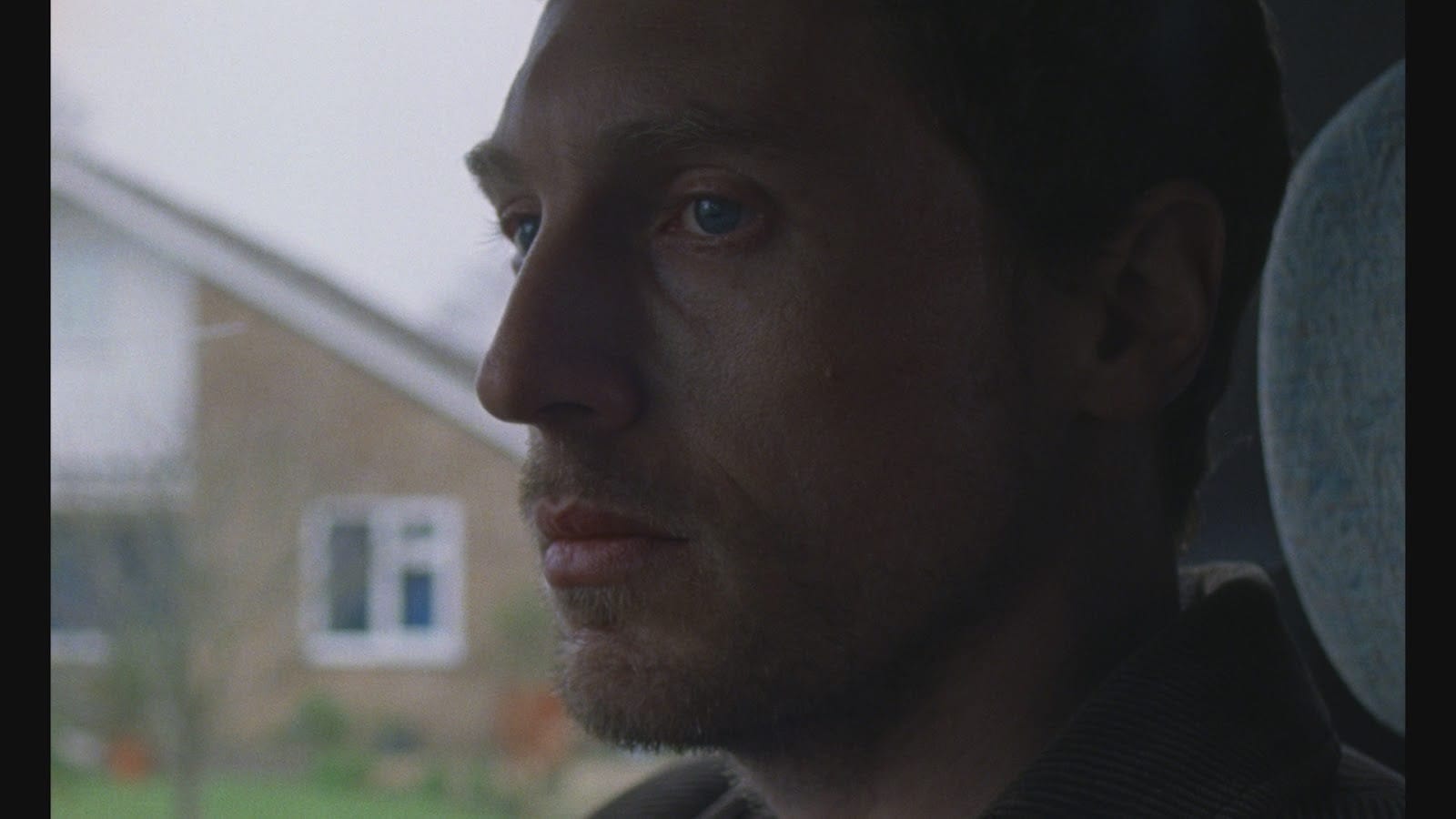
The visual storytelling is so beautiful and evolves with the story. Colours start off muted and melancholy, with overcast skies and scenes bathed in blues and greens. The costuming reflects this as well, with everyone in the same cool, neutral palette. The main character is filmed up close, through reflections, and obscured by foreground elements, in an almost claustrophobic way where he doesn’t quite fit the frame and isn’t quite himself. Slowly we start seeing the introduction of warmth. Oranges, red meat, a yellow jacket. Until the main character is finally glowing in yellow and sunlight.
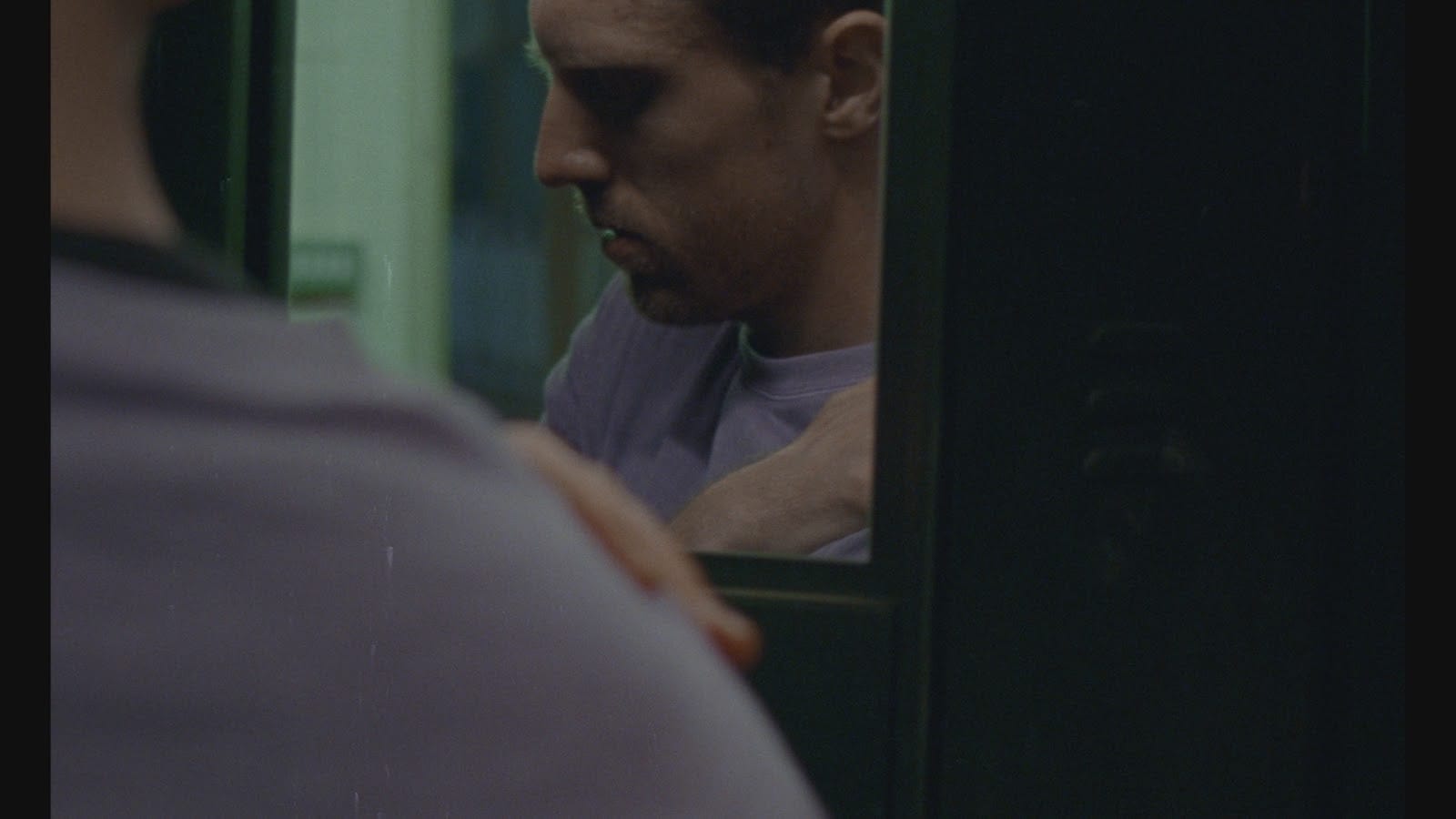
Fleck Byrne’s performance really shines in this film, especially in the dream-like, surreal sequences with uncanny movements. It’s one of my favourite parts of Khalid’s storytelling style. In a scene early on we see him make his way to his childhood bedroom. Bathed in blue, his hand glides along the hallway in a dance, with a whimsical yet eerie (almost alien) sound as the backdrop. That sound continues as we watch him struggle to put on a hoodie, reflected in a narrow mirror, as if he doesn’t fit the space anymore. And his inner child surfaces as he fiddles with an elastic band, clenches his fist while lying on the bed, and fiddles with his hair. There’s a subtle tension and almost out of body experience communicated in Fleck Byrne’s slow movements and facial expressions.
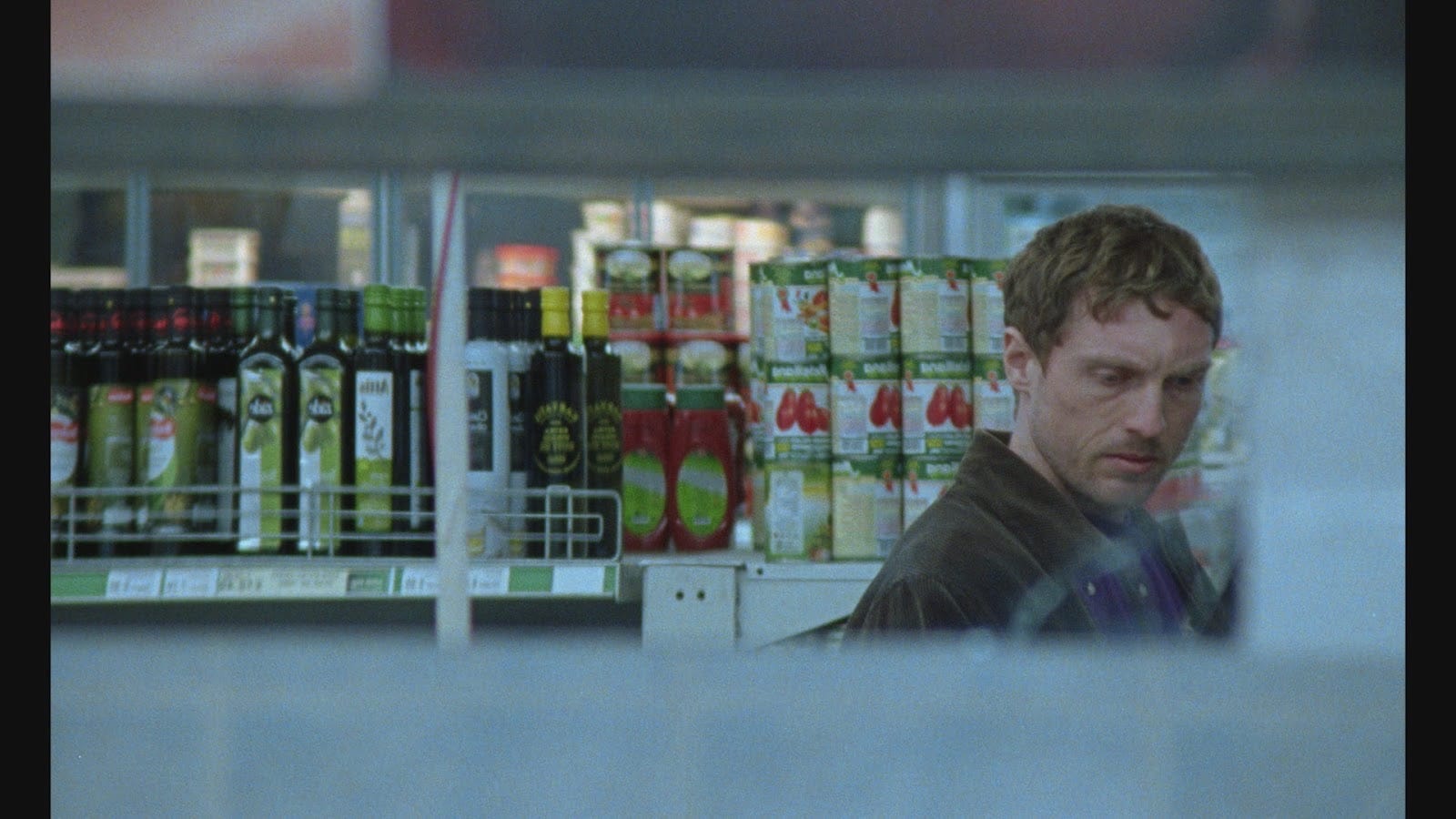
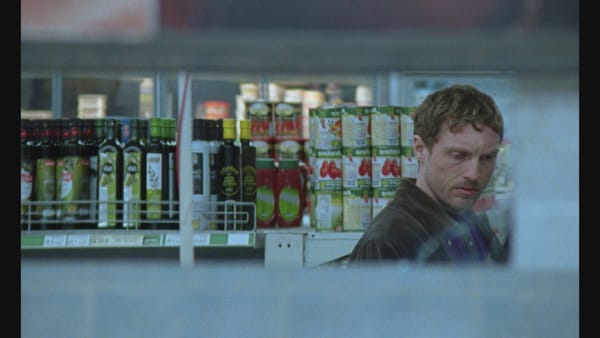
Another sequence comes when he’s in a grocery store with his dad. We follow them around while they have a seemingly mundane conversation, putting various fruit and snacks into his basket. All the while he’s lost in his own head, replying to his dad on autopilot. Then through another mirror reflection, we see him pause, confused, while water sounds play as fish seemingly speak to him. He starts sliding along the frozen food aisle, partly obscured by the foreground, almost as if he’s being pushed and pulled by a water current that’s trying to drag him under. Once again, Fleck Byrne perfectly portrays the complex emotions through movement, close ups, and lingering shots on his face.
These surreal sequences communicate so much about the internal state of his character while also leaving it open enough for the audience to have their own emotions, experiences, or interpretations come to the surface. They feel like the internal world, the subconscious, is clawing its way out to the surface and trying to communicate with our conscious minds.
The sound design deserves its own recognition, adding another texture to the immersive experience. Amplifying ambient noise, adding in unexpected sounds, and playing with volume to represent the internal state of the main character. And sometimes these sounds recontextualize the scene entirely, not quite matching what we’re seeing on screen. There’s an element of play with the use of whispering (which sounds like speech played backwards), sounds of water, repeated loud sounds, and even horses galloping. Some sounds are almost eerie or alien, out of this world. And underlying it all is a subtle heartbeat played through drums. In pivotal moments, the salient or subtle changes in the background sound indicate something has happened internally. A loop completes, tension releases.
The dialogue may seem to take a back seat to the visual and auditory storytelling, but it adds another layer of patterns and loops to the film. “It doesn’t fit.” This line is said innocuously during an early conversation, but nothing is that simple when it comes to Khalid’s incredibly layered and complex writing. We see through movement, costuming, and cinematography how he does not seem to fit this current world. And how it does not fit him.
The phone charger doesn’t fit. He doesn’t fit between the hanging meat at work. His clothes don’t seem to fit in two parallel scenes, putting on a hoodie and later taking off his work overalls. Both in the same uncomfortable way as if they’re too small, despite being his size. And in a pivotal scene, a yellow jacket doesn’t fit and rips at the seams.
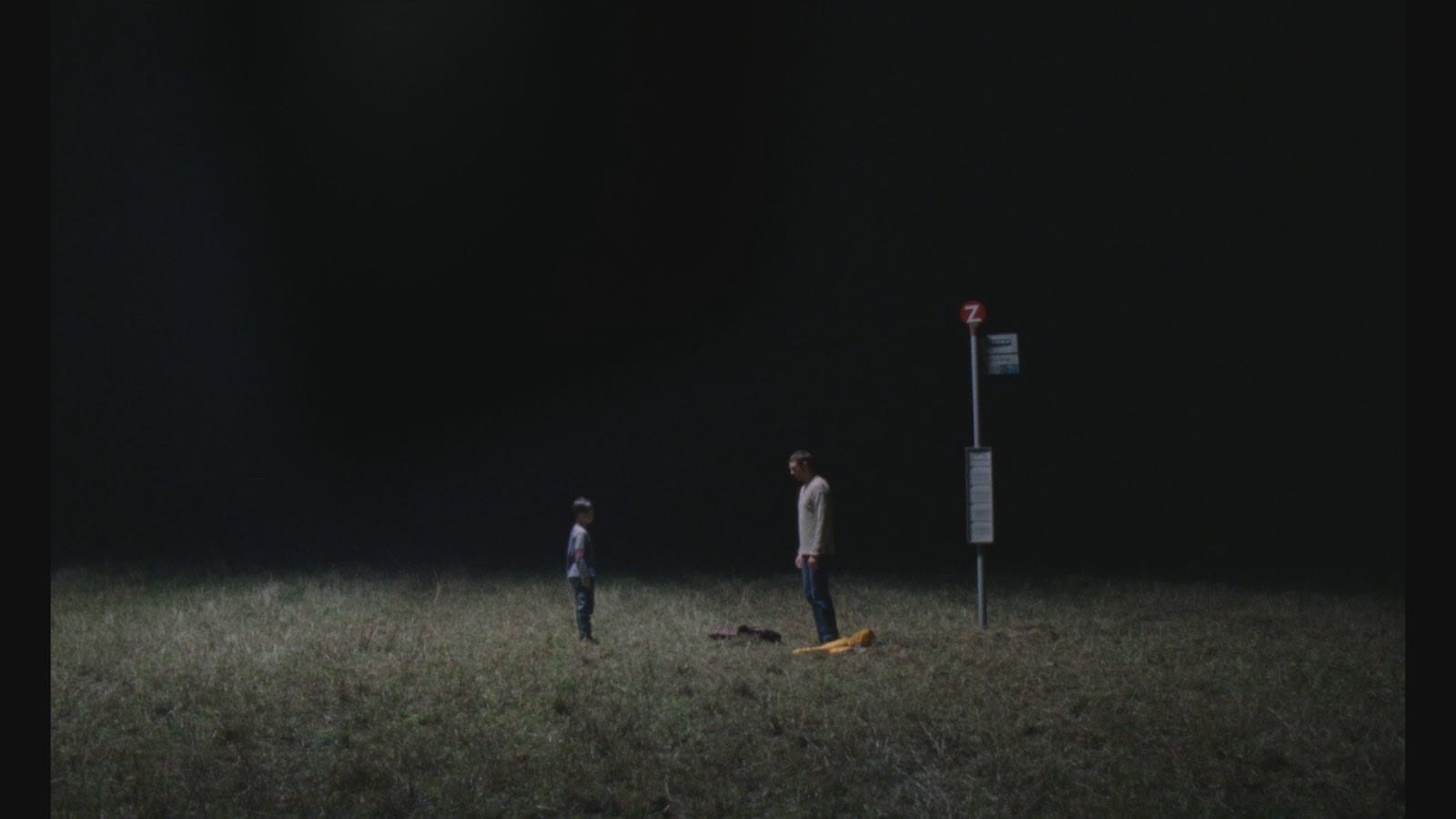
We also get generational parallels in conversations with his family. His father tells him about a dream he had while he’s not really paying attention. Those details end up manifesting later in a dream-like scene with his younger self. Another conversation with his mother shows the cyclical nature of life. He feeds his elderly grandfather after bathing him. She reminisces about how he would take off his sock as a toddler, and how it’s tricky getting socks on her father’s feet. Touching on the way our families imprint on us and how different generations are connected.
The way the story of FLINT unfolds with patterns, connections, repetition, and surreal sequences are becoming a signature in Khalid’s storytelling style. It’s what pulled me in while watching his first feature film “In Camera” and has me coming back to new projects.
One day when Khalid is revered in the world of cinema for his distinctive surrealist, layered, cyclical storytelling, with his films being discussed, dissected, and studied, I’ll smile knowing I saw it coming all along.