Hills Don’t Dance Alone | BFI Flare 2026
A remarkable insight into the journey of a young man’s self-discovery, set against the breathtaking backdrop of the Himalayan mountains.
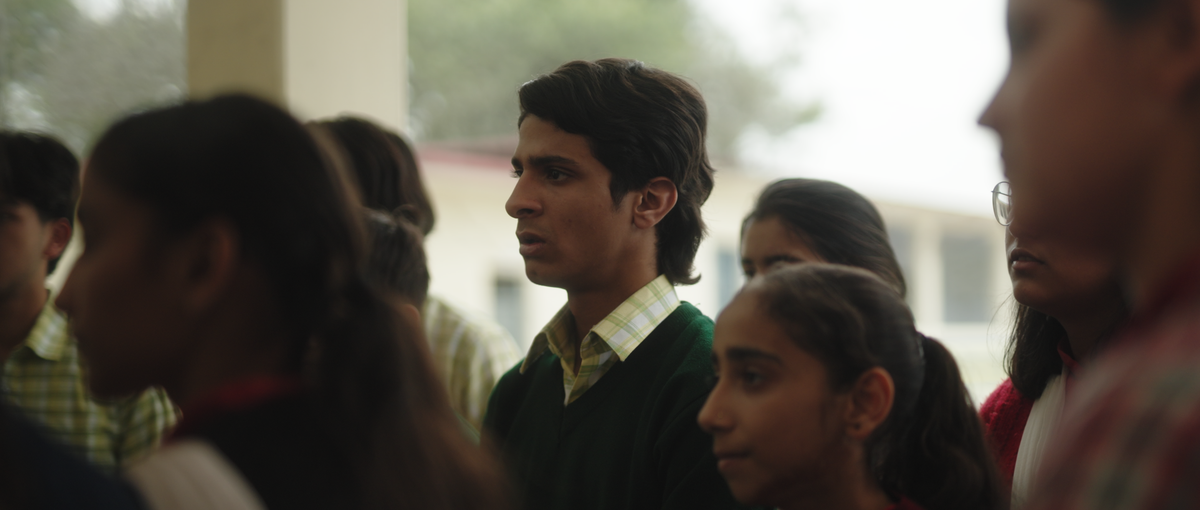
Hills Don’t Dance Alone is a stunning, dreamlike short film set in the small village of Himachal, nestled in the Himalayan mountains. Directed by Shubham Negi, it focuses on the unexpected bond between a student in the throes of self-discovery, Sachin (played skillfully by Tanishq Chaudhary), and his altruistic teacher, Anju (Sangeeta Agrawal). The film was developed through Netflix’s TakeTen grant, an initiative curated by Netflix and Film Companion to fund the new generation of filmmakers.
Sachin is bullied by his classmates for enjoying wearing girls’ clothing for a folk-dance performance in a music lesson. Boys and girls are segregated for these performances, meaning boys play girls’ parts and girls play boys’ parts - because they have to. Anju, the school’s vice principal, witnesses the bullying and converses with the head teacher about it, leading to the solution of mixed gender music lessons, much to Sachin's disappointment - he'll no longer be forced to wear girls' clothing.
Tanishq Chaudhary does a stellar job at portraying such a nuanced character. A young man, only just delving into the complexities of his identity, in such a rural place where terms like ‘gender identity’ literally don’t exist - the concept of which would never be readily discussed in a little mountain village - maybe in hushed tones, and definitely not using the word ‘transgender.’ The location of Himachal (the northernmost state in India and director Shubham Negi’s own hometown) adds to the film’s hazy atmosphere, the lush green landscapes of North India seeming almost like a stage for Sachin’s story. The film doesn’t boast huge amounts of dialogue, but the thick forest and miles of dense mountainscapes and countryside speak for themselves.
The film’s original score (composed by Aditya Buragohain, Geetanjali Kalta, and Mohit Mahore) is particularly excellent. It’s extremely emotive, especially during a scene in which Sachin dances in the forest wearing a ghagra (skirt), no audience to speak of, except Anju, who he doesn’t realise is present. She later invites him to come to her home whenever he would like, where he can wear feminine clothing at his leisure, away from any judging eyes. This moment is so poignant: although Sachin appears bewildered that he has been seen, in all senses of the word, the kindness of Anju to extend such an olive branch is so powerful. She’s giving him a sanctuary to be himself with ease. The only drawback of the film is that Anju features in her own small storyline that doesn’t feel entirely fleshed out or necessary - although much of the film’s excellence lies in its lack of need for copious dialogue or conversation between characters, I feel that this plotline would have benefited from a little more context.
Shubham Negi articulates that when queerness is discussed in rural communities, it isn’t spoken of in words, because it doesn’t have the vocabulary to verbalise itself. Words like ‘trans’ and ‘gay’ don’t exist in these places, so these identities are explored via emotions, rather than labels. This notion is made clear in the film - over twenty-four minutes, not once are any such labels mentioned, but we don’t end the film with any questions regarding sexuality or gender identity in terms of the main characters either. All the information needed is there, but it isn’t spelled out for us. As a viewer, it's always welcome when a film requires some thought, rather than being handed the plot on a plate.
The film, in its essence, is about the importance of empathy and kindness, and the difficulties of self-discovery. Queer coming-of-age stories are so rarely set in such rural communities, let alone focused on such unassuming characters as a student and teacher, and Negi’s goal for this film was to shine a light on these people and locations because they do, of course, exist. All too often, these stories are founded in urban communities and cities, rarely focused on the narratives of people in places like Himachal. It’s certainly successful in its goal.