Night Stage: Desire in the Spotlight


Buy us a coffee (or two!), and fuel our work - for £5 a month you can help us keep OBSCURAE’S independence alive.

Night Stage opens with an immediate sense of artistic intent: a theatrical space, underscored by the classical swell of “Adeus”, and Maura moving through interpretive dance. It’s a striking introduction that signals exactly the kind of film this will be- sensuous, stylised, and deeply performative. From that moment, it becomes clear this is a work more interested in mood and texture than conventional narrative structure.
Set within a troupe of actors scrambling towards opening night without a finished closing scene, the film quickly narrows its focus. The real draw is Matias, played by Gabriel Faryas, whose presence is nothing short of magnetic. From his very first moment, staring directly into the camera, he commands attention. Faryas’ performance is built on precise, almost imperceptible details: a shift in posture, a glance held a second too long. One particularly telling moment sees him subtly mimic the more traditionally masculine stance of a scene partner, signalling both insecurity and adaptability in a single gesture. It’s a performance that rewards close watching.
There’s also a thoughtful layer of symbolism embedded in the film’s use of names. A character adopting “Decreto” on a dating app (Portuguese for “order”) hints at the illusion of control and self-curation, reinforced by his admission that he performs an “ideal” version of himself. This thematic thread recalls the psychological complexities of Almodóvar’s Talk to Her, particularly in its exploration of identity and perception.
Visually, the film leans heavily into a rich red colour palette, saturating scenes with a sense of heat, passion, and latent danger. This aesthetic choice again evokes Almodóvar, whose films often use colour as emotional shorthand. The lighting design is equally deliberate: low-key setups emphasise secrecy and intimacy, while flashes of golden light wash over the actors like stage spotlights, reinforcing the interplay between performance and reality.
The film’s soundscape is another standout element. Each track feels meticulously chosen, imbuing scenes with an almost electric energy that heightens both tension and sensuality. Music here doesn’t just accompany the action- it animates it.
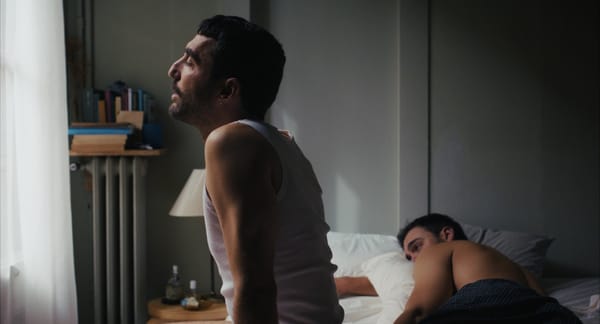
Where Night Stage becomes more divisive is in its explicitness. The central relationship, between Matias and Rafael (Cirillo Luna), evolves into a dangerous fixation on increasingly public sexual encounters. While their chemistry is undeniable and the performances remain impressively naturalistic, so much so that the audience feels like voyeurs intruding on something private, the film’s graphic depiction of sex can feel excessive. There’s an argument to be made that it pushes boundaries rarely explored in mainstream cinema, particularly in its portrayal of male intimacy. However, at times it veers into territory reminiscent of Blue Is the Warmest Colour, where the line between narrative necessity and indulgence becomes blurred.
This sense of over-reliance on eroticism ultimately impacts the film’s narrative weight. While technically accomplished, the plot itself feels somewhat underdeveloped, leaning heavily on its provocative elements to maintain engagement. A more sustained thriller-like tension throughout (not just in its final moments) might have elevated the stakes and given the story greater propulsion.
That said, the ending is undeniably powerful. Without giving anything away, it lands with a shock that reframes much of what precedes it, offering a pointed commentary on society’s relationship with desire, spectacle, and voyeurism. It’s here that the film’s themes crystallise most effectively, leaving a lingering impression that is as unsettling as it is thought-provoking.
Night Stage is, above all, a film of sensations- visual, sonic, and physical. While its narrative may not fully match the strength of its craft, it remains a bold and uncompromising piece of cinema that will likely divide audiences as much as it captivates them.