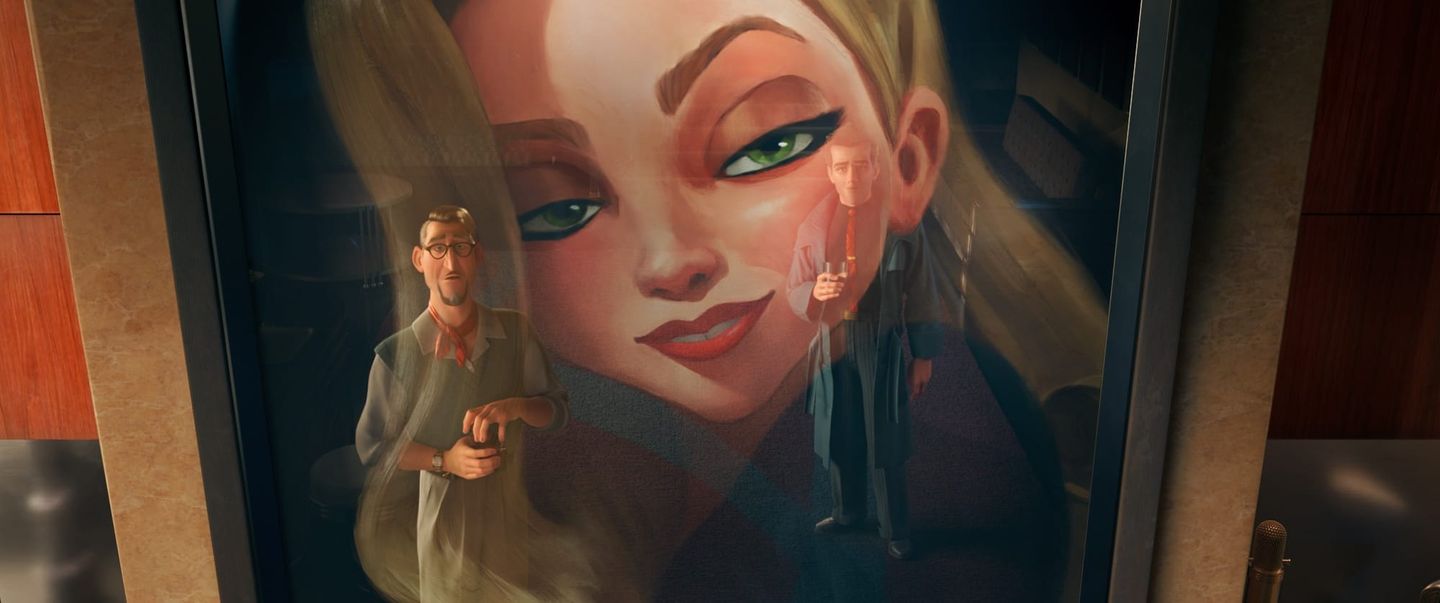
As the title suggests, Ray Gunn is centred around the titular character: Ray Gunn (Sam Rockwell) is one of the last human private detectives in a futuristic world made up of flying cars and guns powered by an illegal replicator particle technology. Ray is a former member of the police force now turned private eye who works with his loyal partner Eye-ra Kadok (Tom Waits), an alien whose one eye takes pictures of everything he sees. While money is running low as everyone else is adapting to new technologies, Ray gets hired by Arnold Dom (Bobby Cannavale) to spy on his wife, the famous pop star Venus Nova (Scarlett Johansson) who has a new album coming out soon and various scandals that seem to follow her around and threaten her career.
Its distinctive animation style is reminiscent of noir films which suits the detective story and mystery element of the film. The mix of noir aesthetic within the science fiction setting of Ray Gunn also creates a unique look for the movie that particularly makes it stand out with the deep shadows and high contrasts of noir combined with flying cars and advanced technology. The retro-futuristic visuals are mirrored in the storyline as well as the latter explores themes of past and future and analyses the effects of technology on the relationships between characters and cultural context that we see portrayed in the movie.
The themes in Ray Gunn are equally as fascinating and well-explored. The aliens are very well integrated within the plot of the movie and also function as a successful metaphor for racism. The movie portrays a segregated society in which aliens are often discriminated against and relegated to alien-only spaces that humans do not step into, adding an element of social commentary to the detective story. Visually, they are also particularly interesting as each alien has its own unique look which adds an exciting element to the film’s worldbuilding.
With its futuristic setting, Ray Gunn successfully reflects on technology as Ray Gunn is shown to be one of the only detectives who still uses the “old” technology such as photographs while everyone else has now moved on. This may seem like a disadvantage for Ray initially, but it may very well turn out to become his secret weapon. Within its exploration of technology, the film also delivers an interesting commentary on a culture of mass advertising where new technologies invade people’s homes and their own privacy. Despite being set in a world that is far into the future, the issues that Ray faces throughout the movie are not so dissimilar to our own in everyday life.
With Brad Bird’s signature animation style that fans of the director will love and its fascinating futuristic setting, Ray Gunn is a film that belongs to the big screen. Its story is compelling and its mystery well written, if only a little predictable at times, and will keep audiences to the edge of their seats until the very last scene in order to get a full picture of everything that happens throughout the course of the movie. With excellent narrative and an aesthetic that matches its themes and setting, fans of detective stories are bound to love this story and the visuals of this film.
Support our work
You can subscribe to the OBSCURAE newsletter for free, or become a paid Aficionado for £5/month to help fund independent coverage, contributor fees, site hosting, and admin costs.