The President's Cake, or; The First Time I Learned About Death and Watching It Again
In a powerful review, Farah grapples with the beauty and the pain of the film within a rich context.

My earliest memory of death and mortality happened on Eid al Adha on 30 December 2006, the day Saddam Hussein was executed. I was six.
It was early morning, and my parents had the TV on. I caught snippets, not comprehending. My mum explained it simply, and I understood. Eid al-Adha falls in the last month of the Islamic calendar, after the pilgrimage to Mecca, when we perform Udhiya, which is the sacrifice of a sheep or a cow, shared with those in need, neighbours, family. The irony is not lost. Many have said those two days were connected for a reason.
I had nightmares for days about masked men. At six years old, it felt like months. But it was not until much later in my adolescence, particularly during the Arab Spring, that I began to understand the politics of that time.
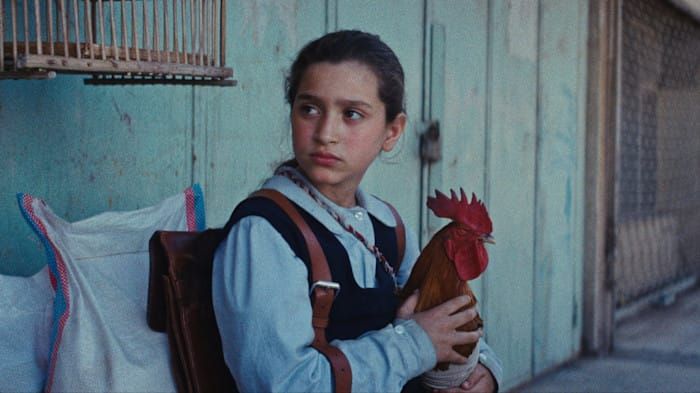
So when I watched The President's Cake, all of those feelings hit me at once. Directed by Hasan Hadi, The film follows nine-year-old Lamia (Baneen Ahmad Nayyef), a polite schoolgirl living with her grandmother Bibi (Waheed Thabet Khreibat) on the shores of the Iraqi marshes, with her pet rooster Hindi. It's set in the 1990s, against the backdrop of western sanctions and Iraq's invasion of Kuwait. In a kind of Hunger Games reaping scenario, students are "chosen" to participate in the president's birthday festivities, required to buy fruit, juices, and the grandest of all: the cake. Lamia and Bibi, surviving on very little, cannot afford this. Lamia prays not to be chosen. Bibi tells her to recite a verse that my mother made me say when I was anxious about missing my homework: "And We have put a barrier before them and a barrier behind them, and We have covered them so they do not see" (Surah Ya-Sin, 36:9).
But, of course, she is chosen. So she and Bibi hitchhike to Baghdad with Jasim (Rahim AlHaj), a kind mailman, to gather ingredients from the souk. Lamia gets new clothes. Then, on their last stop, they visit a woman and Lamia realises this is to be her foster mother. Bibi explains she wants the best for her granddaughter, that she is sick and penniless. But Lamia, overwhelmed and terrified she'll face prison if she fails to deliver the cake, escapes with Hindi. Across Baghdad, she encounters many people, mostly bad, but also her best friend and neighbour Saeed (Sajad Mohamad Qasem). Together, they are determined to get those ingredients in time.
The cast is made up of first-time actors, but they perform with such honesty and pain that it doesn’t feel like acting. Waheed, as Bibi, is especially extraordinary. It is hard to believe she had never acted before. Then you realise: some of them lived it, or lived the consequences that trickled down through generations. I often say, about myself, that being raised in political turmoil changes something in you. It makes it harder to relate to a lot of people in your industry, your age group. It comes with a chronic heaviness, and I think the film captures that feeling hauntingly.
This is a deeply painful film. There isn’t much joy in it, but only the love Lamia has for Bibi, Hindi, and Saeed. The innocence of childhood friendship lingers in intense staring contests and shared sips from expensive bottles of Pepsi. Those small moments of hope feel enormous because everything else feels and is so awful.
Unfortunately, the film also lingers on other parts that, at times, became too much. Especially in Lamia and Saeed’s meetings with the Baghdadi characters. As an Arab viewer, I sometimes fear that watching films like this becomes inseparable from perpetuating a certain kind of narrative, a cinema of tragedy that risks flattening us into suffering alone. I don’t want our identity to be defined solely by pain. Yes, much of our trauma comes from political turmoil, but less so from our communities themselves, which the film occasionally frames as overwhelmingly cruel until its final moments. At the same time, it beautifully captures things that are almost impossible to articulate: the heaviness of heat on an ordinary summer day, the quiet dignity of survival, the way children carry both innocence and unbearable responsibility at once.
Still, The President’s Cake is one of the best Arab films of 2025 and a must-watch, even if it is sometimes difficult to stomach. It left me unsettled long after the credits rolled, not only because of what it shows, but because of the memories and questions I am still trying to understand.