28 Years Later: The Bone Temple
"Despite my usual sequel fatigue, I could not wait for The Bone Temple. I’m relieved to report that it not only justifies its existence but also beautifully concludes the story of its predecessor."

I am, by deliberate choice, not a horror fan. While my friends and colleagues have long described the genre’s cathartic power, it remained mysterious to me until the release of 28 Years Later last summer. That film felt like a revelation. I felt an odd, uncomfortable love pouring out of every line, fearlessly crossing social and political territories few dared to tread, including the movie’s very own screenwriter, Alex Garland. So despite my usual sequel fatigue, I could not wait for The Bone Temple. I’m relieved to report that it not only justifies its existence but also beautifully concludes the story of its predecessor.
Seamlessly taking the reins from Danny Boyle almost seven months after the first film’s release, director Nia DaCosta adds even more soul to the franchise. Although some find this chapter less visually kooky or risk-taking than its predecessor, I see that as a necessary recalibration. I view these two films as halves of a whole, and The Bone Temple is the more reserved, contemplative story, with the threat of the infected taking a back seat.
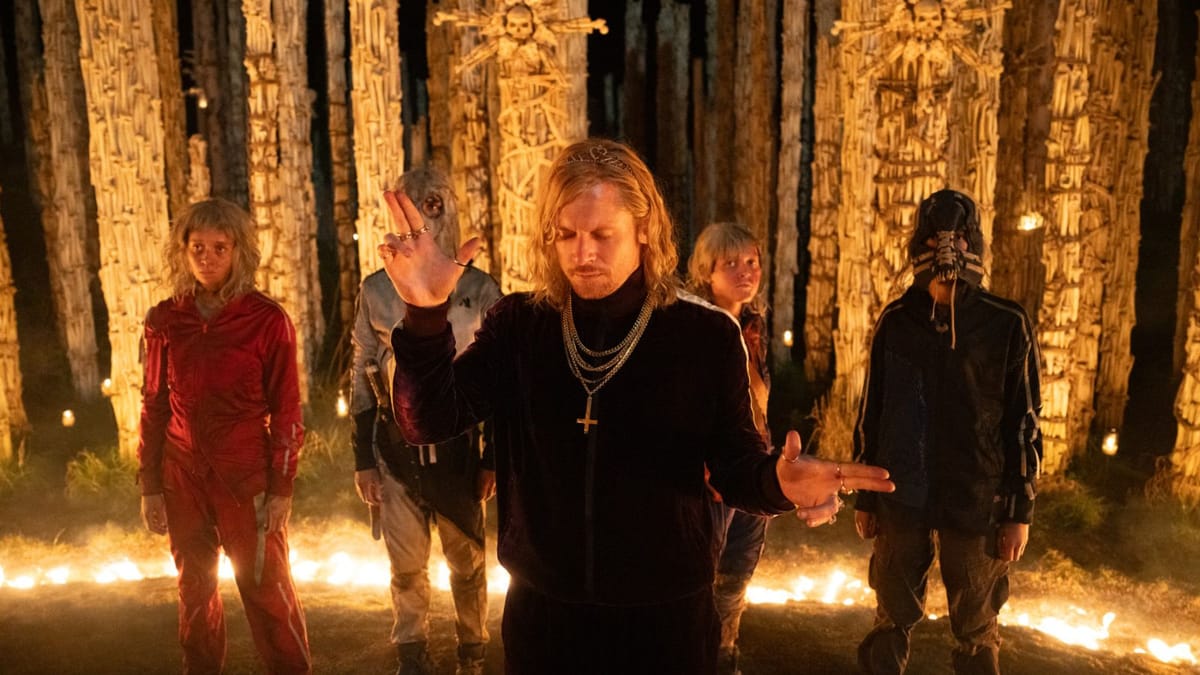
The story picks up immediately from the ending of 28 Years Later, catapulting us back into post-apocalyptic Britain. After being saved by them in the last scene of 28 Years Later, our protagonist Spike (Alfie Williams) is left in the hands of “The Fingers”, a violent satanist cult led by the chilling Sir Lord Jimmy Crystal, played by Jack O’Connell. The tracksuit-clad, blonde-wig-donned, Jimmy Saville-like Fingers are seven individuals who willingly exist outside any semblance of society that still remains. Spike is forced to prove himself through a brutal rite of passage, or he is forced to do “charity”, which is not as kind as it sounds.
Although the film moves us through three different storylines, Spike, Jimmy Crystal, and Dr Ian Kelson, I kept finding myself drawn back to Kelson. Played with almost monastic calm by Ralph Fiennes, he feels like a stand-in for God, or at least for Garland’s version of God. Kelson does not rush to act; he observes, listens, and searches for meaning. His fixation on studying the infected Alpha, whom he names Samson, and trying to understand what remains of his mind becomes one of the emotional cruxes of the film. In a world full of “monsters”, Kelson’s act of naming and humanizing Samson is radical, and an attempt to understand the “Other”. Fiennes’ performance turns Kelson into one of the most original characters of the 21st century.
Additionally, O’Connell’s Jimmy Crystal is bone-chilling, far more terrifying than any infected could be. O’Connell balances impish silliness with a kind of adult psychosis shaped by trauma. It is fascinating to watch him interact with Spike, whose trauma manifests in a completely different way. It is almost like a child in an adult’s body facing an adult in a child’s body, and the result is both hilarious and terrifying.
Alfie Williams as Spike continues to deliver a beautifully vulnerable performance, but this time with such subtle grief. And though her role is smaller, Erin Kellyman as Jimmy Ink is a stand-out, and I am very interested to see how the next film will deal with her own trauma and conflicting loyalties.
As a former horror skeptic, this franchise has moved me. My first thought after the credits rolled was an unexpected longing to sit with Dr Ian Kelson and talk about the transformative power of love.
The Bone Temple is a brilliantly crafted work that will satisfy both horror purists and casual viewers, and give devoted fans of this world a lot to contemplate (and a cameo that is not to be missed).