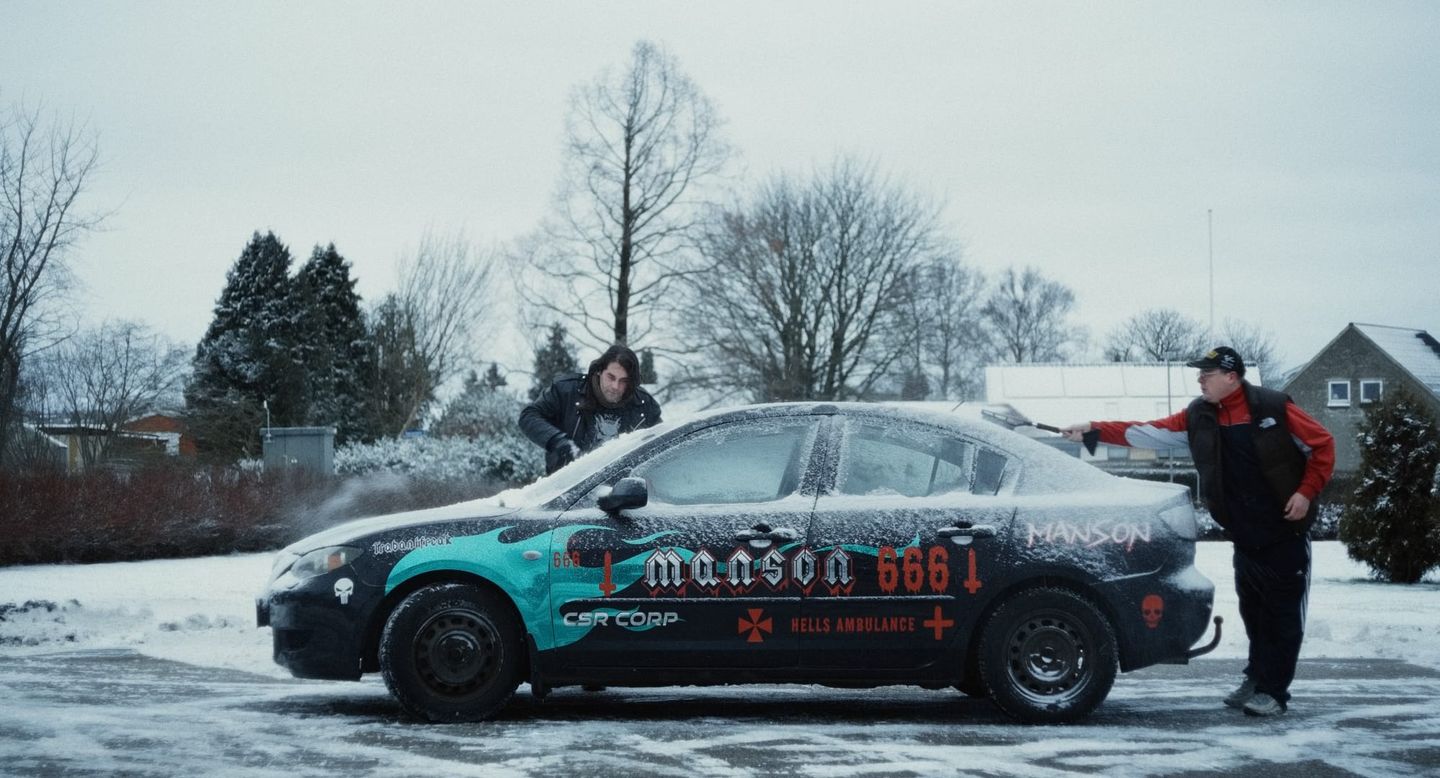
In times where disabled representation is sparse, and neurodivergence is being increasingly trivialised, Petrolheads is a breath of fresh air. It's a documentary about Martin, the director's brother, and Casper his best friend, as they set out to search for a 1994 Honda Civic. It explores their life and struggles with disability and addiction, painting a nuanced image that challenges the usual depictions of neurodivergent people.
I sat down with the director Emil Langballe to ask him about what it was like to create the film, work with his brother, and what it means to him to represent disability on screen in a different light.
One thing that really stood out to me about the film was the focus on friendship above all other things. Of course there was the cars, and there was the whole conversation about disability, but the friendship was really the core of the movie. When did that decision come about? Was that already the intention in the beginning for that to be the focus or did it evolve while you were shooting?
Emil: So, I slowly kind of started filming Martin ages ago and I knew I wanted to make something with him, and he was really keen on me making a film about him, but I didn't really see any kind of cinematic shape taking form before I met Kasper.
I had met Kasper many years before because they've known each other for ages, but once Martin told me about their common blog, they have a blog where they drive around Denmark testing cars and writing about them, and they asked me to come on a ride with them during these test drives, and when I was in the car with them I was overwhelmed with how sensible they were to each other and these conversations they were having and this very special friendship. They could finish each other's sentences. They had almost developed a certain language that they would speak with a lot of slang that I didn't understand.
And then they would have these very intimate and very honest conversations about feeling different and that struck me as very touching and very engaging and then I thought this film is going to be like a buddy movie. It's a film about friendship above everything else. I think for them, they have of course their families, but basically they only have each other because they're the only ones that can understand each other's situation.
So friendship is very important for them and I saw them as these two outsiders against the world in a way.
You said in an interview with Variety once, that your house would always be like full of immigrant children. Do you think being in that kind of environment a lot as a child influenced the kind of movies that you make now?
Emil: Yeah, definitely. And I also think that my mom being a schoolteacher in this neighbourhood in Denmark where we had a lot of low-income families and people with many ethnicities but also Danish kind of family struggling. She kind of took the kids home and that informed adopting or getting my brother later on, taking him in and of course it shaped my whole existence.
Both meeting these kids as very young but also growing up with my brother and seeing his different abilities and his challenges, and how my parents would try to nurture him and take all these things into consideration. I think it made me very aware of people that come from different walks of life and made me very interested in portraying the people on the margins of society in a way.
As someone with ADHD myself, there were some parts of it where I really felt seen. A lot of, especially Hollywood, movies really shy away from showing characters with disabilities as more than just that, but obviously Petroheads really doesn't do that. Even the topic of drugs in the movie is so impactful because it shows that there are more struggles outside of just being disabled that one goes through. I thought that was really important. Is that something that you had planned from the beginning to include? Were you unsure of including it?
Emil: I didn't plan to include it because when we started shooting the major part of the film, Martin had never really touched alcohol, never touched drugs. He didn't have an addiction problem so it was only in the beginning of the shooting that I realised this. He was drifting into addiction and first I thought we would not include it, because I think as a brother I was just too kind of scared of opening that door in a way, but then it became more and more heavy and it became the whole of Martin's life. It took over the film in a way and especially also the friendship with Kasper, because suddenly it also became about how to deal with a friend who's an addict.
And I felt in a way I also identified a lot with Kasper because I was witnessing my brother disappear in front of my eyes, and I could see that Kasper was going through the same emotions in a way. And then I thought it was also very important to show, because Martin is self-medicating, it's his way of dealing with this feeling of not being able to fit in, all the racing thoughts and everything that he's going through. And he doesn't really have any help kind of dealing with those things. So I do understand why, even though it was painful to witness, I of course understand why he also felt he gets some kind of quick relief out of those things.
But from the get-go my first and foremost idea was that I wanted to kind of paint a more nuanced and complex portrait of people with these challenges. Because in Denmark there's always these stereotypes that are projected onto people like Martin and Kasper, but you rarely see that it's not easy. You rarely see the dark side of it. And that was also very important to Martin and Kasper. From the beginning they were like, "Emil this cannot be too much of a glossy picture." "We want to show the world how we feel and it's not easy being us." So I promised them that from the get-go.
And were they with you throughout the entire process? As in, also when you went to the editing stage?
Emil: They didn't sit in the editing room with me but I showed them different cuts of the film along the way. And I also told them, as I always tell my protagonists, that I don't want to make a film that they cannot feel represented by. So if there's anything where they felt like "this is not me" or "this came off in a wrong" way let me know and we'll look at it. But they were so invested in it from the beginning and I really kept them in the loop. So they were very happy with the outcome and there were not really any surprises in that regard. But they saw, I think, maybe three cuts of the film or something before.
How long did the post- production process take?
Emil: It took 24 weeks. But in different chunks.
So also sometimes when I'd shot a scene, and we edited that I thought was nice, I would just kind of share it on WhatsApp to them. Because they really loved it. And they really loved to shoot these more staged kind of tableaus where they had to drive in the frame in a certain way. They felt like movie stars.
And I guess that was also one of my ideas from the get-go. To me they're heroes because they really fight tooth and nail to take ownership of their own lives and to fulfil their dreams. So I wanted to elevate them and show them as these two heroes of a movie. And they found that very appealing. Because it was very collective how we did it.
Would you say it was easier working with your brother than, let's say, just working with actors? Or were there different challenges that came with working with family, a different kind of connection there?
Some things were definitely easier. I mean there was a lot of trust from the beginning, both from Martin and from Kasper. Because Martin is my brother and I've known Kasper for so many years. But they're also, especially Martin, he's very good at preserving his boundaries, which is a good thing. If there's something he doesn't want to do, you cannot talk him into it. So sometimes I would be like, "So can we now shoot this?" And he would be like, "No way, I don't feel like it." And we would just have to find something else.
There's a scene in the film, in the car at night, and they talk about that they both went to orphanages when they were small. We shot that scene half a year before, but the camera ran out in the middle and I didn't notice, so we lost it. And after that I was like, when I kind of listened to the audio, I thought it's such a shame. And they were really vulnerable and really, really sweet in that scene. And I asked Martin, "Can we shoot it again tomorrow?" And he was like, "Hell no, I cannot talk about the same thing. It has to take six months before I can do it again." So we did it again after six months.
So there was this little kind of, you know, we had to do different, new things to kind of keep it fresh. And we couldn't repeat stuff too much, as I could with other previous films and characters. But, of course, there were many gifts because of this intimacy between us and this very small crew. So they got to know Anders, the cinematographer, very well. And we all connected very well and had a lot of fun.
And then, of course, it was incredibly hard to shoot the drug scenes, being his brother and wanting to kind of just take it from him. But at the same time I had made this promise both to Martin and to myself that I didn't want to interfere when something like that would come up, because we had to paint an honest picture of what was happening. And so I tried to kind of restrain myself. And sometimes I also had to deal with these different dubious people on the phone that were trying to get to Martin and harass him and stuff like that. And so it sometimes all became quite messy and entangled. So this role of being a director and a brother at the same time was definitely not easy.
But at the same time it also felt like quite a privilege to be able to, through a very hard period of my brother's life, to be able to be there so much for him. Because I have kids and if I had like a normal job, I would not be able to hang out with him every week. But we had this space that we would go shoot and it was like this protected space where all his troubles would not enter. I mean, of course, he would still have the addiction and everything. But all the people that wanted to get to him and were forgotten for a while and we were just concentrating on the filmmaking. And that really felt nice to be able to be there with him for such a long time.
Because you were saying that they got to know everyone, how big of a crew was it that you were with?
Emil: It was only me, a cinematographer, and Martin and Casper. And deliberately, I would not ever use any other cinematographer because it needed to Anders who they trusted and who they really liked. So, that was really nice to just do it like that. I recorded the sound myself. There were a few times when we had to do really technical shots. We had like a group that would come in and just set up something, but they didn't really interact with the guys. So, it was just our little gang and it worked very well. We had some good times.
I have one last question. Your parents are also in the film, how were they involved? At what point did you go up to tell them you're going to make this movie?
Emil: I think from early on my mom has really been like, "Why don't you make a movie about Martin?" Because he's been going through so many difficult periods in his life. And my mom has always been really touched by his way of dealing with things, and she just said people need to see this. Because, also in Denmark, it's very rare that you see people in this kind of grey area that Martin and Kasper inhabit. Where they have challenges, but they're still quite eloquent speakers and they can reflect and all that stuff.
My mom was just like, "People need to see that." So from early on they were interested in me making a film. But they also, I think, hoped for more of a systemic critique in a way, because, of course, they've been dealing a lot with care homes and funding for Martin's stays in different care homes. All the intricacies and problems they face trying to secure the best possible life for him. And they have very strong opinions about that. So in the beginning I thought they would hope that I would do a more journalistic kind of film. So when they watched the film, they were a bit surprised. But they really like it. And they really felt that it was important for this story to come into the world.
Support our work
You can subscribe to the OBSCURAE newsletter for free, or become a paid Aficionado for £5/month to help fund independent coverage, contributor fees, site hosting, and admin costs.