Content Note: the following review includes conversations of sexual assault, sexual coercion, transphobia, and death.
If there’s one filmmaker out there today with a seemingly clairvoyant ability to tap into the Very Queer Thoughts I had throughout my adolescence and adulthood, it is none other than Jane Schoenbrun. Their filmography puts the thoughts and questions I am still learning to unpack and articulate for myself onto giant thirty-foot screens across the world for thousands of others to see. Their films make me feel utterly exposed and also profoundly seen.
I am one of many who has been deeply affected by Schoenbrun’s work. There is, I believe, a sacred bond between those of us who recognize pieces of ourselves in their films. It’s the strange intimacy of realizing that something you thought lived privately inside of you lives inside other people too.
When I Saw the TV Glow came out, my best friend and I went to see it at TIFF Lightbox. I ugly cried for the majority of the film. It captured so much of my life experience: the colours and textures of my childhood, my obsession with– and queer awakening because of– Buffy the Vampire Slayer, and the decades-long experience of unravelling my own identity and disentangling it from what I was taught as a child who grew up in a fundamentalist Baptist church and home. My “tomboy” years were seen as a threat to my future and being gay wasn’t even an option because it was equated with excommunication from my community, not to mention burning in hell for eternity.
“I don’t really get it,” my friend said after TV Glow finished, “I don’t think I connected to it like you did.” But he held me outside of the theatre and let me weep for a long time until I was ready to go home.
Sometime later, when I showed TV Glow to my partner, I said something to her along the lines of, “I think this will help you understand me better.”
I cried even more during that viewing in the safety of a Montreal hotel room without the pressure of being perceived by audience members around me. She expressed that she, too, didn't fully understand my intense emotional response to the film. But watching the film, and watching me watch the film, made her want to understand my journey with gender-queerness better. She said to me recently, “It’s one thing to understand your identity through queerness as a lesbian, it’s another to understand it through feeling genderqueer and lesbian.”
How beautiful it is that film can help us view the world through new eyes and have a more empathetic grasp on the lives of others that are different from our own?
Because of I Saw the TV Glow, I often remind myself as I await gender affirming care on a lord-knows-how-long waitlist that “there is still time.” That a surgery does not define my non-binaryness. That being nonbinary does not diminish my lesbian identity. I Saw the TV Glow is a film that will always live with me.
And now, Schoenbrun has somehow done it again.
Enter, Teenage Sex and Death at Camp Miasma. As a spoiler-hater, I managed to dodge almost all context about Schoenbrun’s latest feature. I knew it had done well at Cannes. I had heard it was a campy, slasher-comedy. I knew it starred some of my favourite queer icons. But aside from those things, I didn’t know what I was getting myself into.
Sitting in the same theatre where I had watched TV Glow two years earlier, this time alone, and amongst a sea of mostly visibly queer strangers (a beautiful experience in and of itself), I spent the first act of the film laughing along with the audience. I wrote in my notebook, “best opening credits since Napoleon Dynamite?!”
I was not ready for the emotional journey Schoenbrun and co. were about to take me on.
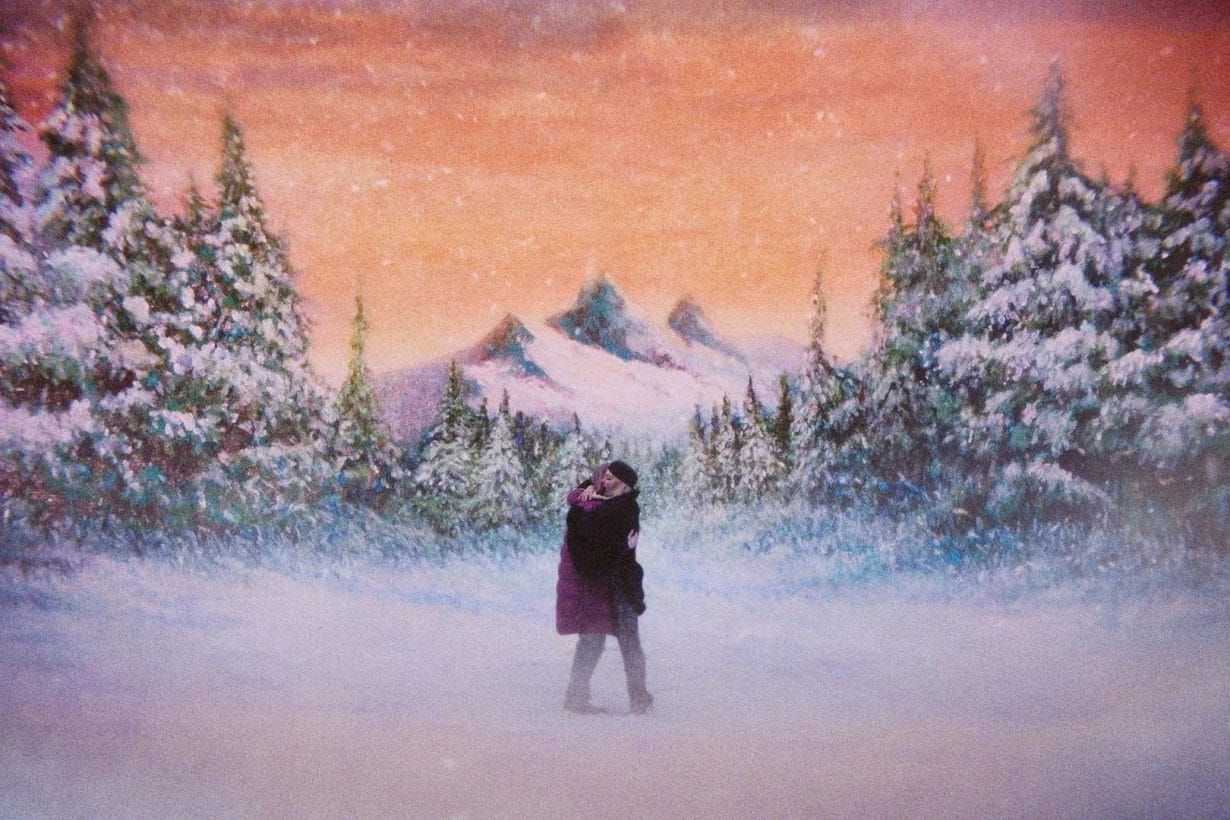
Filmed on Vancouver Island, I was mesmerized first by the production design, particularly the gorgeous hand-painted matte backdrops and the stylistic devices the team uses to build the film’s visual landscape. The film takes place primarily at Camp Tivoli, a defunct children’s summer camp where Billy (Gillian Anderson) lives in solitude in a cozy cabin. Thirty-five years earlier, Billy starred as the Final Girl in the first Camp Miasma film, which was shot at this very camp.
Camp Tivoli has everything you’d expect from a traditional summer camp: cabins with bunks covered in scribbles about who has crushes on whom, a beautiful frozen-over lake, a rock climbing wall, and a mess hall. As a kid who grew up in Evangelicalism, it scratched a weirdly nostalgic itch for me. Bible Camp was, strangely, one of the places where I felt safest being myself despite being part of a religion that taught me so much of myself was bad or needed to be hidden. There was something about seeing those familiar spaces recreated through Schoenbrun’s queer lens that made Camp Tivoli feel wonderfully comforting.
Kris (Hannah Einbinder), a young urban, polyamorous, queer filmmaker, arrives at Camp Tivoli to try to convince Billy to have a cameo role in her reboot of the “Camp Miasma” franchise, slated to be the 15th instalment in the series. Kris discloses to Billy that she attributes her queer awakening to the first film, in which Billy’s character had her first sexual experience with a boy who coerced her into the act. Naturally, in a quintessential “Must Not Die a Virgin” fashion, the two teens are slaughtered by Little Death (Jack Haven), the franchise’s trans serial killer who wears a ceiling fan as a mask and lives in a hole at the bottom of the lake.
Little Death is a commentary on characters like Angela (Felissa Rose) from 1983’s Sleepaway Camp, who is revealed at the end of the film to be trans, which is marked as the true horror of her killing spree. For those not in the know, there are some of us in the queer community who have reclaimed the Sleepaway Camp franchise as queer canon.
His name is also a play on the French term la petite mort (“the little death”), an expression used to describe the sensation or loss of consciousness associated with orgasm. It’s a fantastic name for a character who murders people while they’re having sex, but even more fitting for one who exists somewhere between death and life himself; Little Death was drowned by campers in the lake as a child but continues to return again and again throughout the Camp Miasma franchise.
What I find particularly interesting about Little Death is the way Schoenbrun reworks the history that inspired the character. Where Sleepaway Camp positioned transness as a horrifying element revealed for shock value, Little Death is not simply an object of horror; he increasingly becomes a facilitator of queer fantasy and sexual catharsis. His character was bullied, rejected, and killed, yet he returns to help other queer people explore the desires they have learned to bury.
Schoenbrun doesn’t use Little Death merely as an act of reclamation from the transphobic history of slasher films like Sleepaway Camp. As Billy and Kris begin opening up to one another, Little Death becomes a device for them to explore sexual liberation with each other and within themselves.
Snowed-in at the camp, Billy and Kris spend the night getting to know each other on a deeper level. Their business relationship is set aside and instead they talk about love, relationships, and polyamory over fried chicken.
Together, Billy and Kris watch the first Camp Miasma film, which leads to one of my favourite sequences in the movie: a one-take shot that follows Little Death as he slaughters the camp counsellors who have mocked him. To achieve the shot, a forty-pound 35mm camera was mounted directly in front of Jack Haven as they moved through the carefully choreographed sequence by stunt coordinator Maja Aro.
I love this scene for many reasons, but mostly for its catharsis. Rather than focusing on Little Death’s victims, the camera remains fixed on him. His ceiling-fan mask dominates the frame, but every so often we catch a glimpse of his eyes underneath it. In a genre that so often renders masked killers unknowable, these brief flashes remind us of the human underneath the mask and build audience empathy for Little Death.
As their time together unwinds over the following days, Kris and Billy become more vulnerable with each other, opening up about their sexual histories, fantasies, and desires. Their physical attraction to one another becomes even more palpable, leading them eventually to have sex atop a sea of candy.
Throughout Camp Miasma, pleasure and desire are intertwined quite literally with the indulgence and comfort of food. There is no shame associated with consuming massive amounts of what is often culturally described as “junk” food. Instead, these foods become a source of social bonding and pleasure.
The sex is awkward. It stops and starts. Space is given for conversations to take place. In fact, it’s the most realistic sex scene I’ve ever seen onscreen (shout out to the entire team for achieving this, including Aryn Mott, the film’s Intimacy Coordinator and one of my personal heroes in filmmaking today. Seriously– go follow them on Instagram @vancityic).
“God, I’m so bad at sex,” Kris says when they stop because she’s struggling to get into it. Instead of meeting her with judgement or blame, Billy meets her with tenderness and curiosity. She asks Kris about her desires, and Kris describes her fantasy of being transported into a horror movie, where she is running from the killer, watching themself in a dissociative state, hyper-sexualized. The Final Girl.
Billy shares that she was assaulted while filming the sex scene in Camp Miasma. To get through it, she dissociated, imagining herself as Little Death as he killed the characters in bed. Billy and Kris fall back into uninhibited and embodied sex, welcoming fantasy and play without judgement.
And this is exactly the point in the movie where the floodgates opened for me like Little Death’s hole in the lake. Like TV Glow, the tears didn’t stop until long after the credits rolled.
The next day, Kris pitches her new idea of having Billy as the Final Girl in the franchise's reboot. It doesn’t go well. The studio executives and producers don’t get it. There’s an important difference, though, between not understanding something and refusing to believe there is something there to understand.
The film studio and Kris’ agent don’t see Camp Miasma beyond its potential to make money. Kris’s queerness is only valuable to them insofar as it gives them a “woke” young filmmaker to reboot a franchise that has since been criticized for its trans killer. They want what Kris represents more than they want Kris herself, with little interest in the art she can create because they see it as inaccessible to broader audiences.
I have no way to know if this scene is directly related to A24 choosing not to work with Schoenbrun on Teenage Sex and Death at Camp Miasma after working with them on their first two features, but there is a fascinating parallel to be made about Kris and Schoenbrun’s films and their perceived value as filmmakers by studios.
I digress. When Kris returns to Camp Tivoli, winter is over. Little Death has emerged from the defrosted lake where he lives. “Let’s make a movie,” Billy offers Kris as they dance in a candlelit mess hall. In “making a movie” together, Kris and Billy become the studio executives, writers, directors, and performers of their own sexual fantasies.
The penultimate scene allows Kris to live her fantasy to its fullest extent, becoming the Final Girl she has always wanted to be as the film executives, her lover (and bisexual king Thor, lest we forget!) from back home, are killed off one by one by Little Death.
Finally, Kris arrives at Billy's bedroom, where they have sex and Billy coaches Kris to watch them from Little Death’s eyes. Little Death pierces his spear through the two of them as they make love. They both orgasm and die. A VHS tape is birthed from Little Death’s home under the lake. The product of queer sex is, quite literally, the movie they chose to make together.
The next morning, soaked in blood but very much alive and well, Kris and Billy go into town to shop for more junk food.
Queer pleasure doesn’t happen in a cultural vacuum. For those of us who grew up learning that our desires were sinful, illegal, predatory, shameful, or perverse, learning what we actually desire can be an incredibly difficult task. Add sexual trauma, gender dysphoria, religious shame, or any kind of complicated relationship with our bodies into the mix, and pleasure can become immensely difficult to access. Especially for those of us who have taught ourselves how to survive in our bodies by distancing ourselves from our desires, wants, and needs.
Camp Miasma doesn’t suggest that sex can heal these wounds. Instead, it shows how safety, communication, agency, and imagination can give us space to renegotiate our relationships with desire through play and sexual connection. Sex, after all, is play.
On the surface, I suspect Camp Miasma will be viewed and remembered by many as a sexy, silly slasher. But for many of us queerdos who have had to learn– or are still learning– how to find real safety and pleasure in our bodies and sex, this film will strike a chord much deeper and live with us differently. I hope that for many, Camp Miasma will allow us to become curious and discover what queer pleasure, desire, and sex look like for us on our own terms.
For many of us, a piece of our hearts will always live at the bottom of the lake with Little Death at Camp Miasma. But we will rise again, and again, and again, as queer people always have and always will. We will continue to take up space, to make the movies the studios toss aside, to reach for and find radical self-acceptance within ourselves, to dance with our lovers and lean into the joy and beauty that is queer sex. Because queer survival has never just been about staying alive. It is about claiming the pleasure of being alive, too.
Support our work
You can subscribe to the OBSCURAE newsletter for free, or become a paid Aficionado for £5/month to help fund independent coverage, contributor fees, site hosting, and admin costs.