Written by Anike Aliu.
There are no adults here
My Father’s Island is released in UK cinemas this Friday, 3 July.
Welcome to Dad’s House
There are no adults here
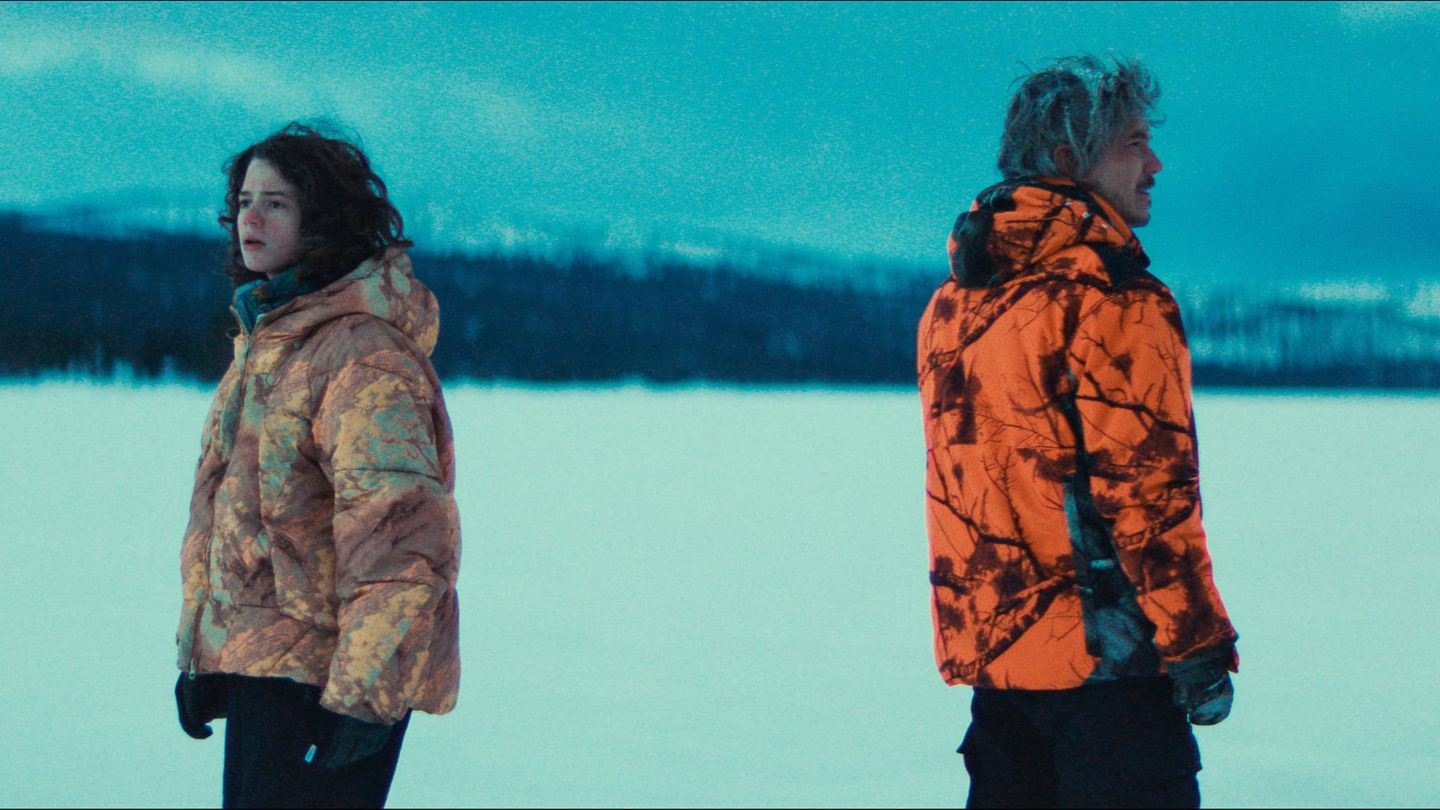
Vladimir de Fontenay’s My Father’s Island (adapted from David Vann’s 2010 novel Sukkwan Island) is a beautifully raw and all too familiar tale of survival, adolescence and reconciliation. With outstanding performances from Swann Arlaud and Woody Norman, the film drops us at a forked road with the choice to love our imperfect fathers down one path and survival down the other.
We follow a young Roy who accepts his absent father, Tom’s, invitation to spend a year with him on a remote Norwegian island as a way to bond and make up for lost time. As temperatures drop and tensions rise, the father and son realise that reconciliation might be untenable and the only toy at Dad’s House is Roy.
Most children of divorce or casual consumers of popular media will be familiar with the idea of Dad’s House. Dad comes blowing into town on an irregular schedule he has created unilaterally and demands fun is to be had! Here, Dad’s House is exported thousands of miles away to an icy, isolated cabin. What could go wrong? Initially the possibilities seem endless. Surrounded by nature, the boys gear up for your standard father-son bonding activities: fishing, hunting, the works, and the tender moments they share almost convince you they might be able to make up for lost time and build a new relationship. At the first major hurdle on this adventure, we see Roy immediately begin to absorb the emotional and some of the domestic labour as Tom’s sheer will can’t make up for his lack of parenting experience, and unsurprisingly, Tom can’t resist a cheeky How’s your mum, is she seeing anyone? I don’t need to tell you this, you’ve been to Dad’s House.
It almost goes without saying that this sort of gesture is often more about the parent absolving themself of the guilt they feel for their absence than the child’s wellbeing, and still we see what I believe to be real remorse mixed up with a general dissatisfaction with life from Tom. However, central to his failing, and part of what makes this film so poignant, is his belief that the separation of the family was a mutual decision or that there is some kind of shared blame between mother, father and child. Tom implies an infant Roy rejected him, justifying his departure. The tendency of fathers to see their children as equal participants in the relationship can stem from a well-intentioned desire to depart from the rules-based system at home. We’re not parent and child; we're buddies. With this impossible burden placed on Roy, Tom’s paternalism can only exist at the most superficial level, ultimately dooming the pair.
Roy becomes aware fairly early on in the experience that he is in danger with his father yet his choice to remain with him is not for a moment confusing. The beauty of this film lies in the universality of Roy’s experience, and without any further spoilers, De Fontenay lands the ending with a perfectly tragic twist, confronting us with the cost of loving our fathers.