Content warning: explicit sexual content, incest.
When you go to a secret screening at SXSW London, you never know what you’re going to get. Still, I would wager that a film in which someone comes on a bunch of roses was not what most people anticipated.
Karim Aïnouz’s Rosebush Pruning is the newest addition to the growing group of dark comedies satirising the upper class. It follows a rich American family living in Spain after their mother’s death. They all have very questionable relationships with one another, which quickly become incestuous, obsessive, and eventually violent after they find out their mother is not actually dead.
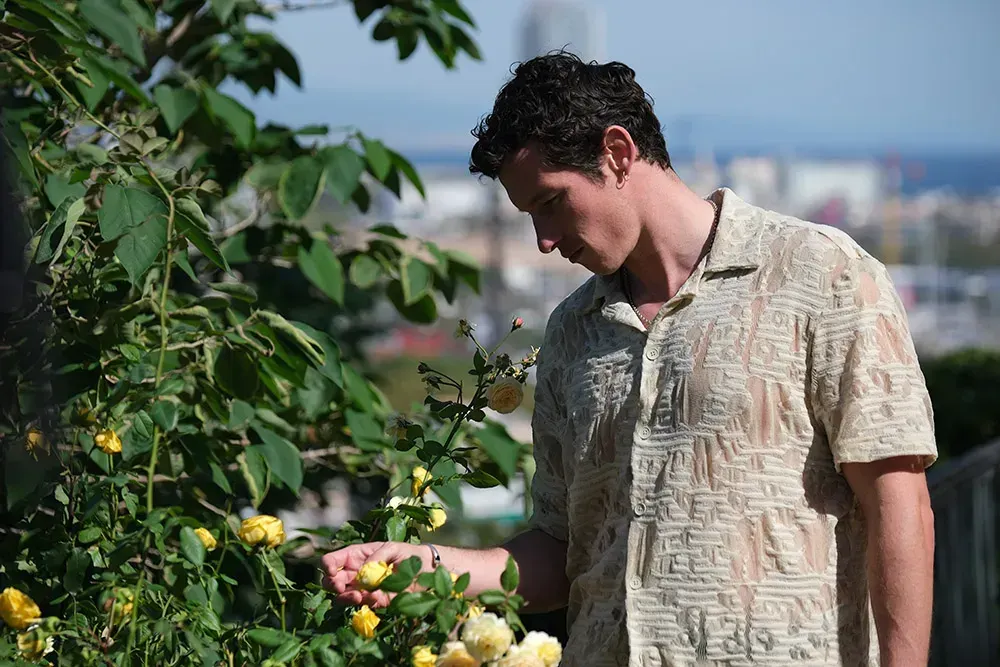
Ed (Callum Turner), the narrator of the film, thinks of himself as an intellectual, coming up with nonsensical proverbs that no one but him understands. At first, this is intriguing, and his voice-over is very American Psycho-esque, but it quickly becomes clear that this is the extent of his characterisation. Ed jumps in front of cars to be brought home instead of getting a taxi, yet the film simply says “he’s lazy” and does not go any deeper. Callum Turner tries his best to sell it, and his performance is one of the highlights of the film; however, the shallow script does not give him enough to work with for a film-saving performance.
The rest of the family suffers similarly. They all say they love art and fashion, though they only seem to care about the price tag, dressed completely in designer brands they constantly name-drop. Their inability to appreciate good music adds to this, challenged when one of them brings home his girlfriend, a guitarist. This could have lent itself to an interesting critique of over-consumerism and obsession with luxury brands if the film were not so preoccupied with being shocking, and so uninterested in the complexities of the characters it seems to satirise.
The tonal dissonance between the film’s bright, colourful visuals and its dark story is one of the few aspects that works well. Aside from looking very beautiful, it makes the film seem smarter and more nuanced than it is. Much like its characters, it is all style and no substance. The soundtrack is similar, packed with great songs like the Pet Shop Boys’ “Paninaro”. As fitting as this song about endless consumerism is, its repeated use feels incredibly on the nose and uninspired.
One might wonder whether, if the characters are not fleshed out, the film’s focus must lie on the mystery of their mother’s (Pamela Anderson) fake death. That could not be further from the truth. The revelation that she is alive is quite inconsequential to the plot, because all the film seemingly cares about is shock value.
When one of the siblings, Jack (Jamie Bell), brings home his girlfriend, Martha (Elle Fanning), the carefully balanced family dynamic starts spiralling out of control. The threat of him moving out to live with Martha upsets Anna (Riley Keough) and Robert (Lukas Gage) the most, both of whom are attracted to their brother. To make him stay, they use Anna’s supposed knowledge of “what turns everyone on” and try to exploit Jack’s previously established blood kink. Robert tries to seduce him by cutting open his inner thigh and, in lingerie, waiting in bed for Jack. This does not work.
Finally, Ed hatches a plan to fully tear the family apart, impersonating Jack and telling Robert to eliminate the obstacles that stand in the way of their love. This causes Robert to go on a killing spree, including their blind father (Tracy Letts), their mother, and her lover (Elena Anaya). This comes to an abrupt and nonsensical end when Robert is shot by Anna after failing to kill her too, and Ed, who has tried to escape to Greece, is hit by a car and dies as well.
As insane as all this is on its own, I have neglected to mention a certain scene that will undoubtedly dominate conversations about this film when it gets a wide release. While impersonating Jack, Ed goes to his father and helps him brush his teeth. After Ed puts toothpaste on his father’s brush, everything seems normal until his father pulls down his trousers and instructs Ed to put toothpaste on his hand and jerk him off. Things escalate further when, after a few seconds of Ed giving his father a handjob, he tells him to use his mouth instead, and Ed obliges.
None of this is played for more than pure provocation, and, outside of an uncomfortable and unfunny joke, the characters do not address it afterwards. Are they trying to say something about familial abuse? Power dynamics? Are they pushing the boundaries of cinema? I have no idea. The film clearly does not care.
If you watched Saltburn and thought it was too vanilla, this film might be for you. Rosebush Pruning is colourful, scandalous, and definitely not boring, but its shallow themes and, at times, incoherent plot stop it from delivering on the intrigue it creates early on. A few years into the fad of “eat-the-rich” black comedies, Rosebush Pruning does not offer anything fresh that separates it from films like The Menu or Triangle of Sadness. It mistakes provocation for interrogation the same way its characters mistake expensive clothes for good taste, and completely misses the mark in both the comedy and commentary departments.