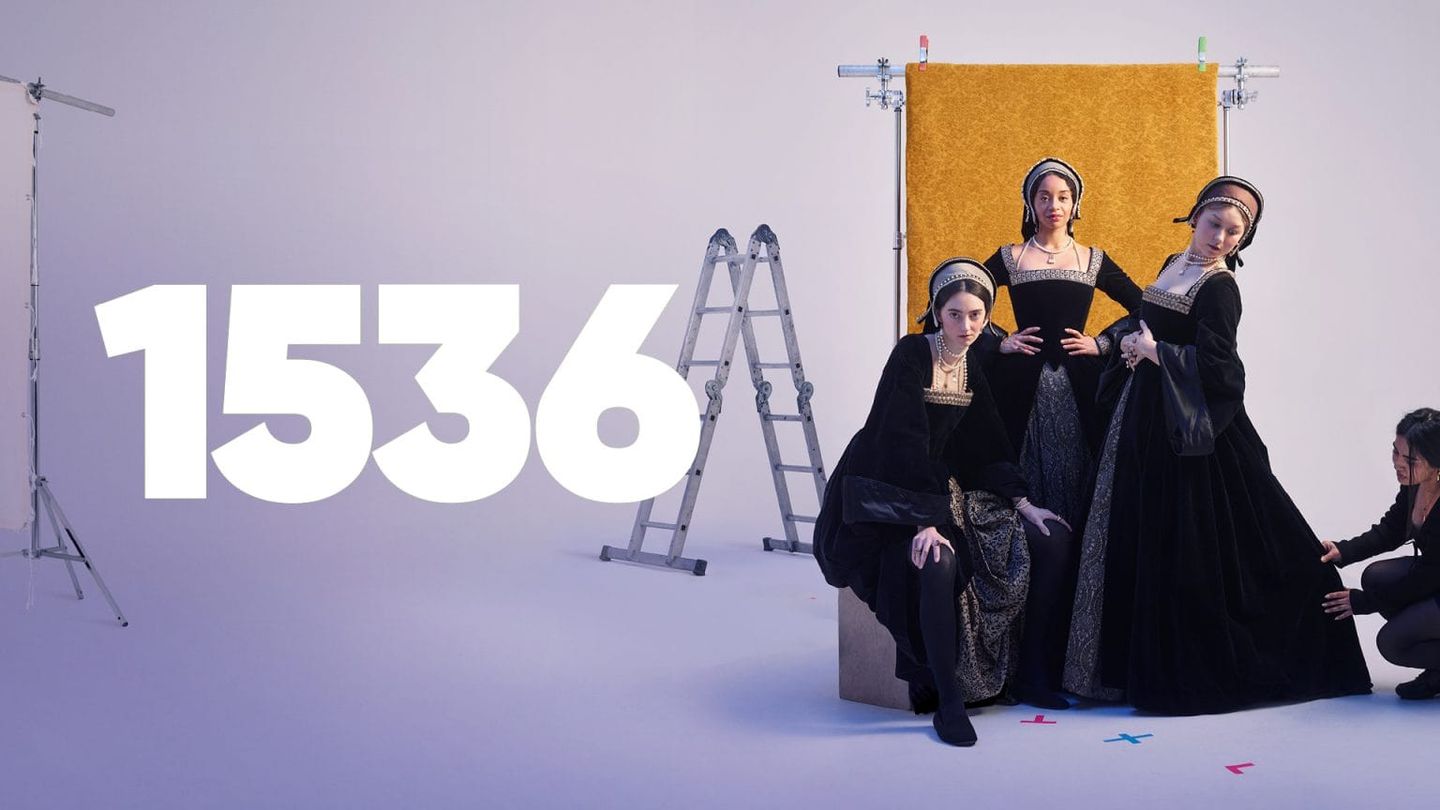
1536 is a play about women’s rage at centuries of misogyny and the patriarchy. It is also a play that, especially in its last act, holds a mirror up to the mostly female audience and reminds us that this system partly goes on because we women, and especially white women, play into it.
Ava Pickett’s play opens up with “Anna (Siena Kelly) fucking Richard (Oliver Johnstone) fast up against a curled tree.” They are in the middle of a wheat field on a hot summer day, the one setting that encapsulates the entire story.
Anna is a free spirit, a woman in service who rebels against the limits society puts on her, including by sleeping with the men in the village. You get the feeling that Anna enjoys sex and some of the presents it brings her, but not necessarily the men she has it with. Like an early Emma Bovary, she wants something more of life, which might mean leaving her town for pastures dreamt and unknown – but it also never feels that she will take this step. She is the Essex mirror of Anne Boleyn, the woman whose imprisonment in the Tower kicks off the play.
Anna is played by a Black woman, the only visible actor of colour in a tight and excellent cast of five. Kelly is really good as Anna, imbuing her with hope, anger and naivete. It’s also impossible to ignore, as the play goes on, that the misogynistic comments towards Anna, including the village harlot rumours about her and the fact that she is the angriest of the cast, are levelled at a Black woman. I am pretty sure she was cast in a blind casting kind of way, but her being Black adds a racial dimension to the story that the text never addresses, so it’s never clear how intentional it was. More diversity in the rest of the cast would have gone a long way to addressing that (the understudy for the other two female characters is Asian, Saroja-Lily Ratnavel).
Kelly is the lead, there in almost every scene. The other two women on stage are girls she grew up with, each embodying different aspects of how the patriarchy shapes women’s actions.
Jane (Liv Hill) has decided that the best way through was to mould herself to what men want her to be. Quiet and pious, she is a sad character because we know that ultimately, her determination to follow societal rules will only help so much. Jane is betrothed to Richard, who will turn out to be not just a cheat but an abusive husband. Jane is Jane Seymour, the pendant to the woman who, in London, is scheming to get rid of Boleyn.
In the middle is Mariella (Tanya Reynolds), who tries to keep the peace between her two friends. She is still reeling from the fact that her childhood crush, William (George Kemp), married another woman because of wealth and class. Mariella is a trainee midwife, and in many ways the audience’s insert. She sees the issues with their 16th-century society in a very contemporary way, and she is also aware of her friends' shortcomings and many of her own. About halfway through the play, she acknowledges that William’s wife is not to blame for their marriage, but it doesn’t mean she has to forgive her for it. Due to the economy of the writing, this speech will come back to bite her, but it’s also one of many instances where we are hyperaware that 1536 is a commentary on today’s society in 16th-century cosplay.
This is also the crux of the play. For most of the story, it feels like the women expect and know that the men will disappoint them, but they never expect it to come from each other. It all changes in the last act, when Anna bludgeons Richard to death to protect herself and her friends. Faced with the gallows, the friends initially hatch a plan that might save them all, but then Jane has a change of heart when she learns that Anna and her husband were having an affair. Her decision to speak out against her, combined with Mariella keeping quiet, condemns Anna, but they think they might save themselves – the culmination of multiple “it happens to the other women, but I’m not like them” moments peppered throughout the story.
Earlier, Jane wondered when Anne Boleyn knew that Henry VIII would eventually murder her – “did she see it in his eyes and ignore it at the altar? Or was it the last day?” By the end, the question becomes: when did Anna realise that her friends would abandon her?