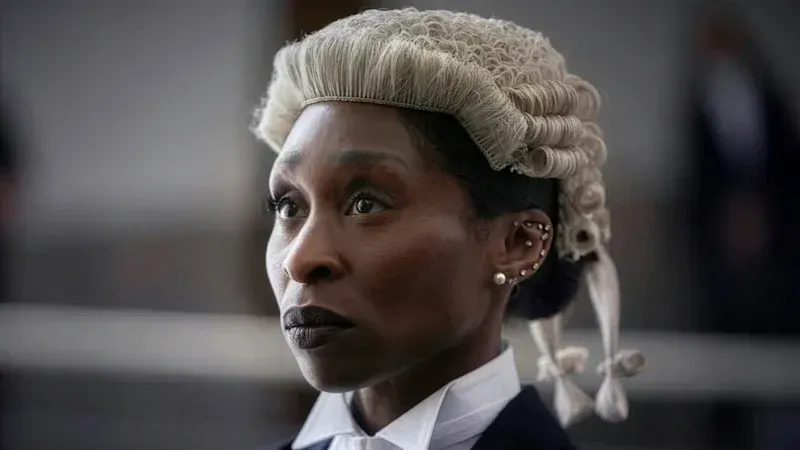
Tessa Ensler (Cynthia Erivo) lives for the law. Not just as a hot-shot junior defence barrister at the prestigious Old Bailey in London, but because, aside from her family, it feels like she only hangs out with lawyers. She is steadfast, borderline religious in her faith in the law, in a way that is slightly less believable with a Black woman as the central character than it was when Jodie Comer played Tessa on stage.
The film never fully explains why Tessa believes in the law so much. It gave her social mobility when, through intellect, hard work and ambition, she got a scholarship for Cambridge. She seems to enjoy the civility, clarity and theatre of it – in the opening sequence, she compares her female colleagues to thoroughbreds, and there are many shots of clicking heels and sleek suits that almost belong in a rom com.
The first third, in fact, has a lot in common with a rom com. Tessa has a very nice apartment overlooking the river by Hammersmith Bridge. She starts dating Julian (Daniel Ings), a legal world nepo baby. Cue cute walks by the Thames discovering each other’s souls, glamorous dates in restaurants and hot sex in Chambers.
Suzie Miller and Susanna White, who respectively wrote and directed Prima Facie, need to build up that fantasy to better shatter it – you get a literal motif of a broken glass at multiple points in the movie. Yet something darker is lurking – Tessa panics when a man follows her from a bar, though it turns out he’s returning her phone; at one point she has to extricate a drunk colleague from a creep.
The rape is filmed from Tessa’s point of view, so when she says she can’t breathe because Julian’s hand is over her mouth, you can’t breathe either. Later, as Julian’s barrister cross-examines her and casts doubt on her memory, you want to shout that this is exactly what happened.
The irony is that Tessa used to be that barrister, mounting the best possible defence for men accused of rape, all in the name of a fair trial. The difference, for what it’s worth, is motive: Erivo makes it clear that Tessa did the job because she believed in the process, while Julian’s barrister seems to be doing it partly to protect the old boys’ club.
We don’t sit very long with the aftermath of the rape – Tessa reports him to the Police, Julian makes bail, she has to change Chambers, and her mum reminds her that as a Black woman, this is going to go differently than it would for a white one. Then we skip three years to the trial. It is a disappointing choice, because we see the outcome – Tessa has lost faith in the law – rather than her process, or what it means for her life, which was all-consumed by her job when we met her.
In her last monologue, Tessa explains to the Court why she now believes that the law on sexual assault needs to change. The content is unimpeachable, but the didactic, almost direct-to-the-audience delivery felt forced. The trial scene is also undermined by Tessa's inner monologue, which has been present as a voiceover since the beginning of the movie to tell the audience how she feels. With an actress who can emote as well as Erivo, this felt like a weird and unnecessary choice, almost like the director didn’t trust her main actress, or the audience, or both.
Prima Facie makes its case convincingly, except when it decides to sum it up for the jury of its audience.
Support our work
You can subscribe to the OBSCURAE newsletter for free, or become a paid Aficionado for £5/month to help fund independent coverage, contributor fees, site hosting, and admin costs.