The Drama: Charlie and Emma and the Terrible, Horrible, Very Bad, No Good Week (Light Spoilers)
How well do you really know the ones you love? The Drama takes us on a dark and twisted comedic ride, putting the wedding vows "for better or for worse" to the ultimate test.


Editor's Note: Be sure to read the Author's Note at the end of this piece.
The wedding of the year has arrived, and it's a hell of a ride. Think, Uncut Gems: Romantic Relationships Edition, meets extreme social commentary, uncomfortable comedy, with a splash of Who TF Did I Marry?. The discourse on this film has already proven to be divisive, and I can understand why the provocative choices would rub some people the wrong way, but I have to say I was here for The Drama's big and bold swings.
Initially, upon seeing the promo for The Drama, it looked like a charming romance starring everybody's faves, Zendaya and RPatz. I've been a big fan of both actors' work for a while (although I am definitely a weird indie RPatz girl rather than a Team Edward girl) and knew I would be in for a treat watching the film for that reason alone. However, upon seeing that director and screenwriter Kristoffer Borgli was helming the film, I knew all was not what it seemed. Much like his dark and twisted satirical comedies, Sick of Myself and Dream Scenario, The Drama takes its concept to extremes with a surprising amount of heart.
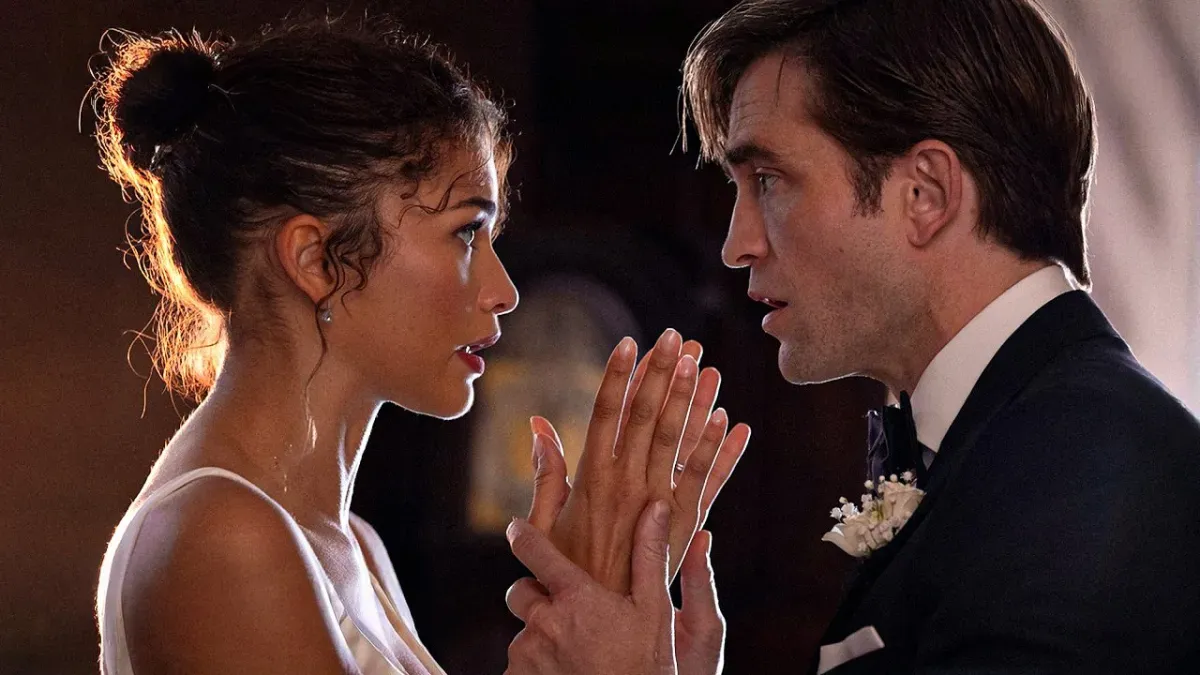
The Drama follows Emma (Zendaya) and Charlie (Robert Pattinson) as they prepare for their upcoming dreamy nuptials. Their love for one another is what one could only hope for. Even before the title card, Charlie and Emma's love for each other jumps off the screen - their love story is framed beautifully as they talk through their wedding speeches with their friends; they sway and twirl, practicing their first dance, bathed in stunning natural light. However, something is amiss. While their love for one another is luminous, the score forebodes something darker underneath. This vision of a love-filled, sun-soaked path to marriage comes to a screeching halt once an unexpected revelation occurs over dinner with friends, forever changing the nature of their relationship. This is a film that is best to experience without too much information - though I will say reviewing content warnings may be wise - and let yourself be taken on this wild, twisty ride.
Once the revelation occurs, we are suddenly dropped into Emma and Charlie's psyches with an extreme and uncomfortable closeness. The vow "I promise to love and cherish you, in good times and in bad" is put to the test even before any wedding has taken place. The editing is visceral, and the imagery is confronting, dragging us from anxiety spiral to anxiety spiral featuring nightmare-fuelled, violent, and strange surrealist daydreams which encapsulate the couple's newly uncovered worst fears about their spouse-to-be. Think of the worst anxiety spiral you've had, now multiply that by infinity.
The film's music is well-placed and evocative, ranging from classic ballads to Daniel Pemberton's tense and anxiety-inducing score. I was also very impressed by Arseni Khachaturan's skillful use of natural light in the film, which made the world feel simultaneously beautiful and haunting. The Drama took me (and the rest of the audience) on an emotional rollercoaster, moving quickly from raucous laughter to stunned horror, then heightened anxiety, and eventually hopeful relief. We are along for the ride with Emma and Charlie, as their tension rises, ours does as well, in an almost seemingly never-ending tightening of the screw. Zendaya and Robert Pattinson also embody their characters so honestly and skillfully- from impeccable comedic timing to heart-wrenching vulnerability. They are the heart of the film; it wouldn't work without them. If there was one thing I could change, it would be only to spend a little more time with Emma's present experience.
Buy us a coffee (or two!), and fuel our work - for £5 a month you can help us keep OBSCURAE’S independence alive.
The controversy of the film lies in its violence, both real and imagined, and the question of whether its darkly comedic nature endorses or makes light of the very serious subject matter. I went into the film with limited knowledge of this particular discourse, wanting to form my own opinions with a cautious optimism. I left feeling clearly in my heart that the film was a cautionary tale with one of many themes encapsulating how we treat and discard one another in varied ways. How, when push comes to shove, we are much better at pointing the finger than reflecting inward. The film highlights how challenging it is to see each other at our most bloody and real, and how the violent structures of our society feed on that avoidance and isolation. I don't think the film is endorsing or making light of the challenging topics, but rather forcing us to face them. If we believe in a world of restorative justice, what do we say for people who have battled against their worst impulses, against society's insistence to dehumanize, to isolate? Many characters' responses in this film are extreme, but their reactions uncover something very real and true about how we relate to each other.
The film asks us many questions, like, what does it mean to love someone unconditionally? How many times do we reacquaint ourselves with those we love as we evolve and grow, as we learn more about their past and present? Are we not constantly reacquainting ourselves with those we love, with ourselves? What does it mean when our fear and anxiety take such a hold that we can no longer see the people we love clearly? What do accountability and justice mean, and how do we care for and see those in deep pain? Also, what's the line between a pink flag and a red flag? What do our answers to these questions say about us and society? The satire of the film takes these questions to an extreme degree, but leaves us with something thoughtful, complex, and heart-rending at the end.
There's a blink, and you'll miss it Lynchian nod in the film, which I think speaks to the love and cruelty and violence that surrounds us every day. This reference encourages us to take a closer look beyond the shiny surface of white picket fences and white wedding dresses to the darker reality underneath. What do we do when we see each other at our most messy, most ugly, most vulnerable? What do we owe each other? What do we justify and what do we owe ourselves?
You may finish this film with many unanswered questions and find yourself having a hard time figuring out how you feel about it. And I think that's a point, to get us to sit with, to question, to reflect, to reckon with that which makes us human. This is a film that is rich with so many themes and questions that I will be reflecting on for a long time. What I do know is that, at the end of this film, I found myself feeling a deep empathy for our main couple and a sense that a critique of society rather than of people was at the core of the film's thesis. It's hilarious, heartbreaking, heartfelt, and confusing all at the same time - as is love, as is life. The Drama has a lot to say and has a heck of a good (and horrifying) time saying it.
I ended the film unexpectedly with tears brimming in my eyes - reflecting on what it means to be seen, to uncover the darkest parts of ourselves, alongside the physical and emotional violence our society subjects us to on a daily basis. The Drama captures the human experience (albeit, in the most extreme of ways) - its anxiety, its pain, its humour, its heartbreak. I'll end with a line from the song repeated throughout the film, Inside Out by Jesse Rae, whose refrain I think encapsulates a key theme of the film: "And you just don't think you got the strength to fight it/Don't give up/Don't give up". In pain and in laughter, crashing out but dancing, we're in it together, don't give up, don't give up.
Author's Note:
After finalizing this piece, I came across the controversy happening around a newly uncovered 2012 essay written by Borgli about a predatory relationship he had with a teenager, in which he doubled down and justified his disgusting actions. It was a blow to my own psyche to read of the morally reprehensible actions of a director whose film I loved so much. I find it continually difficult to reckon with the reality that shitty people can make good art. I've never been one to laud separating the art from the artist, as I understand that support is support, be that giving your money or time, no matter your moral reservations. And I also recognize I am not perfect and have made my own justifications for engaging with art where I felt the positives outweighed the negatives. It can feel overwhelming to navigate a world where it feels like every day, there is new information about someone else being awful in some manner. It sometimes feels like - what art will there be left if we remove all the art made by shitty people? And, at the same time, we have the absolute responsibility to make mindful and morally responsible choices when new information comes to light.
What I find puzzling about this particular controversy and this particular film is that, for a film that really aptly explores morality, empathy, and regret is how something so profound and reflective of humanity can be made by someone who has not reflected on or shown remorse for their own morally reprehensible choices. Learning about this has caused me to reflect on my own questions posed in this piece, challenging me to reflect on my own feelings of harm and restorative justice. As I mentioned in this piece, this film is a call for reflection and accountability alongside empathy and love. To do that, though, you have to be real with yourself about your harmful actions and impact. I sincerely hope that Borgli reflects on the themes of his own film and takes accountability for his actions to do better and be better. Recognizing the darkest parts of oneself does not absolve one of responsibility for one's actions, but it does not seem that Borgli has reckoned with that personally as he has artistically.
As it is often said, once you release art, it is also up to the audience to decide how they feel about it and interpret it; it is no longer "yours". With that in mind, I decided to keep this review as it is (with a few minor tweaks), as this film is more than one person, and the way it moved me still remains. My feelings on the film will absolutely continue to evolve as I sit with this new information, and I am sure this will impact how you perceive the film as well. Amidst this upsetting news, the lines I shared at the end of this piece still provide me with comfort and hope (and I hope they do for you too), as I said, we're in this together, don't give up, don't give up.