Last March, Adolescence, dominated media conversation and sparked debates around violence against young girls and policing online algorithms aimed at young boys. This March, Louis Theroux’s documentary, Inside the Manosphere, exposed the rise of content creators promoting right-wing ideologies and anti-feminist, hyper-masculine views online. Watching Theroux’s film in my partner’s living room alongside his twenty-something flatmates, the reactions were as revealing as the footage itself. While a few sat in stunned silence, most laughed at the absurdity of the men being interviewed, oblivious to the fact these figures are radicalising a generation of boys and causing real-world harm.
I witnessed the same audience reaction in a packed cinema screening of Curry Barker’s Obsession, as if his film is a surface-level mixture of horror and comedy rather than a starkly depressing reflection of our current society. When will we stop laughing at media like this as if it’s only far-fetched fiction and rather confront the reality staring back at us?
From a television series to a documentary to even the viral book Yesteryear—which dissects the dangers of the ‘tradwife’ lifestyle —the exploration of masculinity has surged to the forefront of entertainment and cultural discourse. Most recently, it has become the focus of male film directors’ work with the breakout hits of Backrooms (Kane Parsons) and Obsession (Curry Barker). The horror film genre is being utilised in the independent film sector to unpack the modern anxieties of men — isolation, social media fixation, the need for validation and control and the fear of failure and social humiliation — without relying on Hollywood clichés. It is empowering to see new, young directors compete against major studio blockbusters with original concepts and be rewarded with record-breaking statistics. Yet, the fact that modern culture inspired these films highlights just how urgently it needs to change and in the same way that we can’t take Theroux’s documentary lightly, Obsession and Backrooms which are also unpacking ideas of the manosphere, must also be considered seriously.
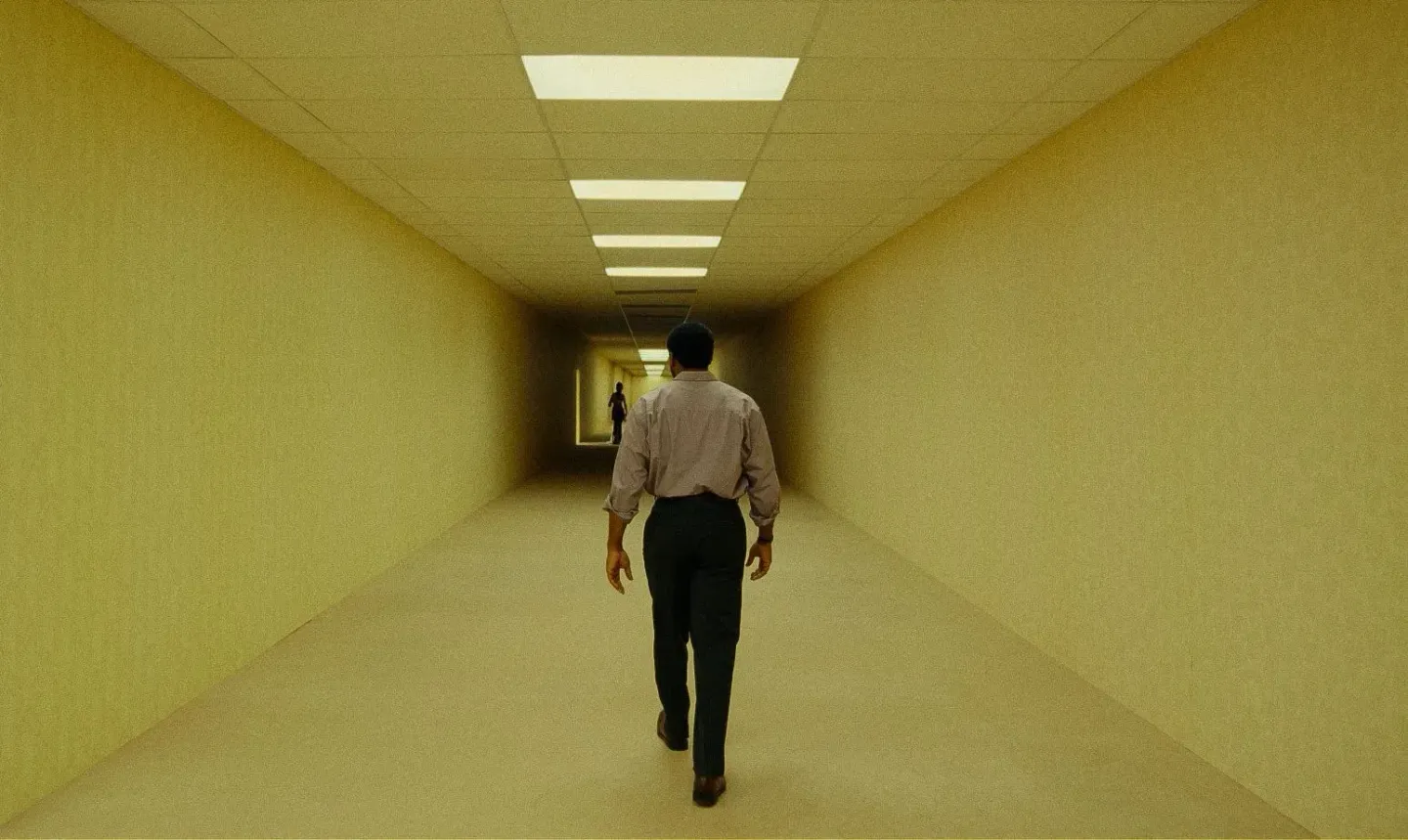
Through both films, the directors’ critique elements of the ‘manosphere’ demonstrated through the exploration of the ‘red pill’ theory which suggests there is a better, alternative life you can be leading if only you embrace the idea that “emotional control, material wealth, physical appearance and dominance, especially over women, are markers of male worth.” In Backrooms, the main protagonist Clark is offered this kind of ‘alternative life' in the physical form/manifestation of the ‘backrooms’ where he discovers the liminal, yellow wall-papered maze is the one place he feels like he belongs and an escape from facing his own issues. In there, Clark has total control of his wife, his house and the other ‘still life’ entities in there who have no autonomy and is free from taking responsibility of his actions. Despite how unsettling the backrooms are, Clark prefers it to the real world, mirroring how many people today prefer being online because they feel unable to cope with modern society. Lacking the patience for authentic relationships, many prefer controllable environments and simulations — heavily fuelled by manosphere ideology that preaches total male control as the superior lifestyle.
It’s interesting to note how Kane Parsons found a similar solace in creating and imagining these weird, liminal spaces as if he too was looking for an escape.
Obsession also offers its protagonist, Bear, a way to take full control and live his life differently via a ‘red pill’ in the form of a ‘One Wish Willow’. This grants him a friend-turned-girlfriend that is forced to love him more than anyone else in the world. Although this is exactly what Bear thinks he wants, when it comes to fruition he slowly realises he doesn’t want it anymore. Similarly, Theroux allows his documentary subjects to show their true selves on camera which reveals that beneath their apparently enviable lifestyles lies a deep well of anger, unfulfillment, and moral emptiness. For these men—and Bear—nothing is ever enough; even their actualised dreams bring no satisfaction because they are built on fragile, ill-intentioned foundations.
‘Freaky Nikki’ embodies the manosphere’s ideal girlfriend: infatuated, subservient, conventionally attractive, needy, sexy and devoted to her partner. Yet, Barker shows how forcing a woman into this male ideal results in a splintering of her character, being and identity. Unable to survive within this mould and these boundaries, Nikki deforms into something uncanny and supernatural. Barker proves the wish Bear wants, that so many men think they want, is unnatural, purely horrifying but most crucially, impossible to sustain.
Obsession also dissects the central male friendship which is built on fragile egos and insecurities. Ian consistently belittles Bear, mocking his timidity and poor romance skills to boost his own self-esteem, all the while secretly sleeping with Nikki behind his back. Despite being his best friend, he never has his best interests at heart, reflecting the mindsets of the monstrous ‘mentors’ that Louis Theroux encounters in Inside the Manosphere. Content creators like HStikkytokky don’t care about their young male followers, monetising their insecurities for their own gain and dangling an impossible lifestyle just out of reach at all times.
While both films explicitly critique toxic masculinity, they can be considered to do so at the expense of their female characters who are used as tools to illuminate the male character’s flaws and prompt their self-reflection. In this film and Obsession the man allowed to be himself in the film narrative but the woman is required to be someone else (Mary role-plays as Clark’s Wife and Nikki becomes Freaky Nikki) in order to enlighten the audience. *
Since their release, both films have sparked significant online discourse with Obsession in particular generating a troubling debate over whether Bear is as much a victim as Nikki. Many discussions of the film’s sexual assault scene, even online articles, avoid using the word “rape” despite the clear, non-consensual violation of Nikki’s body and autonomy. I even saw a TikTok video of a man rewording Bear’s wish so that he wishes Nikki to be “consensually” agreeing to everything, extending the disregard for Nikki’s autonomy into real-world commentary. In interviews, Barker is constantly asked to assess whether Bear is a good or bad person and while it is understandable that his character is suffering from the male loneliness epidemic, female characters are often not afforded this level of sympathetic contemplation. Why are women confined to binary judgments while men occupy a complex, grey area? This double standard reveals how deeply entangled these issues are with gendered expectations.
For the film industry at large, it goes without saying that it is exciting to see these young, male, independent filmmakers tackling societal problems around masculinity and creating representations that speak to the current state of our world. However, it’s impossible to ignore that this is much easier for them to do so than female directors with Youtube establishing itself as a pathway for male filmmakers. Both Barker and Parson’s attribute their success to their origins on Youtube and Nikki Baughan from Screen Daily observed that there are many women posting film content but their work is not being propelled or supported by the algorithm in the same way and it is actually skewed towards men. While new paths into the industry (like online platforms) are opening up, the people successfully crossing over into mainstream filmmaking often represent that exact same demographic. The shift in platform hasn't fundamentally changed who gets recognised which is something The Guardian touches on.
Nowadays success in independent film relies heavily on having a “pre-existing relationship with an audience” which Kane Parsons established for years before putting out the feature film. (Film Independent) There is an inherent comfort in and this likely explains why male viewers were generally less shocked by Inside the Manosphere than female viewers because it’s themes were already in their periphery. It is a well-known fact that viewers respond well to media regurgitated and both films capitalise on this by unpacking known manosphere tropes through new concepts. As mentioned, upon release, there was an immediate, massive boom in online conversation, which the upcoming Teenage Sex and Death at Camp Miasma cannot begin to rival. Is this because the manosphere ideologies are spread almost entirely online and people recognise these themes of masculinity and are drawn into the broader discourse? This is not to discredit the male directors achievements but perhaps their success is also a product of these kinds of topics breeding their own visibility.
Furthermore, with so many male directors in the horror genre, it’s easy for them to lend a helping hand to those who they saw themselves in before their big breaks. This can be seen in an interview for Cultured magazine where Curry Barker named people who have offered support on his Directors Guild of America application: “Zach Cregger, I’ve talked to a bunch. Ari Aster has been really helpful for me, and texted me […] It’s nice to have people in my corner.”
It exposes the abysmal state of society that young people like Parsons and Barker are imagining unsettling worlds to escape into that aren’t too much scarier than our own. It’s more important now than ever to analyse and think deeply about the media we are viewing rather than playing it off as entertainment.
It will be interesting to see what these directors do with their success.
Support our work
You can subscribe to the OBSCURAE newsletter for free, or become a paid Aficionado for £5/month to help fund independent coverage, contributor fees, site hosting, and admin costs.