My friends, pack your tissues, Elsinore just took home TIFF’s International People’s Choice Award and is one of the triumphs of this year’s festival. It’s likely to keep you crying for at least two acts. It affected me deeply and I am calling it now: will absolutely be one of the stand out films of the Oscars this year in a number of categories.
Set in London in 1989, Elsinore follows the true story of Ian Charleson played by Andrew Scott, who was often compared to Charleson during his early career. Charleson was a Scottish screen and theatre actor best known for his role in Chariots of Fire, which won the Best Picture Oscar in 1981. He also starred in a number of London theatrical performances.
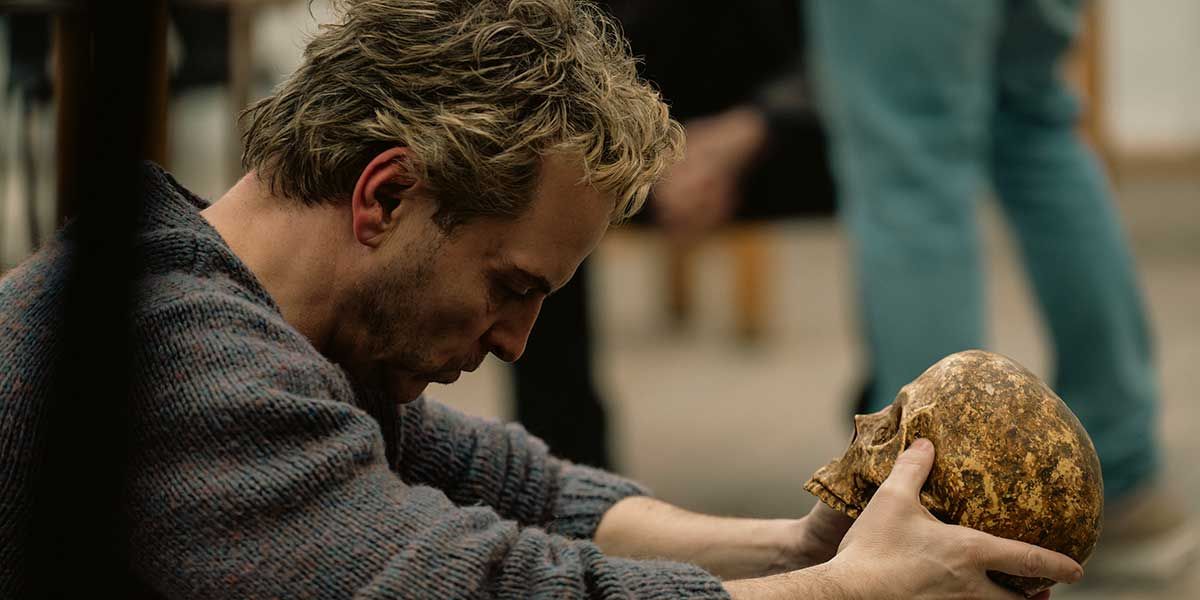
Elsinore follows Charleson as he prepares for his final role, stepping into the National Theatre’s 1989 production of Hamlet after Daniel Day-Lewis famously walked offstage mid-performance.
Scott is a triumph as Charleson. I can absolutely see Andrew Scott taking Best Actor for his triumphant and sensitive portrayal of Charleson. In addition, I think we may have two worthy Best Supporting Actress nominations in Olivia Colman, who plays Dr. Margaret Johnson, a physician who pioneered a holistic approach to caring for patients with HIV/AIDS, and Billie Piper as Patsy Pollock, who offers one of the most compassionate portrayals of chosen family I’ve seen on film.
What makes these performances so effective is the restraint with which Elsinore approaches Charleson’s final months. The film could have easily tipped into melodrama but never does because writer Stephen Beresford has no interest in depicting Charleson as a symbol for tragedy.
With a strong screenplay and fantastic direction by Simon Stone, Elsinore allows Charleson’s illness to exist as one part of his life rather than the organizing principle around which everything else revolves. There is still humour, friendship, frustration, desire, and the work of bringing the play together itself. The theatrical sequences are particularly effective in this regard, allowing Charleson’s performance as Hamlet to exist alongside his illness rather than reducing the role to a metaphor for AIDS.
Watching the film, I couldn’t stop thinking of my friends who live with HIV, who– thanks to the monumental health breakthrough of antiretroviral therapy (ART)– live vibrant and healthy. ART can now suppress HIV to undetectable levels, allowing people living with HIV to live long and healthy lives while preventing transmission of the virus.
Outside of the theatre where Elsinore was screened, I– gratefully (still crying)– bumped into a number of friends on my way out. We talked for some time about how the film had affected each of us differently. About its beauty. About the care that was taken in crafting this story.
“It’s a life-affirming film,” said our colleague Ozioma Nwabuikwu.
There was something in that sentence that let loose the grief I was holding in my body at that moment. Because Elsinore– like Hamlet– is a story about death. More than that, however, both are stories about coming to terms with– and accepting– the inevitability of death, which ultimately makes them stories about embracing the finite time we each have.
In the case of Elsinore, that means refusing to let AIDS become the totalizing story of Charleson’s life.
In the final act of Hamlet, Horatio pleads with Hamlet to not duel with Laertes. Hamlet tells him,
“Not a whit, we defy augury; There’s a special providence in the fall of a sparrow. If it be now, ’tis not to come; if it be not to come, it will be now; if it be not now, yet it will come. The readiness is all. Since no man knows aught of what he leaves, what is't to leave betimes? Let be.”
Let be.
This philosophy runs through Elsinore. Charleson cannot control what is happening to his body or how much time he has left, but he can decide what to do with the time that remains. His personal agency and the retelling of his life matters enormously in a cultural landscape that has too often remembered those lost to the AIDS crisis through the suffering of their deaths rather than the fullness of their lives.
Elsinore makes room for grief without allowing it to swallow everything around it. Charleson contains multitudes: he is an actor; a friend; a son. He is funny, stubborn, sweet, beloved, and extraordinarily, profoundly alive. He determines how he will spend the rest of his life and how his story will be told and remembered.
What makes Elsinore so life-affirming is that it asks us to remember the queer elders we lost to the AIDS crisis but– more importantly– to remember the lives they lived. Their stories do not end with their deaths; they are carried forward by the people who loved them, the communities that cherish them, and through their legacies of family, art, community, and joy they left behind.
Like Charleson’s, the legacies of countless queer elders lost to AIDS live on in the world they helped shape and through generations of queer people who continue to fight for our rights, our health, and the freedom to live our lives on our own terms.
Elsinore reminds us that a life is always more than its ending.
Support our work
You can subscribe to the OBSCURAE newsletter for free, or become a paid Aficionado for £5/month to help fund independent coverage, contributor fees, site hosting, and admin costs.