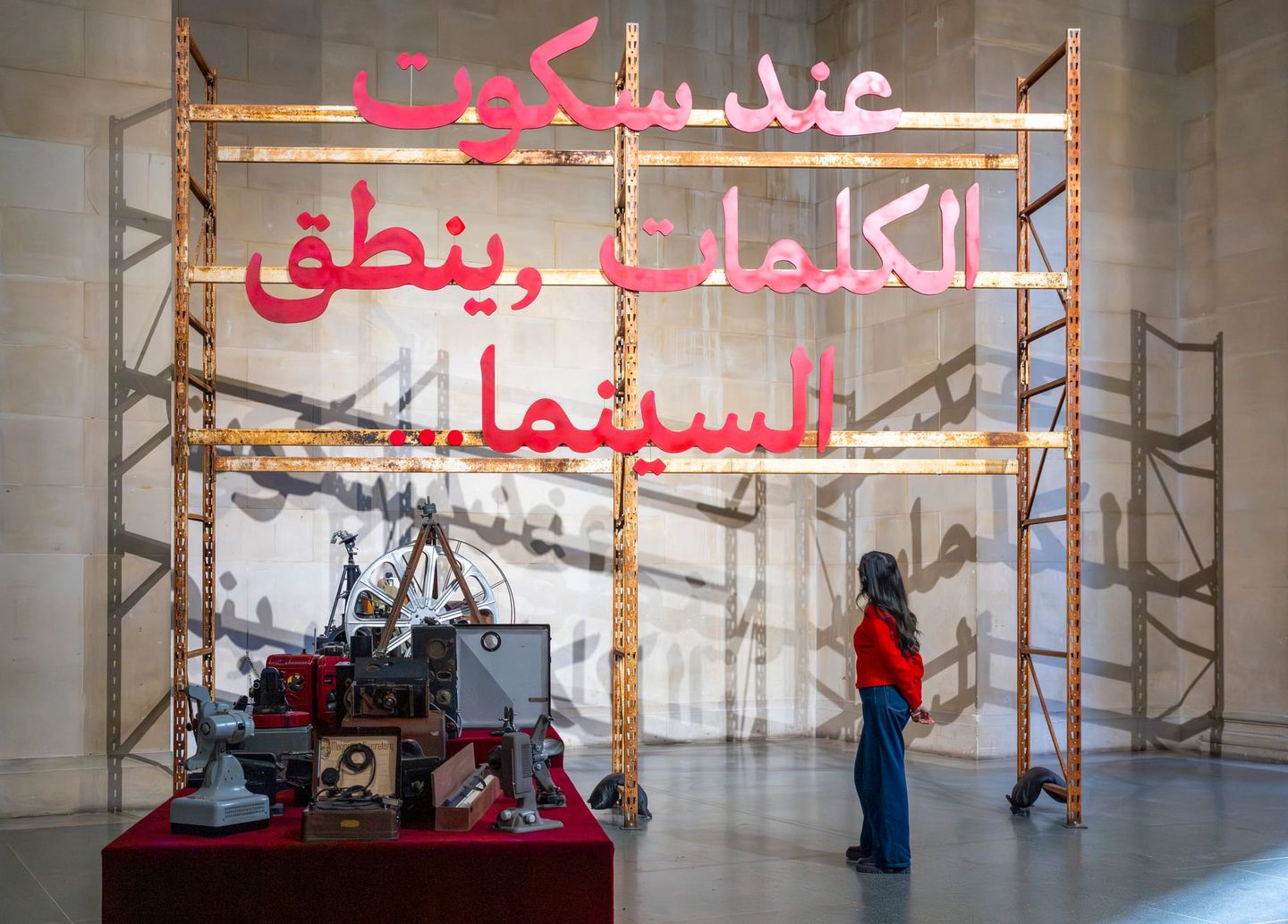
We speak to British-Algerian-French artist Zineb Sedira about her latest installation drawing on the legacy of 1960s and 70s African cinema, on display at the Tate Britain until 17 January 2027.
Let's start with the title, When Words Fall Silent, Cinema Speaks… Where did it come from?
I was thinking about militant cinema of the 1960s and 1970s, and how, particularly in Africa, local cinema emerged as countries gained their independence. Under colonial rule, Africans had very limited access to filmmaking because it required a level of knowledge, technology, and resources that colonial powers had largely made inaccessible to them.
After that colonial period, filmmakers felt the need to speak about their experiences: colonisation, racism, oppression, and the many other problems they had encountered. They began using cinema to speak out through images and visual storytelling, rather than relying solely on words.
I could have expressed this through the phrase, “When words fall silent, art speaks,” because when I talk about cinema, I am also talking about culture. The 1969 Pan-African Festival in Algiers, for example, was centred on the idea that “Culture is a weapon in the struggle for liberation.” The idea was that, for African countries to reclaim their identities, they needed to reclaim their culture, particularly after colonisation had attempted to erase or suppress it.
Culture can be an incredibly powerful way of communicating, but it can also be a means of rediscovering and reclaiming oneself. I think all of those ideas are contained within that one sentence: when words are no longer enough, art, cinema, and culture become another way of speaking, sharing, remembering, and finding yourself again.
The Tate Britain commissioned you specifically. There's a history of museums being linked to colonisation and imperialism, so I was curious how you took the space, and its history, into account.
The Tate Britain curators invited me precisely because my work engages with postcolonial issues. I think they felt it would create an interesting dialogue with the building itself and with the Duveen Galleries. I didn’t have to think too explicitly about the building, given the Tate’s own history and its links to the slave trade, particularly through the sugar trade, as well as to imperialism.
In some ways, I am talking more about French postcolonialism, but within a British context. Tate Britain, as its name suggests, is a museum focused on British identity—whatever that means today. Bringing a French perspective into that context is a way of saying that imperialism is imperialism, whether it is French, British, or Belgian.
Could you imagine taking the installation to France?
Of course, I would also like to show the project in France, particularly because it explores the Cinémathèque algérienne and its early connection with the Cinémathèque française, which helped establish it in the years following independence. Many French intellectuals and filmmakers, particularly on the political left, were anti-colonial and supported Algeria’s independence.
The Cinémathèque algérienne was established in 1965, just three years after independence. At that time, the Algerian state did not yet have the means to acquire or rent films, so the Cinémathèque française helped by lending films to Algeria.
But more importantly, my project needs to be shown in Africa or the Global South. I am glad to say that, after the Tate, it is going to Madagascar! I am very excited because my projects dealing with colonisation, Pan-Africanism, and ‘Third Worldism’ tend to be shown mainly in the Global North. When I show my projects in Africa, the Middle East, or Asia, the work takes on a different dimension.
One of my favourite parts of the installation is the mobile projection van, first used for military propaganda and later reappropriated by Algerians. Could you say a bit more about it?
The Ciné Pop was René Vautier’s idea, a French communist filmmaker who supported Algeria during the Algerian War against France. He proposed reusing the French army’s propaganda mobile cinema to show Algerian films in remote villages and in the desert. I like this idea of transgression: how one vehicle could go from French propaganda to showing Algerian anti-colonial cinema. Mobile cinema still exists today, bringing culture to people who wouldn’t otherwise have access to it. It’s a democratic way of sharing cinema.

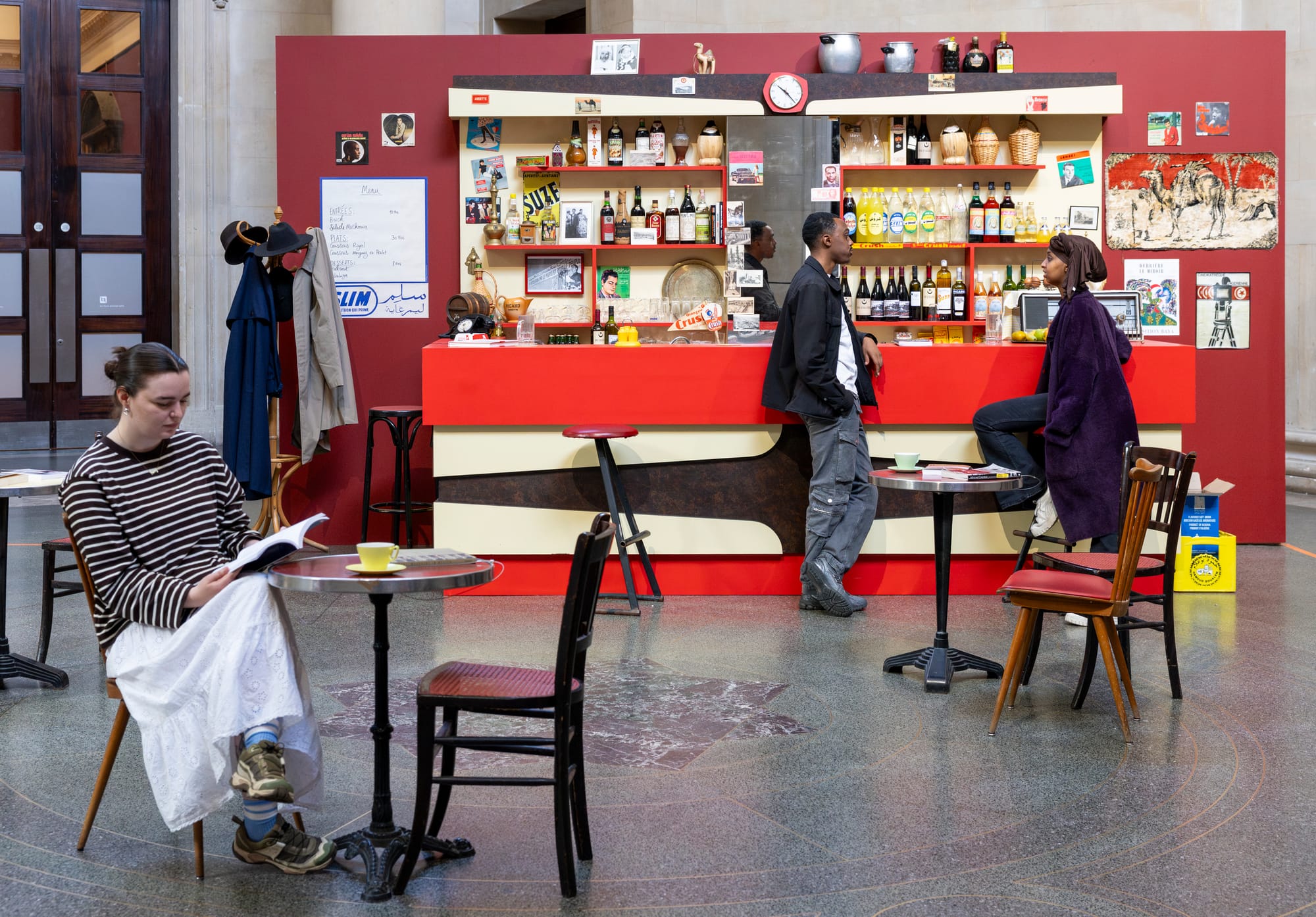
In the middle of the installation there's this café, with books on the tables. It's a space you can spend time in, rather than just look at and pass through. What was the thinking behind that?
Over the last ten years, I have created a few projects that ask the audience to participate, like sitting in a living room, in a bar, or dancing on a dance floor. But this time, it is a 50s and 60s Parisian Algerian café, during the Algerian War and early post-independence. During that time, Algerian men immigrated without their families and worked during the day. They were staying in small hotel rooms where they couldn’t entertain. The café became a substitute for a home. During the war, the FLN was fighting in Algeria, while the Fédération de France was active in Paris, and their partisans met in cafés for political activities. You could discuss politics, drink or eat, but also dance, because there was often a scopitone, a kind of music-video jukebox. It often played Maghrebi music and recreated a familiar sense of ‘home’. I was always fascinated by scopitones, the precursor to music videos!
When I was a child, I used to go with my dad to those cafés, often in Barbès. So, I tried to rebuild that café from memory, and of course, I added my personal touch. Many photos and objects in the decor or props are from my own family. By recreating a café similar to the one from my childhood, I wanted to activate a space for sharing. By placing books on militant cinema on the tables, I am offering the audience the chance to read them, discuss them, and dance if they wish.
And the Scopitone plays Agnès Varda’s “Salut les Cubains”.
I could have easily played Scopitone’s films featuring Maghrebi singers, but because my project is about cinema and militancy, I looked for a political film with dance passages. Besides, I love that film! There is something about the way it was constructed, using mainly black-and-white photography with archival documentary footage. This 1964 film has three moments of Cuban music and dancing during the Cuban Revolution, a way of resisting American imperialism. I like the idea of being in an Algerian café and listening to Cuban Caribbean music! This is a form of solidarity…
Below the screen, where the song titles would have been, I created a list of political films that influenced my project: African cinema on one side and global cinema on the other. All about anti-imperialist or anti-fascist films from the 1960s to 1970s. If anyone is interested in this type of cinema, they can research and watch them.
On 12 September 2026, you’re overseeing “African Cinema Speaks: Screenings and Seminar” at the Tate Britain. How did you work on the curation of that day?
It’s a film programme in collaboration with Cinémathèque Afrique, a cinémathèque funded by the French Ministry of Culture, which financed part of my film When Cinema Speaks at Tate Britain. Thanks to Cinémathèque Afrique, I was able to access many African films while researching my project, so it made sense to screen films from their archives.
We then invited Roisin Tapponi, who created Shasha Movies, a streaming website for Arab films, and Abiba Coulibaly, who knows African cinema well. Let’s not forget that Algeria is an Arab speaking African country. As an artist, I can only talk about cinema through my research and cinephilia, so it’s always interesting to hear what film ‘specialists’ have to say and the way they say it.
What was your working process with Boudjema Kareche? I imagine his memory makes up for things you couldn't find in archival footage.
Over the last ten years, researchers have asked Boudjema Kareche, ex-director of the Cinémathèque algérienne, to talk about the institute in general. For me, it was important to ask him to focus on his program about ‘Third World’ film directors and his passion for Third Cinema. But also, the importance for an Algerian audience to interact with filmmakers from these regions, and beyond. He also loved French Nouvelle Vague cinema and was strongly drawn to experimental, political, and social cinema beyond the ‘Third World’.
In the 1950s and 1960s, many film directors were fighting back against the Hollywood film industry and were looking to create a new cinema. These films were interesting both politically and aesthetically, at a time when there was growing interest in anti-colonial and anti-war politics. And Boudjema insists in my film, “Politics, yes, but art before all.” At the Cinémathèque algérienne, each film was followed by at least a three- to four-hour conversation between the filmmakers and the audience. It shows a strong interest in film production and ideas from the Algerian audience. Art, film aesthetics, culture, and politics were favourite subjects, probably because they had been deprived of them for 130 years during French occupation!
How does this fit within your wider body of work, especially your installation at the Venice Biennale?
Both projects are concerned with militant and political cinema. Dreams Have No Titles, exhibited at the Venice Biennale, focused more specifically on film co-productions between France, Algeria, and Italy, and on the artistic, intellectual, and political alliances that emerged around them. One important example was the well-known film The Battle of Algiers.
When Cinema Speaks... expands this focus to Pan-Africanism, Pan-Arabism and Third Worldism, while continuing to explore the networks that developed between filmmakers. In this sense, it can be seen as a continuation of the Venice project, but also of a project I exhibited at the Jeu de Paume in 2019, Standing Here Wondering Which Way to Go, where I began looking more closely at Algerian cinema.
Many people discovering the installation won't be familiar with Algerian cinema or Third Cinema. If there's one thing you hope they take away, what is it?
I want people to come away knowing that Algeria, Tunisia and Morocco are African countries. Many books about African cinema exclude North Africa, which I find very problematic, especially given Algeria’s role in showing and co-producing African cinema, as well as the JCC's role in an African film festival in Tunisia. It questions the narrative itself: challenging the tendency to essentialise Africa as exclusively or primarily ‘sub-Saharan’, and recognising the longstanding connections, exchanges, and solidarities that have shaped African cinema across the continent.
Support our work
You can subscribe to the OBSCURAE newsletter for free, or become a paid Aficionado for £5/month to help fund independent coverage, contributor fees, site hosting, and admin costs.