Carrie Fisher once said, “If my life wasn’t funny, it would just be true, and that is unacceptable.” Although Elsinore is not a comedy by any means, that line echoed in my head throughout Simon Stone’s film.
One of the most human experiences there is is realizing you won’t have time to do everything you want to and it is devastating whether you’re simply thinking about the books you’ll never read or on a bigger scale, all the paths you’ll never walk. The scariest part is the mystery of what we’ll actually have time for. Simply speaking, this is the ethos of Elsinore.
Since it hit the festival circuit, Elsinore has been accused of being “Oscar-bait,” the kind of film made to please a wide audience rather than a niche, highbrow one. That comes from the modern flood of nostalgia in media, where biopics, remakes, and sequels make up most of the box office. It’s a valid worry, but to paint Elsinore with that brush would be a terrible mistake. Although the film does everything but avoid its cliches, I would argue that it has earned almost every single one of them. (This would also require you to reconsider your definition of a cliche as being inherently bad. Cliches are popular for a reason.)
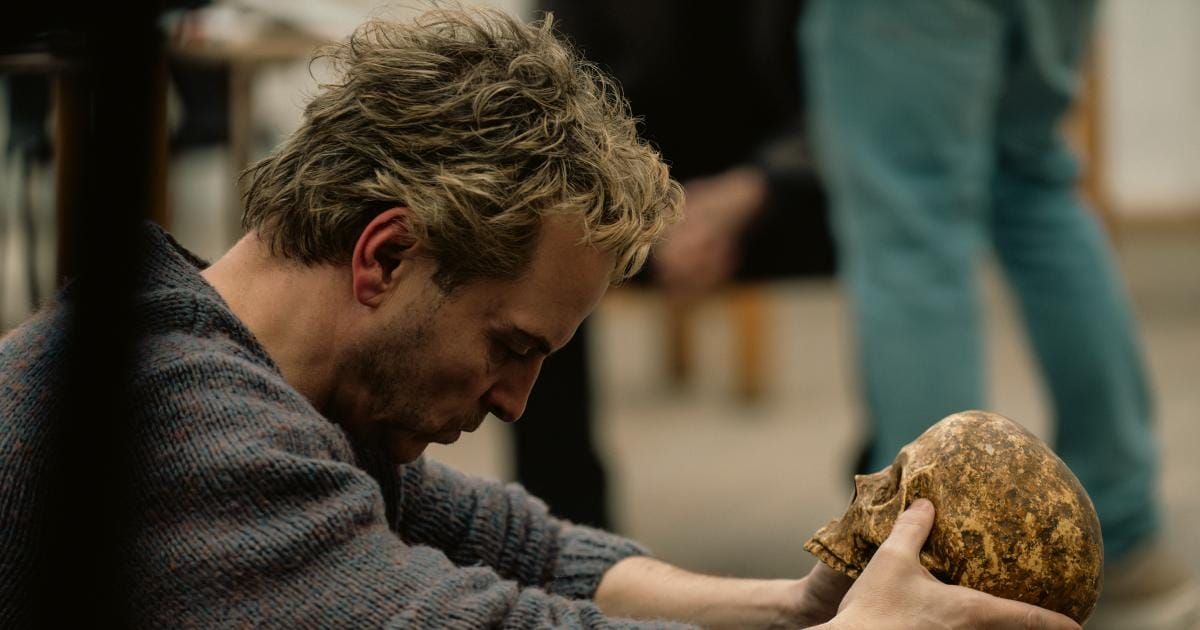
The film follows the last year of Scottish actor Ian Charleson’s life, through the late stage of his AIDS diagnosis and his last wish is to play Hamlet at the National Theatre. Charleson is played by Andrew Scott, whose wry physicality and dynamic with every character, however small, is captivating. It also adds an extra layer to his performance as someone who famously played Hamlet at the Almeida theatre and later, on the West End. It is a testament to Scott how his own Hamlet never once bleeds into his performance as Charleson as Hamlet.
From the opening scene there’s an implicit timebomb, even if you don’t know he’s already been diagnosed three years prior, and it pairs perfectly with the sterile, buzzing sound that mimics hospital halls. We meet Charleson in 1989 and are dropped straight into his world. He obsessively checks his body every day for skin lesions, namely Kaposi sarcoma, which the characters call the “polka dot stage,” the point where the disease has spread.
He’s also restless. Having recently made his first mainstream film, Chariots of Fire, Charleson laments that he wants to do real work again. “All anyone can remember [from the film] is the theme” is the perfect recurring joke. He itches to prove himself, so he takes on a lot of auditions, in which he’s overqualified for, and some friends, namely early collaborator Derek Jarman (David Dawson), call him a sellout for it. Jarman, who directed Charleson in his first film role, constantly berates him for not sticking it to the system and tells him to make bold choices rather than playing heterosexual roles.
Then his best friend and casting director, Patsy Pollock (Billie Piper), tells him that longtime collaborator Richard Eyre (Johnny Flynn) wants him to play Hamlet following Daniel Day-Lewis’s departure from the production.
When Charleson finally gets to the National, its grey brutalist atmosphere seems to follow the whole film. His dresser, Ralph, played by Paul Chahidi, immediately picks up on his symptoms and tells him to see Dr. Margaret Johnson (Olivia Colman). But Charleson has no interest in getting better to live. He wants to be well enough to do Hamlet, which frustrates Margaret.
The closest thing he has to a love interest is Georgie, who is not a specific real-life character, but rather meant to be an amalgamation of past lovers and friends, played by Luke Thompson, who acted opposite Scott in the West End’s Hamlet. Thompson is a standout in very few scenes and drives the narrative more than his screen time suggests. One scene they shared in particular, unfortunately already shared in the trailer, shows off both his and Scott’s prowess and tenderness and ends up being the emotional crux of the film.
Fortunately, Elsinore justifies its existence with a line that Charleson tells Dr. Margaret, “I’d rather die of Hamlet than AIDS.” This ideal is a powerful reclamation of agency for Ian Charleson as a fighting, living person, and later on, his legacy.
It’s fair to say Elsinore won’t be everyone’s cup of tea, but it has a lot to say, and whether or not you’re a theatre lover, it has one plea for you. When Charleson tries to convince Eyre to let him play the part despite his diagnosis. Eyre asks, “Should I engage my heart here or my brain?” I believe, in the best way possible, that the film asks the same of its audience. Whether you let it is your choice.
Support our work
You can subscribe to the OBSCURAE newsletter for free, or become a paid Aficionado for £5/month to help fund independent coverage, contributor fees, site hosting, and admin costs.