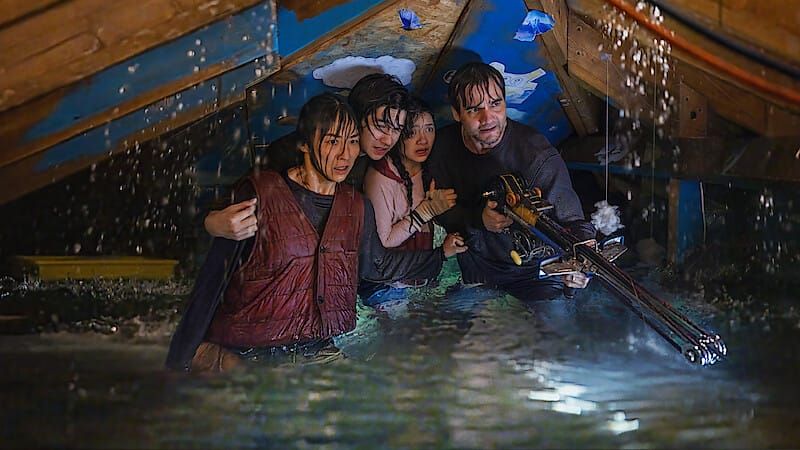
The Last House is a pandemic movie that differs from others created so far, making a story about COVID-19 surprisingly palatable for audiences with COVID fatigue. Rather than recreating the pandemic literally, the film transforms pandemic anxieties into the language of a creature feature horror sci-fi.
Arriving at a time where pandemic-related compassion fatigue is saturated throughout just about every aspect of our lives, the Last House asks us what it means to live in a world where COVID lives alongside us in our “new normal” (baaaarrrf!!! I know, I know I am sick of hearing this too!)
Directed by Louis Leterrier, The Last House isn’t the movie of the year by any stretch of the imagination, but it is enjoyable enough that it’s largely worth the watch. The film struggles with its screenplay, poor lighting design (photosensitive viewers beware), chaotic cinematography, and strange production design choices. Although these issues can be distracting, the film manages to remain grounded largely thanks to fun performances by Greta Lee and Wagner Moura and creative creature design.
The Last House never names the COVID-19 explicitly, but the pandemic’s fingerprints are everywhere.
Anxieties surrounding food security, access to medicine, and the conservation of increasingly limited household resources all become central to the family’s survival.
The film briefly alludes to intimate partner violence, recalling the documented increase in domestic violence against girls and women during pandemic lockdowns, while also reflecting the disproportionate toll COVID took on elderly people.
Isolation is one of the film’s most palpable anxieties. As the family spends more and more time confined to the house, tensions rise and the psychological consequences of remaining confined inside become progressivly challenging for each family member. Instead of the pandemic lockdown most of the world experienced, the film uses a literal lock-in as its device, which captures that strange collapse of time and space many of us experienced when our homes suddenly and simultaneously became our schools, workplaces, recreation spaces, and places of refuge.
As the film puts it: “Days blurred into weeks… weeks into months. […] The outside world had become strange and dangerous. Inside, people found what they needed to survive.”
Some of the film’s semiotic references are more patently linked to images from the pandemic. At one point, Lee’s character sees a wolf outside the window and tells it, “it’s your world now,” recalling the viral images of wildlife wandering into unusually empty urban spaces at the peak of lockdown. As the film progresses, outdoor shots show flora reclaiming human-made spaces, while the family’s indoor environment becomes increasingly wild and unruly.
Contagion does eventually enter the home, but not in the way audiences will anticipate. The Last House cleverly redirects our pandemic-era fear of infection by using a surprising device that I’ll keep secret here.
Around the one-hour mark, the plot holes become impossible to ignore. I mean… we literally have Greta Lee crawling through a household sewer pipe at one point—a moment film critic Kit Lazer hilariously sums up, “is there a plot point where a human literally has to crawl through a residential sewer line, which are typically about four inches in diameter? Yes! Who cares!”
The Last House is certainly a film where you need to choose to lean into the suspension of disbelief. In many ways, it seems to reference the visual and linguistic worlds of M. Night Shyamalan’s filmography, particularly The Happening (2008), Old (2021), and Signs (2002) and Matt Reeves’ Cloverfield (2008).
Ultimately, the most viral (wink, wink) thing about The Last House might actually be its ongoing marketing campaign, which has gone so far as to trap a poor guy (jk he's allegedly being paid a lot) inside a billboard in Los Angelas for three days over a busy WeHo street. It’s a wonderfully ridiculous bit of experiential marketing for a film fundamentally concerned with confinement. I’ll take it over the abysmal AI-generated marketing campaign for the upcoming the End of Oak Street any day.
Perhaps the strangest thing about The Last House is that it isn’t particularly great, and yet I remained engaged almost the entire time. Its filmmaking is messy, its dialogue is silly, and some of its creative choices are downright baffling. But turning the collective anxieties of COVID-19 into a creature feature is something my brain never would have come up with and truthfully, I had a lot of fun watching it.
We have already seen plenty of pandemic stories (Host [2020]; Eddington [2025], the Four Seasons [2025–] just to name a few), about masks, social distancing, Zoom calls, infection, and death. The Last House takes a riskier route. The result may be imperfect, but as a horror movie about the pandemic that never actually references said pandemic, is considerably more interesting and entertaining than I thought it could be.
The Last House is streaming on Netflix now.
Content note: Viewers sensitive to animal death may want to check Does the Dog Die? before watching. The site a great resource that provides content warnings for a wide range of potentially triggering material extending far beyond animal death.
Buy us a London-priced coffee once a month, and fuel our work - for £5/mo you can help us keep OBSCURAE’S independence alive. Become a Paid Aficionado