Vampires have always been queer. Whether that means simply being "different" or actually homosexual, they have served as an allegory for otherness since the 1800s.
Released in 2022 and starring Jacob Anderson and Sam Reid in the lead roles, Interview with the Vampire is an adaptation of Anne Rice’s series The Vampire Chronicles. The show and the book differ quite substantially, but the most significant changes concern its protagonist Louis, particularly his race and his explicitly romantic relationship with his maker Lestat. Changing a character's race in adaptation is nothing new, but what sets this show apart from others is that it recognises changing such a fundamental trait can have implications on the story being told.
The source material, written in 1976, depicts its protagonist, Louis de Pointe du Lac, as a white slave owner in the 1790s. After his brother's untimely death, he sinks into a depression until he meets the French vampire Lestat de Lioncourt, who offers him the dark gift. Louis accepts, thinking losing his humanity would free him from his pain, but quickly discovers that isn't true. He finds killing humans repulsive, at odds with his vampiric nature, and instead lives off animal blood. However, when the enslaved people on his plantation begin to suspect that he and Lestat are vampires, Louis kills one of his slaves out of fear that he will expose them. As tensions escalate into an uprising, Louis and Lestat – in an incredibly unsympathetic moment – kill more slaves before fleeing and finally setting fire to the plantation.
This characterisation of Louis was clearly a product of both its time and an earnest attempt to make Louis morally grey. While it may have worked in 1976, reading it nowadays leaves you baffled with how little the story seems to care for the lives of the slaves, rather using their death to prop up its white protagonist as a sad and tragic figure. So when AMC decided to adapt this story for modern audiences, significant changes were in order.
In Interview with the Vampire, Louis is changed from a white slave owner to a Black brothel owner, and the setting is moved from the late 18th to the early 20th century. This change adds several layers to Louis' character, making him more sympathetic, yet still keeping his grey morality. Before being turned into a vampire, he even explicitly acknowledges this conflict in his morality as he goes to church to confess in one of the best scenes in the entire show: "I profit off the misery of other men, and I do it easy. I take daughters with no homes, and I put 'em out on the street, lord...I look in the mirror, and I know who I am – the big man in the big house, stuffing cotton in my ears so I can't hear their cries." This monologue also acknowledges that even as a Black man at the time, he still had a certain privilege due to his wealth, an aspect vital to his character and his later hypocrisy.
Louis' motivation for accepting the dark gift is now fuelled by the false belief that becoming a vampire would give him power over his oppressors. His immortal companion Lestat, still a white Frenchman, believes this as well, even using it to persuade Louis when he turns him. Though of course they are both wrong. Vampire or not, Louis is still a Black man, and he doesn’t exist in a vacuum, a fact which becomes horrifyingly apparent to him very quickly.
His first taste of vampiric power comes when he kills one of the white business owners who tried to close his brothel, hanging his corpse on a fence for all to see, with a "whites only" sign around the dead man's neck. This triggers mass retaliation, not at Louis, but at his community. Black neighbourhoods are burnt down and Louis realises that he is still powerless against society’s oppression, instead having brought harm upon others on his quest for vengeance. In an attempt to soothe his conscience, he saves a young girl, Claudia, from a burning building, dragging her to Lestat and begging him to turn her into a vampire as well, without caring if Claudia actually wants this or not. This perfectly encapsulates Louis’ flawed morality and selfishness, while developing the story’s commentary on discrimination and power dynamics.
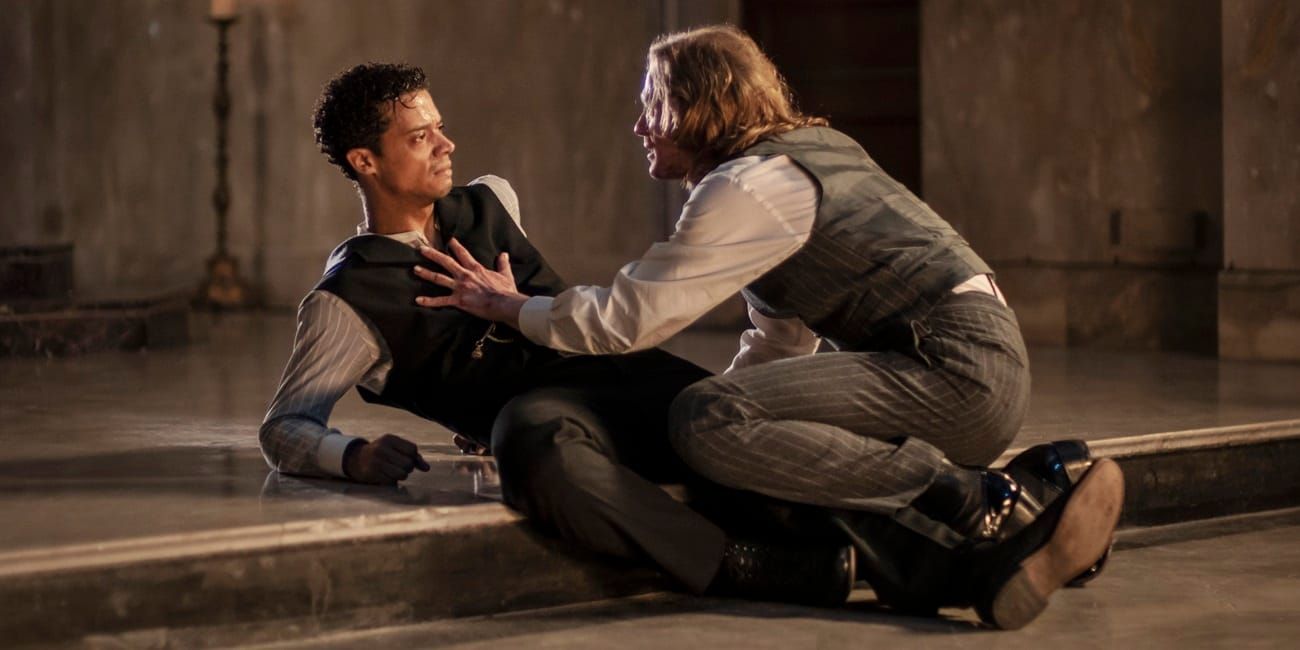
This theme of discrimination is further built upon in another significant adaptation choice. In 2022's Interview with the Vampire, Louis is not only Black but also explicitly gay. In the novel he was always queer-coded, but in contrast, in the show's first episode Louis and Lestat have sex, and the vampire transformation sequence takes place in a church on the altar, clearly evoking a wedding. This isn't particularly unusual for 2022, but what sets Louis' story apart from others is that even though he is a Black, gay man, he is also allowed to exist outside of this identity. While both his race and his queerness shape his life, they do not define his entire character. The show doesn't shy away from depicting racism and homophobia, but Louis is still allowed to be cruel, selfish, and even monstrous.
Interview with the Vampire sets an example of how to tackle monumental changes in adaptation like race. It fundamentally alters the story, giving it the opportunity to compellingly discuss topics like oppression. The show uses Louis' reimagined identity to shape him into a more interesting, complex, and sympathetic character, unable to come to terms with who, or what, he truly is – whether that is a Black man, a queer man, or just a vampire.
Support our work
You can subscribe to the OBSCURAE newsletter for free, or become a paid Aficionado for £5/month to help fund independent coverage, contributor fees, site hosting, and admin costs.