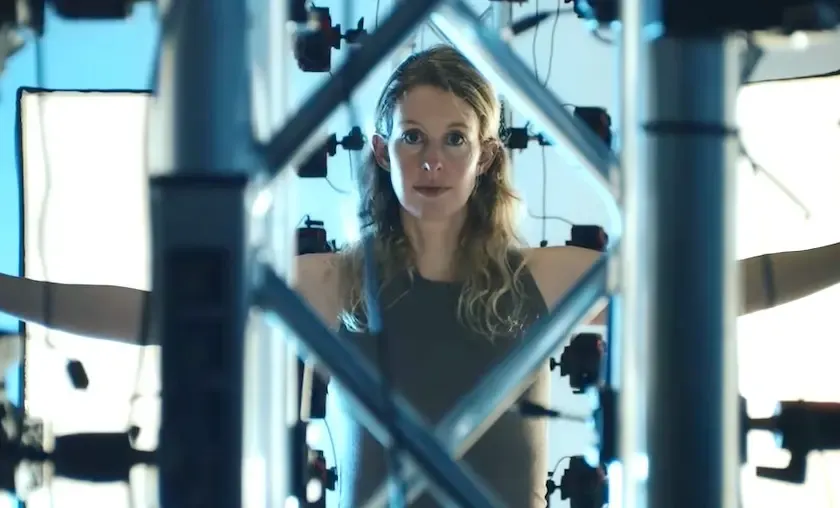
The promotion for You Can See Everything has been inescapable, taking social media by storm. The film is a triple Venn diagram of lightning-in-a-bottle documentary magic, with Lance Oppenheim and Nathan Fielder co-directing and Elizabeth Holmes at its centre.
The film begins 34 days before Holmes, the founder and CEO of the infamous company Theranos, is due to report to prison to begin her 11.25-year sentence. Convicted on four counts of fraud in 2022, Holmes, alongside her husband, Billy Evans and their two children, open their home to the documentary crew to capture her final days leading up to her prison sentence, seemingly with the goal to show the “true” Elizabeth Holmes that they believe the public has never seen before and ultimately, in an attempt to show that she is not guilty of the crimes she has been convicted of.
The film’s nearly three-hour runtime is never felt and together, Oppenheim and Fielder have created one of the most fascinating character studies (criminal or otherwise) in documentary history.
I am both a fan and critic of both Lance Oppenheim and Nathan Fielder’s work.
While trying to convince a friend to come see You Can See Everything with me, we got into a debate about the ethics of Fielder’s earlier work. My friend argued that Fielder takes advantage of the many participants featured in Nathan for You (2013–2017). And, although I admittedly enjoy the majority of the series, I had to agree that there were episodes in Nathan For You that have rubbed me the wrong way because I didn’t like how the participants were treated or portrayed.
That said, I think Fielder’s latest creative endeavours through the most recent season of the Rehearsal (2022- [fingers crossed a future season]) and the Curse (2023) are some of his best creative work and You Can See Everything is another credit to his character in which we witness both a softer side to Fielder and a sharper, no-bullshit edge. It’s fascinating to see which parts of his personality (or character– do we ever fully know with Fielder?) he tactfully pulls from in attempts to draw out honest answers from Holmes and Evans.
Lance Oppenheim is having quite the year– he recently released his first feature drama Primetime starring Robert Pattinson as Chris Hansen. Before this year, Oppenheim was best known for his documentary work on Ren Faire (2024), Spermworld (2024), and Some Kind of Heaven (2020). His filmography has a pattern of depicting unflinching portrayals of the underbelly of American culture, which proves to be– are we surprised?– simultaneously seedy and terrifyingly mundane.
Oppenheim is often criticized for his documentary techniques. He works with an extreme precision and his documentaries are very controlled, carefully constructed, and highly stylized. For example, he will often shoot conversations with documentary participants multiple times to get different angles on subjects’ faces. In doing so, Oppenheim’s work begs the question to many whether it can be considered documentary or not.
Of course, many documentarians use techniques like dramatic reenactments or animated sequences, and every filmmaker ultimately decides which footage makes the final cut to construct the narrative they want to tell. Oppenheim, however, pushes the boundaries of documentary filmmaking further than his contemporaries. His filmography invites us to ask: at what point, exactly, does a documentary become a docudrama?
Without spoiling anything, You Can See Everything pushes this question to another level.
Like Oppenheim’s previous work, You Can See Everything offers another glimpse into Americana through the documentary lens but this time it feels different. This is perhaps due to Fielder’s onscreen presence and role as co-director.
The film retains Oppenheim’s beautiful cinematography and knack for crafting fascinating narratives, but it is also a bit rougher around the edges. Booms occasionally enter the frame, the camera crew is sometimes visible, and shaky camera movements follow the participants more organically. These stylistic choices feel distinctly different from Oppenheim’s typical highly controlled approach.
Together, Fielder and Oppenheim have created a film that functions both as an engrossing character study of Elizabeth Holmes and Billy Evans and as a meta-documentary about the ethics of documentary filmmaking itself.
For a documentary called You Can See Everything, the question becomes: what exactly are we being shown? The film investigates who Holmes really is, what she may be capable of, and how much of her public persona reflects the person behind it. But it also asks us to consider the limits of what a documentary can reveal, and the extent to which those revelations are shaped by the people behind and in front of the camera. What do Holmes and Evans choose to show us, what do they leave unsaid, and how do Fielder and Oppenheim's own choices shape the story we ultimately see?
The film's title feels less like a promise of transparency and more of an invitation to question what we are bearing witness to.
That is all I will say on that for a spoiler-free review and– as always– I invite you to go see it for yourself and inform your own opinion.
For those who want a truly thrilling cinematic experience, I recommend staying away from spoilers, reviews, and even the film’s IMDb page. Get tickets as soon as you’re able to in your country. I caught a screening on one of the largest screens in Canada at 2 p.m. on a weekday, and it was sold out. If that tells you anything, it’s that this is one film you’ll want to experience on the big screen and debate with your friends afterward. As someone who loves going to the cinema alone, this is one film that left me wishing I’d brought a few friends along for the ride.
Support our work
You can subscribe to the OBSCURAE newsletter for free, or become a paid Aficionado for £5/month to help fund independent coverage, contributor fees, site hosting, and admin costs.