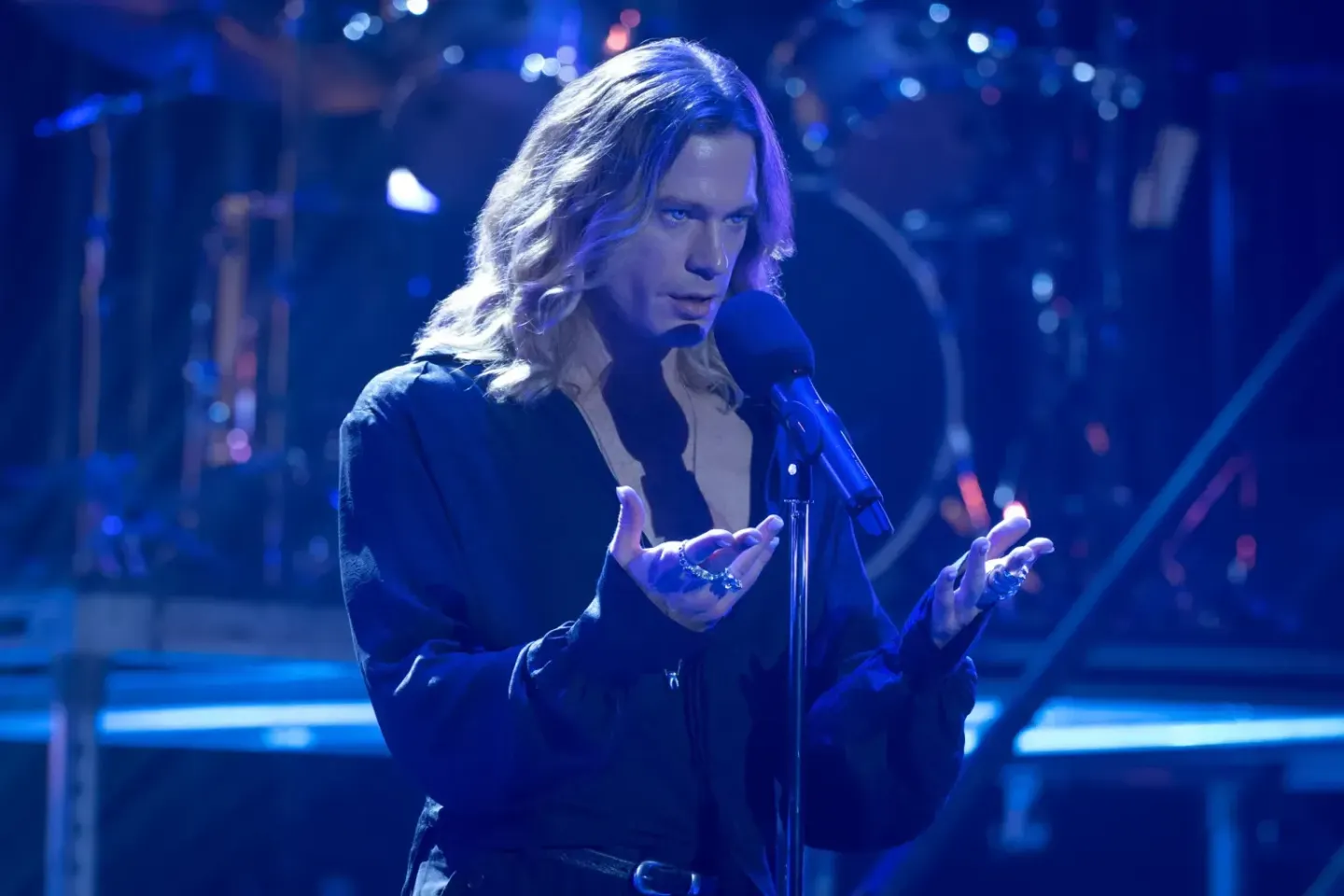
This late-season review contains spoilers up until episode six of The Vampire Lestat.
In its opening episodes, The Vampire Lestat used fractured editing to place viewers inside the unstable architecture of Lestat’s memory. The past did not return cleanly or chronologically. It intruded, repeated itself, transformed under pressure, and resisted every attempt to contain it. By episodes four through six, the season begins asking a different question: once those memories have broken through, what can Lestat possibly do with them? The answer comes in the form of music, which Lestat said would pull him through the shattering of his psyche in the third episode.
Across “The Devil’s Road,” “New York,” and “Montreal,” the songs, written by composer and writer Daniel Hart, become central to the way Lestat (Sam Reid) understands his own history. They become the season’s most revealing form of narration, carrying him toward truths he cannot articulate in conversation. At first, Lestat uses music to command attention and make impressions. Eventually, he uses it to confess. By the middle of the season, his songs remain tangled with spectacle, vengeance, and the need to control how deeply he lets himself be seen, but their evolution traces a steady movement toward vulnerability. The closer Lestat comes to honesty, the less room remains for the untouchable rock star persona he has built around himself.
Episode four, “The Devil’s Road,” finds him caught between public ascent and private collapse. The tour is finally gathering momentum, the band’s popularity is rising with mortals and immortals alike, and Lestat is becoming a symbol for vampires who have spent their long lives hidden and alone. The Great Conversion movement looks to him as proof that another kind of existence might be possible, transforming his concerts into something larger and more dangerous than entertainment, and all the while he reckons with Gabriella (Jennifer Ehle) abandoning him once again.
When Armand (Assad Zaman) arrives with warnings about Lestat’s growing influence and a plea to stop, Lestat responds in the language the ancient vampire knows well, and one they both have in common: theatre. He invites Armand to a concert, seducing him with the one thing he knows Armand won’t be able to resist, which is Lestat's own allure. “Big Boss”, the song he writes for Armand, is a trap, not a "sexy" romp on stage as promised, but a scathing diss track reclaiming imagery associated with Claudia’s trial and using it against the man he holds responsible for her death. The song is funny, vicious, and engineered to humiliate. It allows Lestat to address Claudia’s death without speaking directly about her, bringing focus to the Great Laws that Armand religiously upholds. While it serves its intended purpose, it is clear from the performance and the backstage moments afterward that Lestat is experiencing a breakdown as he grapples with Gabriella's departure.
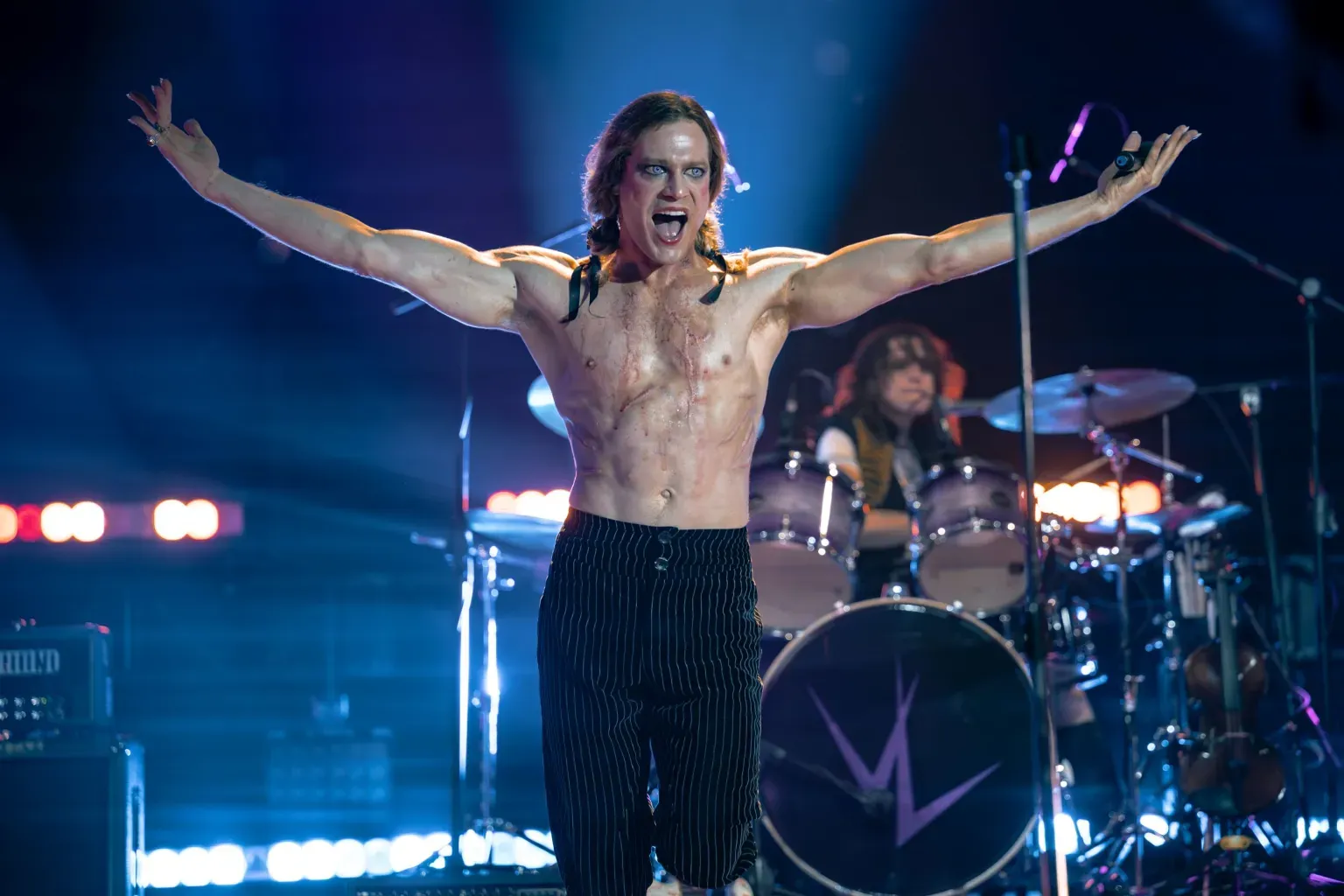
A shooting at the hands of an overzealous “vampire truther” ends his brief, perceived triumph, and forces another shift. Lestat is less shaken by the threat to his own life than by the harm done to everyone around him. The tour, once imagined as a liberating communal space, is contaminated by terror and ultimately cancelled. The road ends, but the music does not. Gabriella’s return places him back inside the oldest emotional pattern of his life. She disappears, he panics, she returns when it suits her, and he is so relieved to have her attention again that he mistakes manipulation for love. Her influence shapes the music as decisively as it shapes him. She hears the call of vampires everywhere, asking Lestat to continue creating, then uses those “voices” to persuade him that his art must serve something greater than himself. It becomes less about his own reasoning for making music, and more about doing what he must to keep her around and satisfy her.
A song we hear bits and pieces of later in episodes five and six (and the full version of it released after the episodes aired) showcases how Lestat feels about all of this even as he dubs it the anthem for the movement she wants him to lead. “Cabbage” makes the pressure put upon him audible. Lestat sings of wanting “to exorcise the voices that keep me humming,” framing music as both release and compulsion. Those voices belong to the vampires who have found solace in him, but Gabriella converts their longing into a mandate. She pushes Lestat to record an album for vampirekind and to accept the role of a dark monarch for the Great Conversion, transforming artistic need into her version of a political destiny. Its rallying refrain, “make more,” asks for more vampires, more music, more followers, more of Lestat himself.
Episode five, “New York,” moves Lestat into the recording studio, where performance becomes harder to separate from confession. Believed dead by the public, he creates an album intended for vampire ears, a posthumous offering that might survive even if he, publicly, does not. The studio becomes a sealed chamber in which every unfinished song, unresolved memory, and impossible standard echoes back at him, a chamber he even refers to as his coffin of choice for the time it takes to record the album, shared with his band, now mom-ager Sofia-Gabriella, his appointed producer (the vampire Sam Barclay, played by Christopher Geary), and his muses.

He relentlessly rerecords tracks, pushes the band beyond exhaustion, and fixates on flaws no one else can hear. Each failed take resembles another failed attempt to articulate himself correctly. He is trying to make the album truthful enough to outlive him, hoping it will “kill [him] savagely” for the public eye, but that’s hard to do when it feels as if he is still partially in the middle of the breakdown he’s been experiencing. The sessions keep returning him to the wounds he would rather direct elsewhere. He records “Big Boss” again and again, eventually taking the performance into daylight while the sun scorches his face and the muse of Nicki, manifesting as his guilt, drives him through the song. The self-punishment exposes what the earlier concert concealed, the fact that Claudia’s death can no longer remain solely an indictment of Armand, as Lestat grapples with his own guilt for the deaths of the multiple fledglings that have died at Armand's hand. Lestat turns his body into part of the recording, hurting himself in an attempt to approximate the pain for which he feels responsible.
That effort carries him back to the “weird and haunting origins” of his musicianship, memories of the vampire queen Akasha (Sheila Atim), and Marius (Christopher Heyerdahl), her original keeper, who bestows the responsibility upon Lestat with minimal instruction before leaving him alone with the first vampire. “She loves music”, Marius tells him before he goes off on his holiday, and so music becomes his way of enduring that isolation. He teaches himself the violin, stages dinners with imagined companions, and fills the empty rooms with questions about creation, evil, abandonment, all while playing her music, before she eventually awakens. Akasha’s dependence makes him feel indispensable, repeating his tendency to understand love through usefulness.
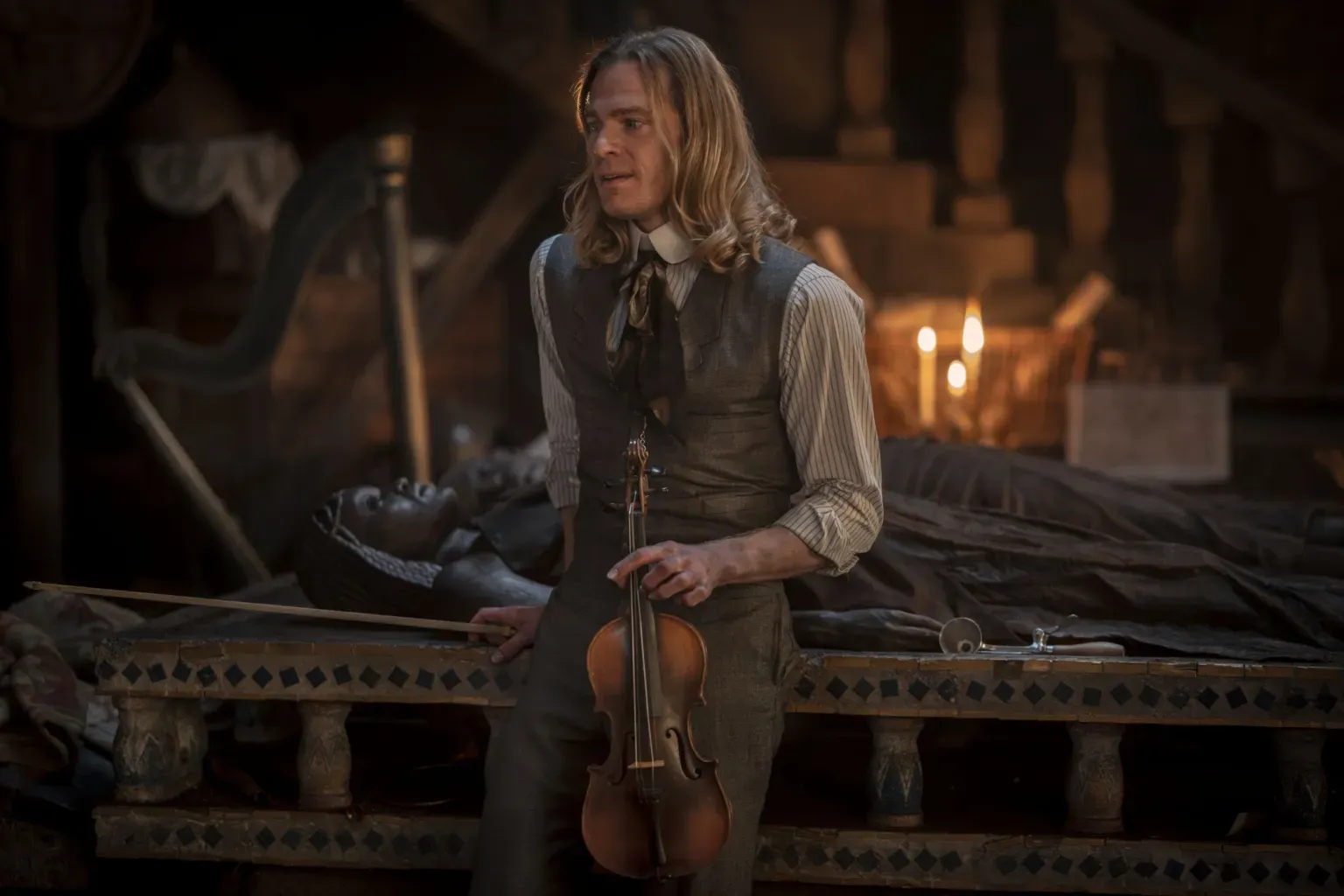
The uncertainty he feels while in Akasha’s lair carries into “When I Call Out Your Name”, another track Lestat struggles to perfect during the recording sessions. The episode offers only a fragment, its lyrics circling existential questions such as, “What are we doing? Why are we here?” Because the song accompanies Akasha awakening from her stone state and drinking from Lestat, it initially appears to belong to her, an extension of the questions he has spent years asking into her silence. The full track released after the episode complicates that reading, revealing Gabriella as its true subject through details from their shared history, including references that longtime readers of the novels will recognize.
That revelation retroactively alters the studio scene. Gabriella is absent, occupied with the calls and arrangements surrounding Lestat’s growing influence, despite being the person who pushed him toward the album, as he is trying to perfect a song about their very relationship still holding him in its grasp. As he records, the muse of his younger self appears, stumbling over a passage until the adult Lestat gently completes it for him. The moment echoes the song’s chorus, where Gabriella’s name catches behind his childhood stutter before he finally cries it out repeatedly at the track’s end. His voice can be a rallying cry for his fans, yet the name of his mother and lover still reduces him to the frightened child waiting to be chosen by someone whose love has always arrived with the threat of leaving him behind.
The song’s description of their bond as a “deep lover’s spell” also echoes “Your Biggest Fan,” Lestat’s romanticized account of the kidnapping, assault, and forced turning he endured under Magnus. That earlier song, written from his maker’s perspective, warns him not to admit that “the spell is breaking.” The repeated language is revealing, as in both songs, coercion is translated into enchantment, as though calling abuse a spell might make captivity resemble devotion. Lestat continues serving Gabriella’s ambitions, submitting to the warped intimacy she demands and doing whatever he can to keep her near, but the music betrays the fear beneath that compliance. “When I Call Out Your Name” may sound like a love song, yet it offers some of the clearest insight into how thoroughly Lestat has learned to confuse being controlled, possessed, and abused with being loved.
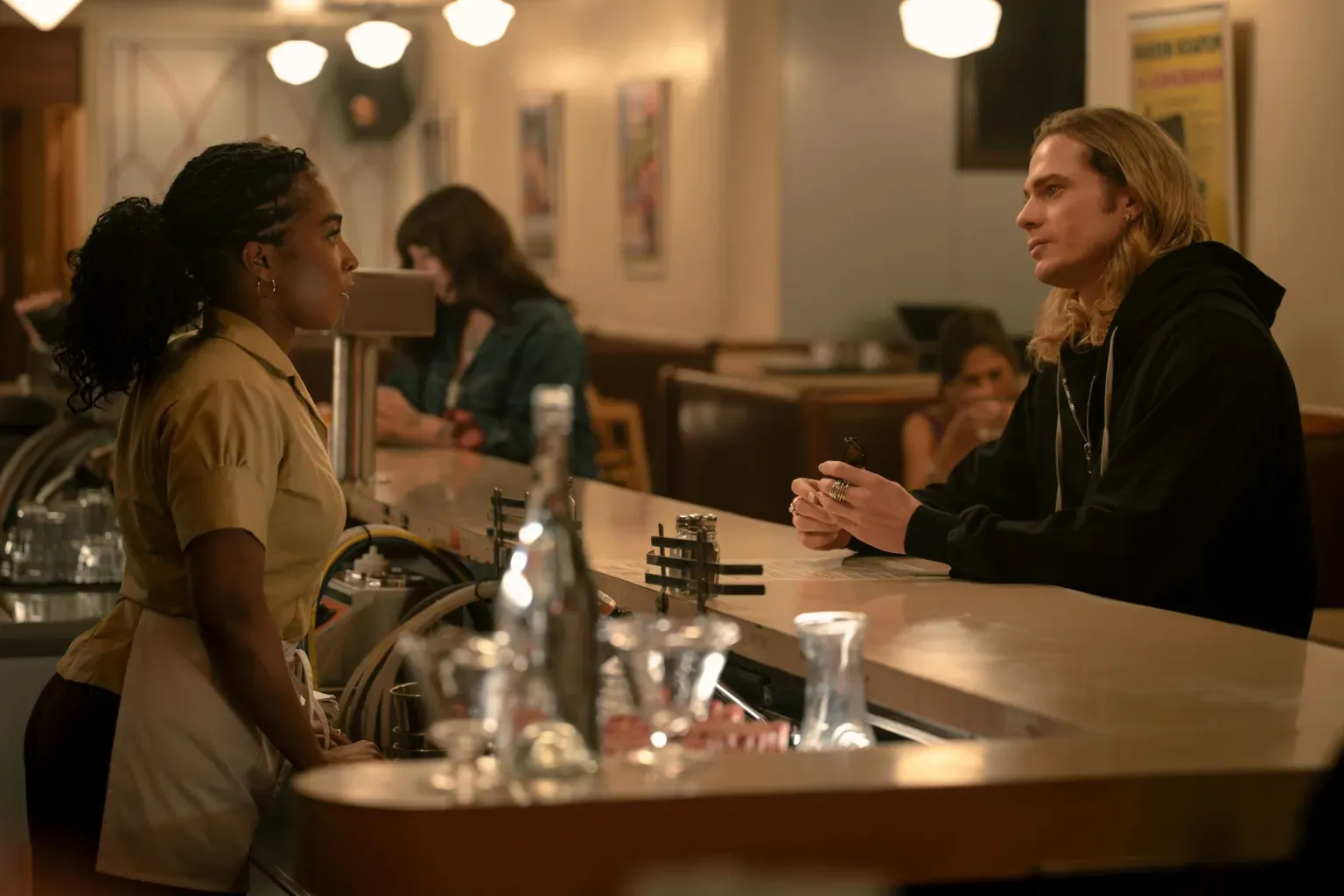
The breakthrough around his deceased daughter does not arrive through another take, or an already-written song, but through the only other person who can understand his pain. When Louis (Jacob Anderson) calls asking for help with Regina (Delainey Hayles), the waitress whose resemblance to Claudia has become both a comfort and an increasingly creepy fixation, Lestat goes to him despite the distance between the pair. Seeing Regina unsettles him as profoundly as it has unraveled Louis. Her familiar face, paired with cruelty directed at him in her practiced imitation, brings to the surface memories of Claudia burning in the sun as she looked back at Lestat in her final moments. Lestat tries to protect Louis by confronting Regina and asking her to stop indulging the imitation, but he cannot remain in her presence for long. He leaves shaken, tells Louis there is no resemblance, especially because of “the eyes”, and begs him not to see her again. The encounter tears through the defenses he has maintained around Claudia. It is one thing to call out Armand through “Big Boss” or punish himself beneath the sun. It is another to look into a familiar face and recognize how much remains unresolved.
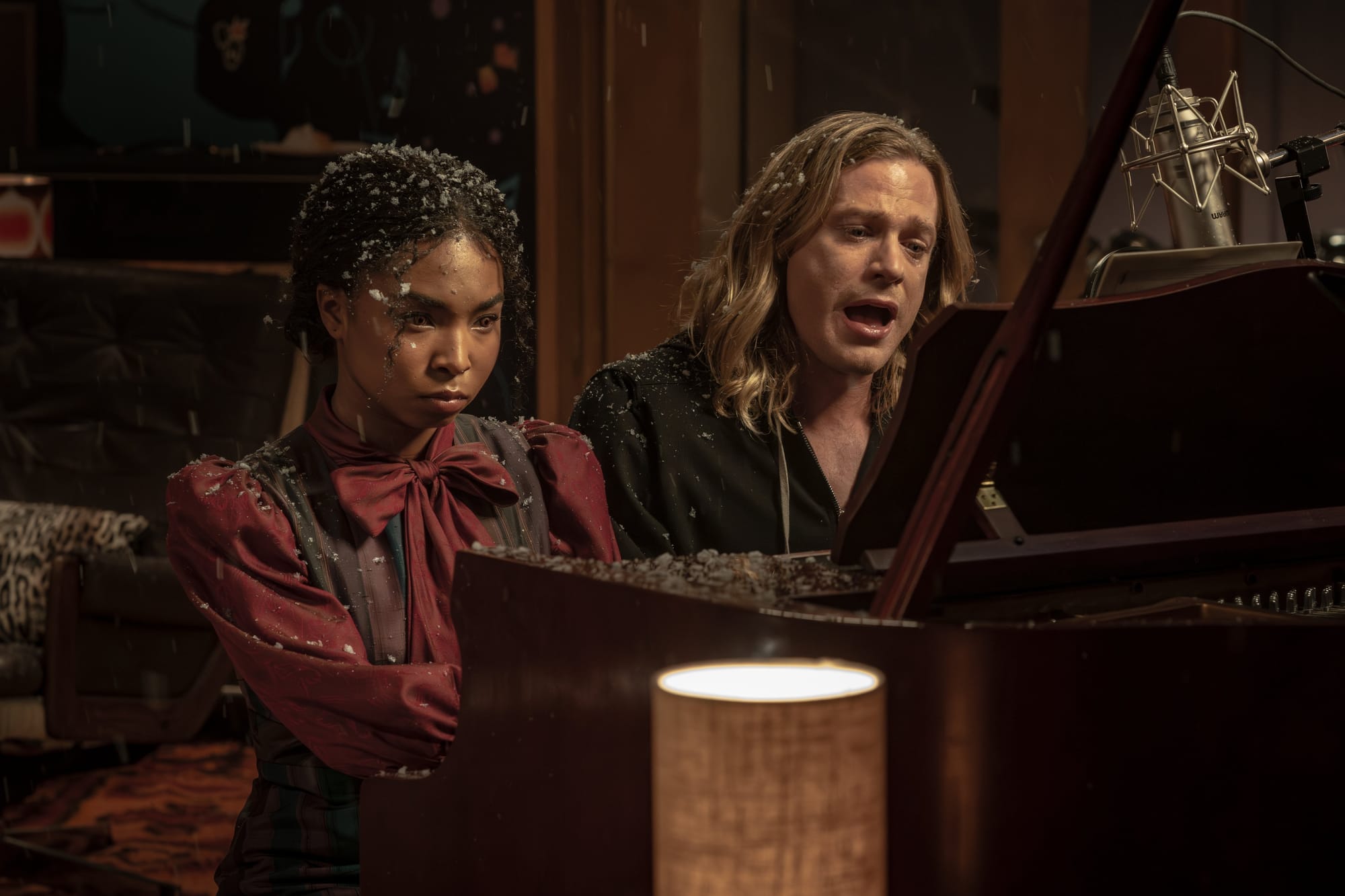
The album turns inward completely with “Stained Glass Eyes”. The styling disappears, the rock star armour falls away, as Lestat sits at the piano, the instrument he once taught Claudia to play, and finally allows his daughter to become more than an absence circling the edge of his story. The song does not demand conversion, provoke an enemy, or transform his pain into spectacle. It holds his own love, regret, and grief together without trying to make any of them easier. Hayles’ performance as the muse of Claudia gives the sequence its ache. She haunts Lestat with sorrow in her eyes, gradually burning and shedding ash over him as he composes. Her presence makes the grief almost unbearable. Lestat is not granted forgiveness or absolution, and in fact the lyrics compel him not to “try to forget all the things you regret”. He is simply made to remain in the presence of who he loved, who he failed, and who he can never recover. This song shifts the entire album for him, as he decides to rerecord it once more, this time with "instruments played like metaphors" for vampire ears, which leads to the band choosing to be turned so that they can finish it alongside him.
Episode six, “Montreal,” begins in the emotional space that last song creates. Lestat has completed the album Gabriella requested and has plans with his recently-turned vampiric band for one last “posthumous memorial concert,” with fifty thousand vampires converging on Montreal to witness the supposedly dead rock star’s return. Louis, meanwhile, finally re-enters Lestat’s life with something approaching ease after Lestat invites him to stay at his place, after helping him end his tangled situation with Regina. They walk through the city, trade jokes, revisit old times, and circle reconciliation with a tenderness the season has withheld until now, a calmness that is palpable in an episode with no presence of muses and minimal narration from Lestat’s future self. The two even have a brief visit with “[their] biographer, [their] documentarian, [their] shared ex’s abandoned offspring”, Daniel Molloy (Eric Bogosian), to give him an ending for his work, even if it doesn’t satisfy the younger vampire who is acting oddly during their meeting.
Meanwhile, “Cabbage” has already escaped the studio and become communal property alongside Lestat’s album, which didn’t resonate with mortals but has served its purpose for the Great Conversion. Vampires visiting the city for the concert pull up alongside Lestat and ask him to sing with them as the song plays over the radio. “This is a song for all the Beautiful Unwell,” the lyrics say, invoking the name he has bestowed upon his fans and encouraging vampirekind to embrace who they are through their loneliness.
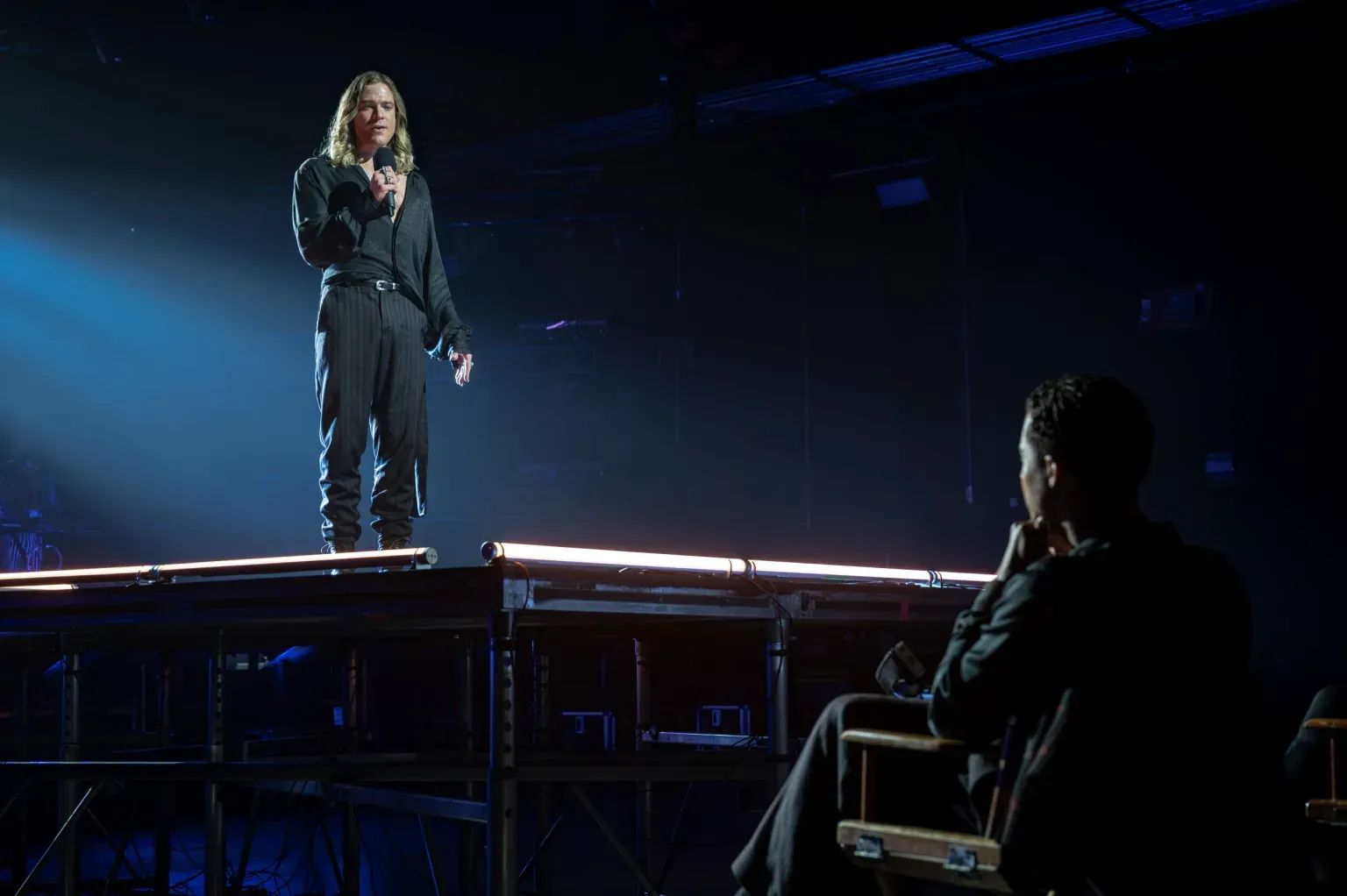
At rehearsal for the concert, Louis finally meets Gabriella, but as her alias “Sofia”, Lestat’s manager and lover, and while the tension can be felt, they both try to get along for his sake as he sings and twirls on stage. Then comes a new song, one he asks them to give him “brutal truth” for: “Brutal Love”. As the song is played, the camera gradually reveals the song’s recipient. Gabriella initially occupies the foreground, smiling and seemingly certain that Lestat’s tenderness belongs to her and her alone. As the performance continues, the focus moves toward Louis. Gabriella, staring at Louis in shocked realization, softens into the background and then disappears from the frame, leaving Lestat and Louis held in each other’s unwavering, tearful gaze. As Lestat sings of that "brutal love", stating over and over that he "want[s] it all", the song does not imagine love simply as something pretty and pure. It understands love as capable of containing ugliness, betrayal, longing, cruelty, forgiveness, and a century of accumulated damage, alongside the safety. Lestat wants everything with Louis, not merely the parts that can be made beautiful: the good and the bad, the tenderness and the harm, the devotion for each other and everything it has survived.
That promise is tested almost immediately. Daniel Molloy and Armand retaliate against the wrongs they believe Lestat has committed against them by revealing, to the entire world through a post online, that Sofia is actually Gabriella. This was something Armand revealed to Daniel an episode prior, hoping to get him to join him in stopping Lestat from continuing on his musical path to monarch. The intimate footage they post exposes the sexual nature of Gabriella’s relationship with Lestat, as well as the fact that she is his mother. The revenge porn takes the one story he has refused to tell anyone and tears away his agency over how it is revealed. For a season built around narration and his desire to control it, that violation is devastating.
Lestat vomits, dissociates, lashes out, and attempts to recover control while his body makes that impossible. Louis’ anger recalls the manipulative secrets that defined his relationships with Armand, while Lestat hears his reaction as confirmation of his oldest fear: that being fully known will always lead to abandonment. Reid and Anderson push the confrontation into a place painfully devoid of vanity: Louis’ hurt over the lies remains sharp without flattening it into outright condemnation as realization shifts his reaction, and Lestat’s shame feels enormous, physical, and disordered. His laughter fractures, his speech slips as his stutter reappears, and every attempt at composure collapses under the terror of exposure. Their performances allow both men to be wounded and wounding at once, preserving the argument’s emotional complexity. Lestat finally says how much he has been hurting. He speaks of helping Louis through Regina, of being alone after the shooting, and of how difficult reconciliation is for him too. “Brutal Love” promised a love capacious enough to hold the worst truths. The argument asks whether either of them can survive what that promise requires.
And, upon the realization of how wounded Lestat really is and how deep that wound runs, Louis stays. That choice becomes tangible in the quieter scene that follows. During an attempt to understand and communicate better about the reveal, amidst an apology for the initial reaction, Louis asks Lestat to add his blood to a beer so he can enjoy the human drink, an intimate gesture charged with unmistakable desire after so many years apart. The moment carries several meanings at once. Louis drinking Lestat’s blood again after decades apart rekindles the sensual current that always runs between them when together, yet its tenderness matters even more in the aftermath of Gabriella’s identity and the nature of their relationship being exposed. Louis has now seen the secret Lestat believed would make him repulsive, and still chooses closeness and an intimacy that is incomparable for their kind. There is no disgust in the way he accepts Lestat’s blood, only familiarity, hunger, and a quiet reassurance that complete knowledge has not erased desire.
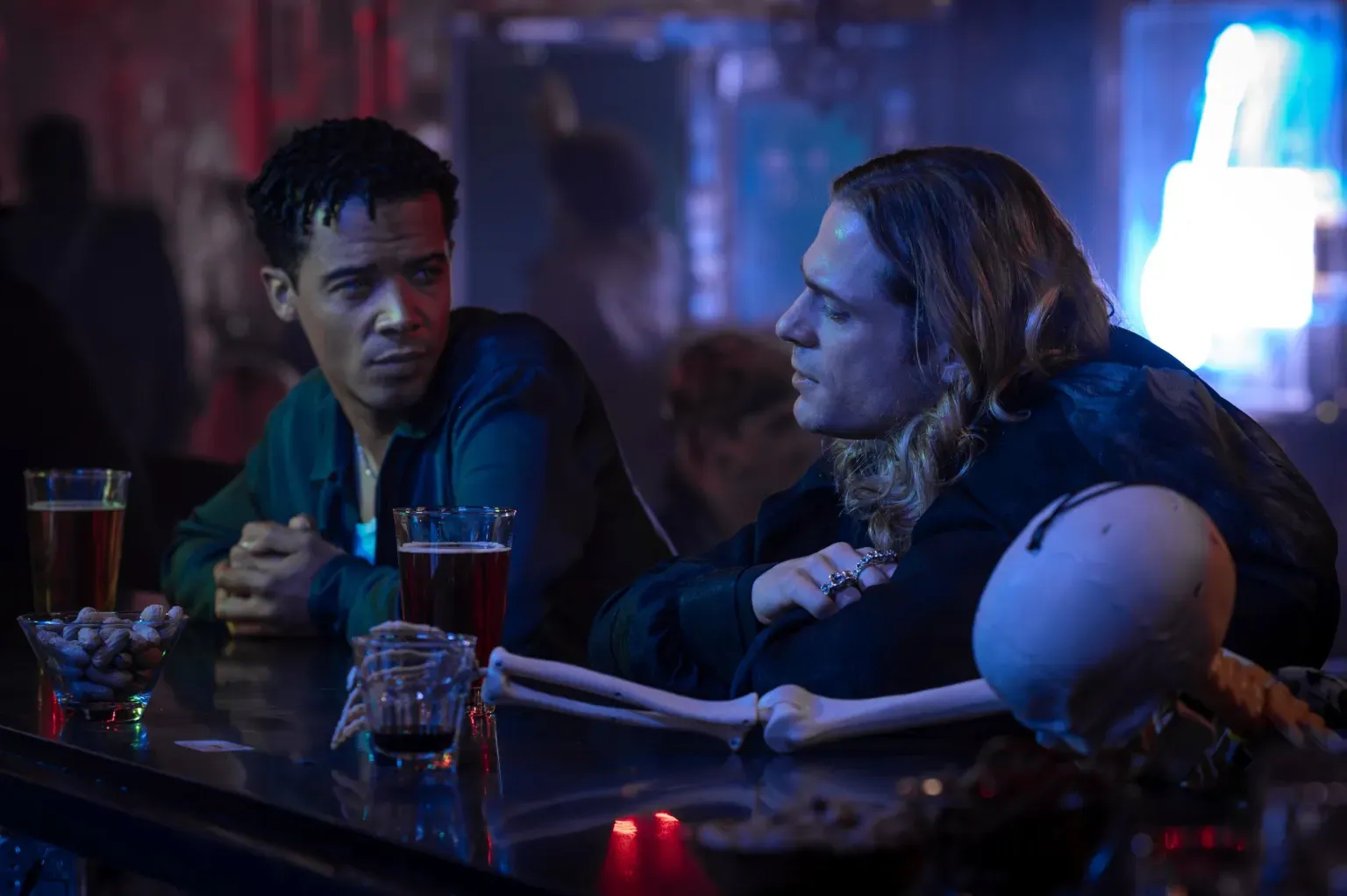
Reid and Anderson’s chemistry makes the scene hum without either actor needing to push it. Their eye contact alone restores the voltage that has been missing during a season spent largely apart, allowing attraction, affection, uncertainty, and history to pass silently between them. After waiting all season to see Lestat and Louis share the screen with this degree of intimacy again, the scene feels less like a return to an old dynamic than a deepening of it. Their connection survives not because the worst has remained hidden, but because it has finally been dragged into the light.
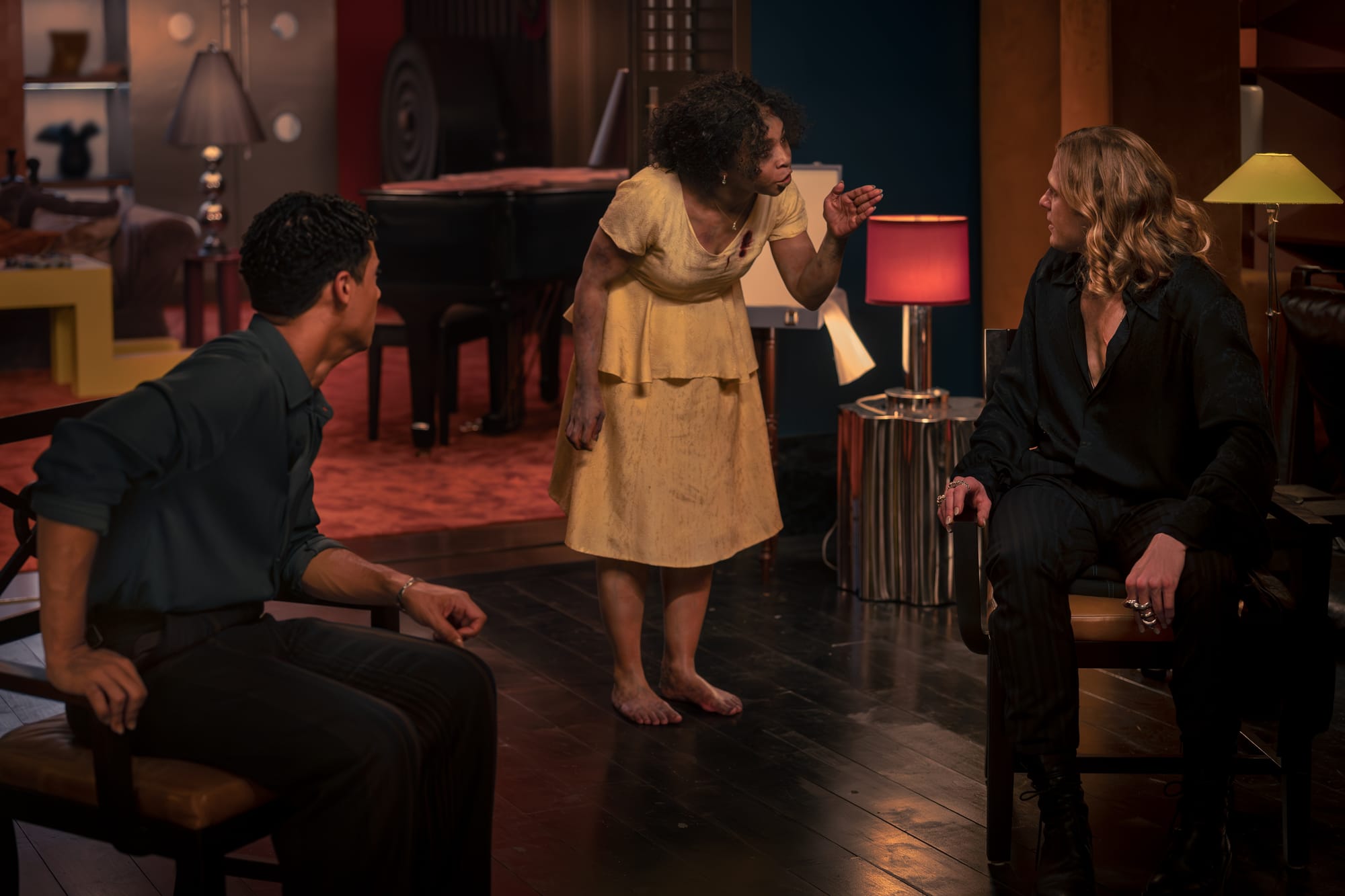
Music allowed Lestat to shape his encounter with her muse in “Stained Glass Eyes,” but the séance the pair planned to say goodbye to her gives Claudia a voice that neither father can control. Hayles somehow surpasses the quiet devastation of episode five by unleashing Claudia’s anger and sorrow in full. Her rage is volcanic, yet grief remains visible beneath it, the pain of a daughter denied a full life, adulthood, autonomy, and any ending she might have chosen for herself. Claudia offers no easy absolution. Her fury forces Louis and Lestat to confront how thoroughly their love for her was tangled with their own needs. Lestat’s failures have always been visible. Louis’ are harder for him to acknowledge. Her words rupture the idea that love alone can excuse what they did, leaving both men without the comfort of uncomplicated mourning.
Only after this reckoning can they dwell in the aftermath. Sitting together on a bench, reminiscent of the earliest days of their tumultuous journey together, Lestat asks why he “actively, manically pursue[s] failure.” The question reaches across the tour, the album, Gabriella, Louis, Claudia, Nicki, his very existence. Louis suggests that this may be the burden of vampirism itself. Mortals have death to give life shape and certainty, while vampires replace that with trying, failing, and beginning again, an endless cycle through which immortality acquires consequence.
That observation reframes the music carrying Lestat through these episodes. “Cabbage” gives Lestat a purpose and imagines collective transformation. “Big Boss” projects grief outward as fury. “Stained Glass Eyes” turns that grief inward and mourns without defence. “Brutal Love” reaches toward the only person from whom Lestat wants such acceptance, asking whether Louis can see every part of him and remain. None of the songs heal him in the way he desires, a failure in itself if that was the intention, but that may be the season’s most affecting understanding of art. Music cannot undo trauma, repair every relationship, or absolve anyone of the harm they have caused. For Lestat, though, it can give shape to what would otherwise be unbearable, holding love beside resentment, shame beside desire, and joy beside grief. Most importantly, it can make truth endurable long enough to be heard.
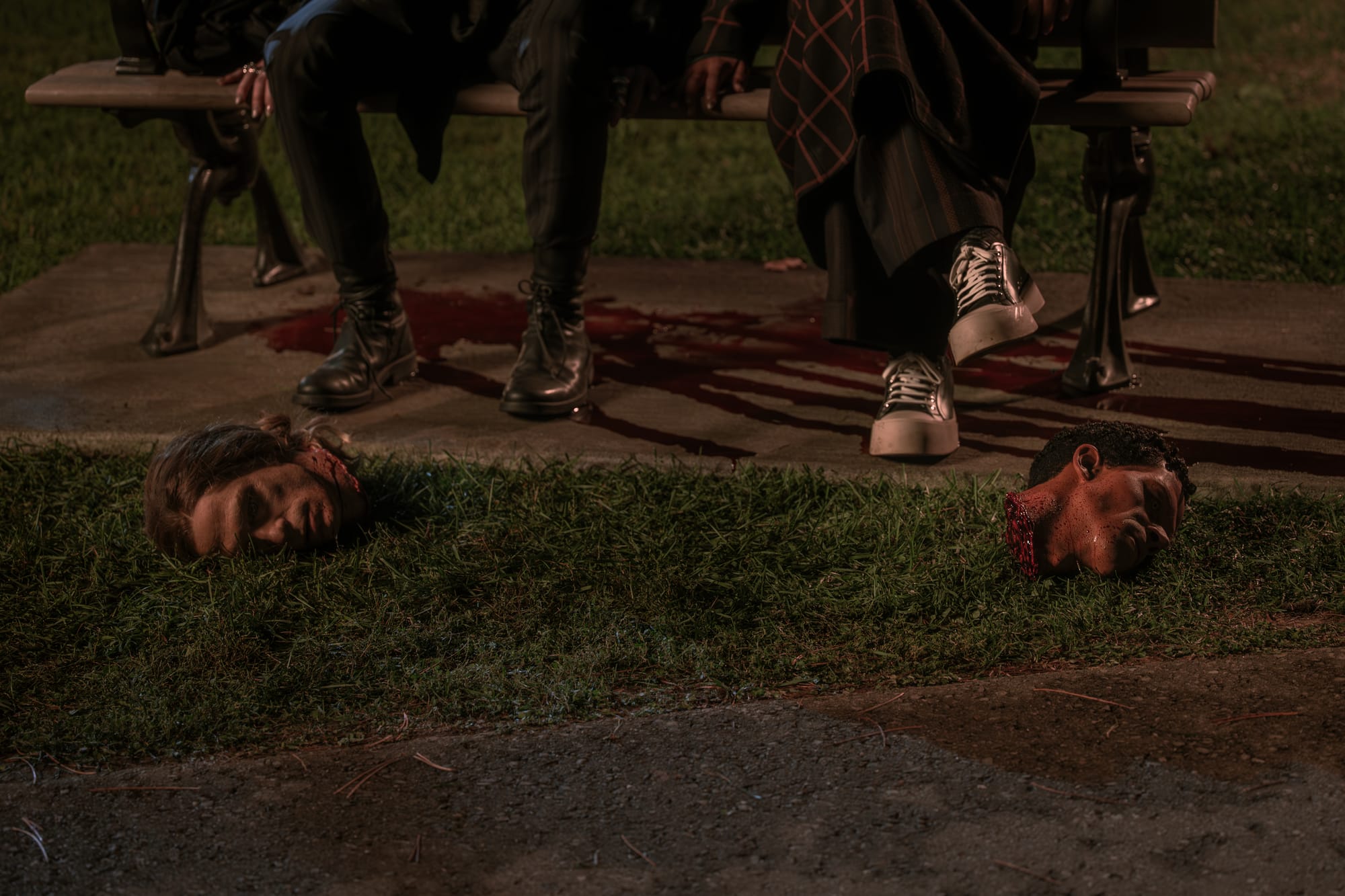
With its piercing writing, fearless performances, and an emotional current that shifts effortlessly between tenderness, shame, grief, and dread, “Montreal” is not simply a high point of the season, but one of the strongest episodes of the entire series. It ends with quite the shock as the conversation is cut short, literally, by Daniel and Armand, with help from Lestat’s bandmate Alex. Stay tuned for our review of the jaw-dropping, head-rolling (pun fully intended) conclusion to this season of The Vampire Lestat.
The season finale of The Vampire Lestat airs Sunday, July 19th at 9 p.m. EST on AMC, and will be available to stream on AMC+. The show is slated for release on BBC iPlayer in the UK on Tuesday, July 28th.