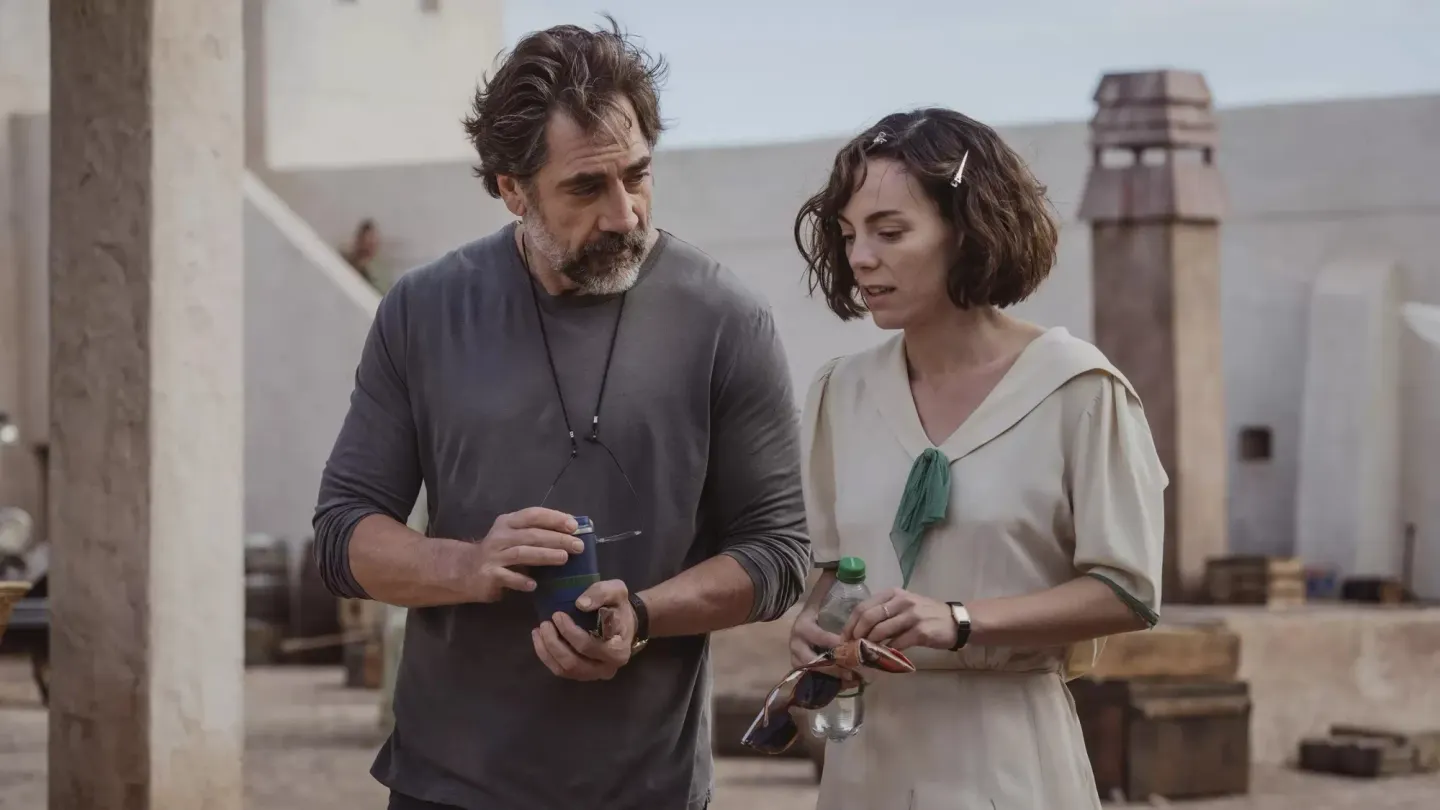
Men would rather make a movie than go to therapy or take accountability. For two-time Oscar and Palme d’Or winner Esteban Martínez (Javier Bardem), this means moving back to Spain to write, produce, and direct Desierto, a film about the country’s colonial history in Western Sahara.
Esteban sees this latest script as a way to rekindle his relationship with Emilia (Victoria Luengo), his 30-year-old estranged daughter and a struggling actress born from a liaison during his first, now cult film Siroco.
It’s clear, from the opening 20-minute-long awkward lunch scene, shot mostly in close-ups and in a single take, that Esteban is, to be polite, a complete asshole – but the kind who gets away with it, because he’s a male genius, and a reformed one at that.
Esteban was a 1990s wunderkind director, the kind who drank and took drugs. On a rare occasion when he spent time with 12-year-old Emilia, he took her to see Kill Bill 2 – the movie alone telling you a lot about the kind of father he was – and got into a fight with another audience member.
If Emilia was hoping for contrition or an apology, however, she’s in for a disappointment. Esteban disputes her version of events, arguing that her mother put ideas into her head. Emilia is annoyed, but you never get the feeling she is surprised at how her father shows up.
There is a strong white male saviour complex to Esteban, underlined by the way he handles the colonial narrative he is shooting. To play the Sahrawi shepherd who befriends one of the Spanish characters, he casts a Moroccan actor, which doesn’t seem like the best idea given the contemporary controversy over Morocco’s occupation of Western Sahara. He seems to think that offering his daughter a role is going to magically erase both his absence and his terrible behaviour, so Emilia is the one left having to do the work of making him understand the pain he has caused her.
In the whole movie, women are the only ones who hold Esteban vaguely accountable. When he is horrible to his actors during the film’s tense climactic scene, Emilia uses her position as his daughter to speak up. Following the same altercation, the director of photography (Pepa Gracia) walks out with her entire crew – times have changed, she tells Esteban, but a male DoP immediately takes over.
For a movie titled The Beloved, or to stay closer to the Spanish title El ser querido, the loved one, there is little love throughout, except for cinema. Rodrigo Sorogoyen plays with both colour and black and white, and a few scenes feature the grainy texture of film. The soundscape, which strikes you with silence and heightened background noise, is brilliant. Esteban seems to think that making good movies justifies all ills – as the audience, we are never under the illusion that the loved one might be his daughter.
Support our work
You can subscribe to the OBSCURAE newsletter for free, or become a paid Aficionado for £5/month to help fund independent coverage, contributor fees, site hosting, and admin costs.