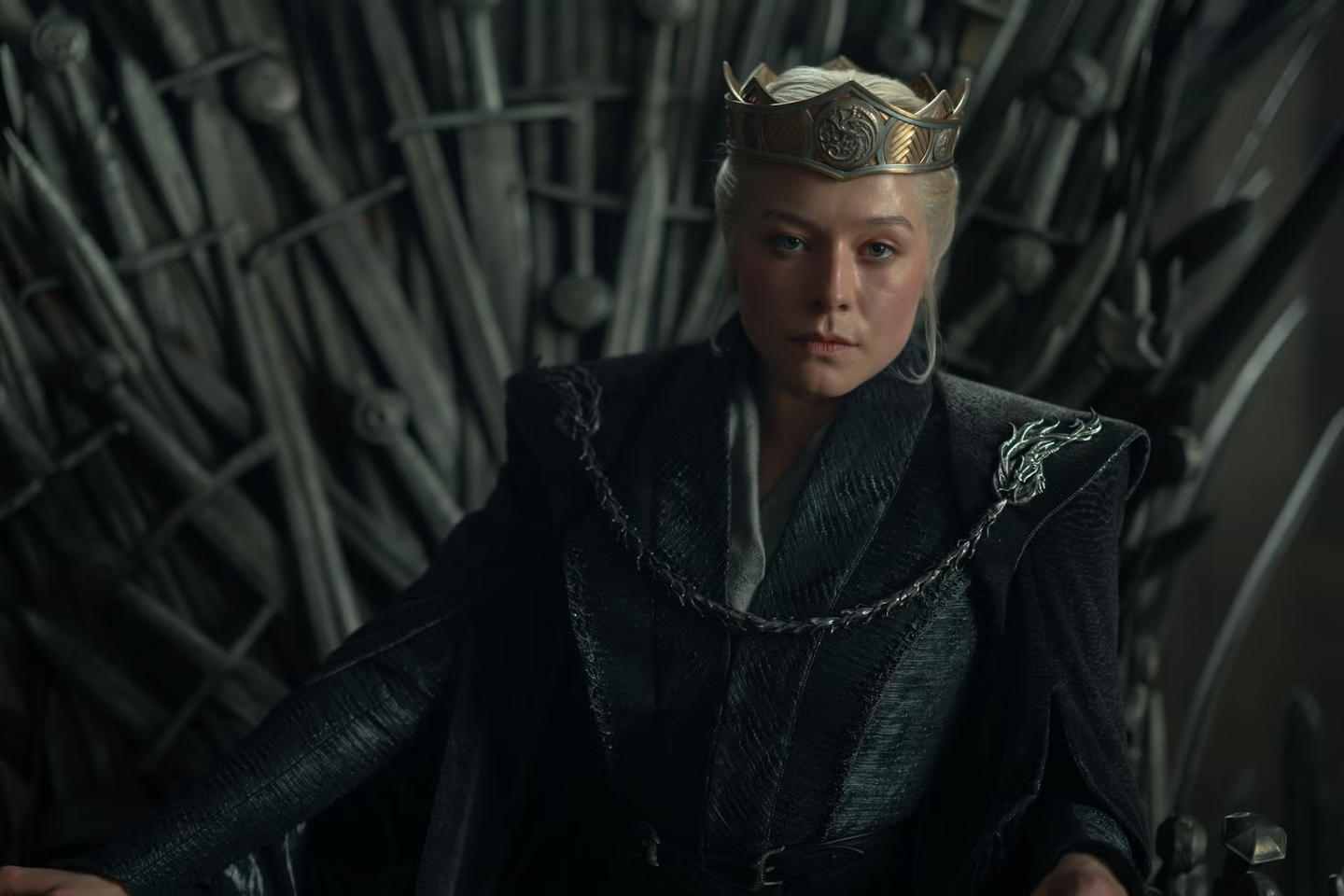
Standing in the shadow of a television behemoth like Game of Thrones is a tough spot for any show to be in. It's hard to describe the impact that Game of Thrones had on the television landscape, helping usher in a new era of high-budget fantasy media and redefining "event TV". Everyone and their mother was watching it, and in its heyday, it was one of the highest-rated shows on air.
Sadly, its impact on TV isn't all it's known for nowadays, as Game of Thrones has become the poster child for an increasing trend in television: the disastrous final season. The show's stark drop in quality is often attributed to a combination of two factors: the writers running out of source material, as George R.R. Martin has still not finished the book series it's based on, and a declining interest in the show by its showrunners, David Benioff and D.B. Weiss. So what happens when three years after the infamous finale a prequel series is released?
House of the Dragon Season 1 was pretty widely praised for its focus on political intrigue over huge battles, as later seasons of Game of Thrones tended to do. Ironic, considering that nowadays the show's marginally higher-rated episodes are the ones with huge battle sequences. Furthermore, it was commended for its faithfulness to the source material, "Fire & Blood", which is written as an in-universe history book, rather than a multi-POV novel like "A Game of Thrones". Fans of the "A Song of Ice and Fire" universe, which both shows are a part of, have a tendency to favour adaptations that stick most closely to book canon. The newest spin-off, A Knight of the Seven Kingdoms, is another example of this trend. It gets to the point where George R.R. Martin's works are sometimes treated as near-sacred, and any changes made are scrutinised.
This, in part, stems from the later Game of Thrones seasons. Martin was involved heavily with the production of seasons 1-4, but as they progressed, he felt he had less and less input. From this past experience, fans take his loss in creative control as a bad sign, and with Martin's relationship with House of the Dragon's showrunner deteriorating after its first season, some fans started turning on it.
The main gripe general audiences have with this season is that it feels very anticlimactic. Season 1 ends with the promise of a coming war, but its continuation doesn't fulfil that promise as much as people hoped. With only one big battle, Rook's Rest, it spends most of its time in small council rooms discussing strategy. This isn't wholly the writer's fault. Their budget was cut mid-production, forcing them to cut the episode count down from ten to eight, and due to the ongoing writers strike they weren't able to do any rewrites. However, other unpopular narrative choices cannot be explained by these circumstances. The characters occasionally go around in circles or follow similar arcs to the previous season, and audiences especially disliked Daemon spending multiple episodes hallucinating in Harrenhall, repeating the question of whether he will support Rhaenyra or not.
Die-hard fans had more complex issues with Season 2. The nail in the coffin came after George R.R. Martin publicly criticised aspects of the adaptation, cementing the parallel to Game of Thrones seasons 5-8 in fans' heads. Every little change in adaptation was debated, especially the characterisations of the main cast. As stated earlier, "Fire & Blood" is a history book, written from an outsider perspective. Uncertainty, biases, and misinformation are intentional parts of the worldbuilding in the universe of "A Song of Ice and Fire", but some fans treat the characters' personalities as written in the book as gospel. Condal has said that House of the Dragon aims to depict a true version of events, and while this is up for debate, this means characters do not necessarily have to act as they are described in "Fire & Blood".
Condal wanted to create a more sympathetic look at House of the Dragon's main players, especially Rhaenyra and Alicent. Their childhood friendship adds an intended layer of tragedy to the story, and their portrayal as 'less evil' than in the book could just be a new perspective. If we didn't see Rhaenyra go through everything she did, we may also have seen her as 'Rhaenyra the Cruel', on par with characters like Cersei Lannister, but due to the show's structure, we know why she does what she does. Though some people may have wished for more morally grey characters like Cersei and therefore are, at least in part, justified in their disappointment that House of the Dragon did not deliver on this. Furthermore, while Condal's philosophy is fine, it does lead to some divergences. Removing characters like Nettles, a young girl who Daemon is rumoured to have had an affair with, does strip the story of some more complexity. Then again, to general audiences an infidelity storyline between Daemon and Rhaenyra might feel like more drama between the two just for the sake of it. The task of adapting a book like "Fire & Blood" is a complicated topic. Season 2 gets the brunt of the 'unfaithfulness' criticism, but the question is, did this change with Season 3?
Early audience reactions show that opinions have started to shift. The first two episodes, originally intended to be the last of the previous season, premiered to rave reviews. Episode one features one of the most anticipated battles of the entire show: the Battle of the Gullet, and episode two deals with its ramifications and ends with Rhaenyra finally ascending the iron throne. The following episode feels like the closest we can ever get to an adaptation of a POV chapter from the main book series. And most recently, episode four introduces another contender for the throne, while five ramps up the tension in Kings Landing.
So far Season 3 has been just about as faithful as its predecessor, but to much higher acclaim. Its first episode omits the presence of multiple characters at the battle and adds others that weren't originally there, yet those changes have been met with much less backlash than similar deviations in Season 2. This may prove that the show's main issues are not with adaptation and it is capable of writing its own story without being shackled to the canon of its source material. Only time will tell, but it's definitely too soon to call it a lost cause.
With House of the Dragon ending with its next season, only one question remains: Will House of the Dragon suffer the same fate as Game of Thrones? It is a divisive topic, as are many aspects of the show, and while some fans have a tendency to be very negative, there just isn't anything to back up that claim yet. House of the Dragon was the first spin-off to come out, but it certainly isn't the last, and damning every piece of media that follows Game of Thrones to crash and burn is nonsensical. While Season 8 looms large over the series, the universe's other shows cannot all be viewed through the lens of fan trauma. This is why I choose to look into the future with optimism, both for the rest of this season and its eventual finale. Given enough time, House of the Dragon could still be something great, and it deserves to be judged on what it is and not the ending of the show that came before it.
Buy us a London-priced coffee once a month, and fuel our work - for £5/mo you can help us keep OBSCURAE’S independence alive.