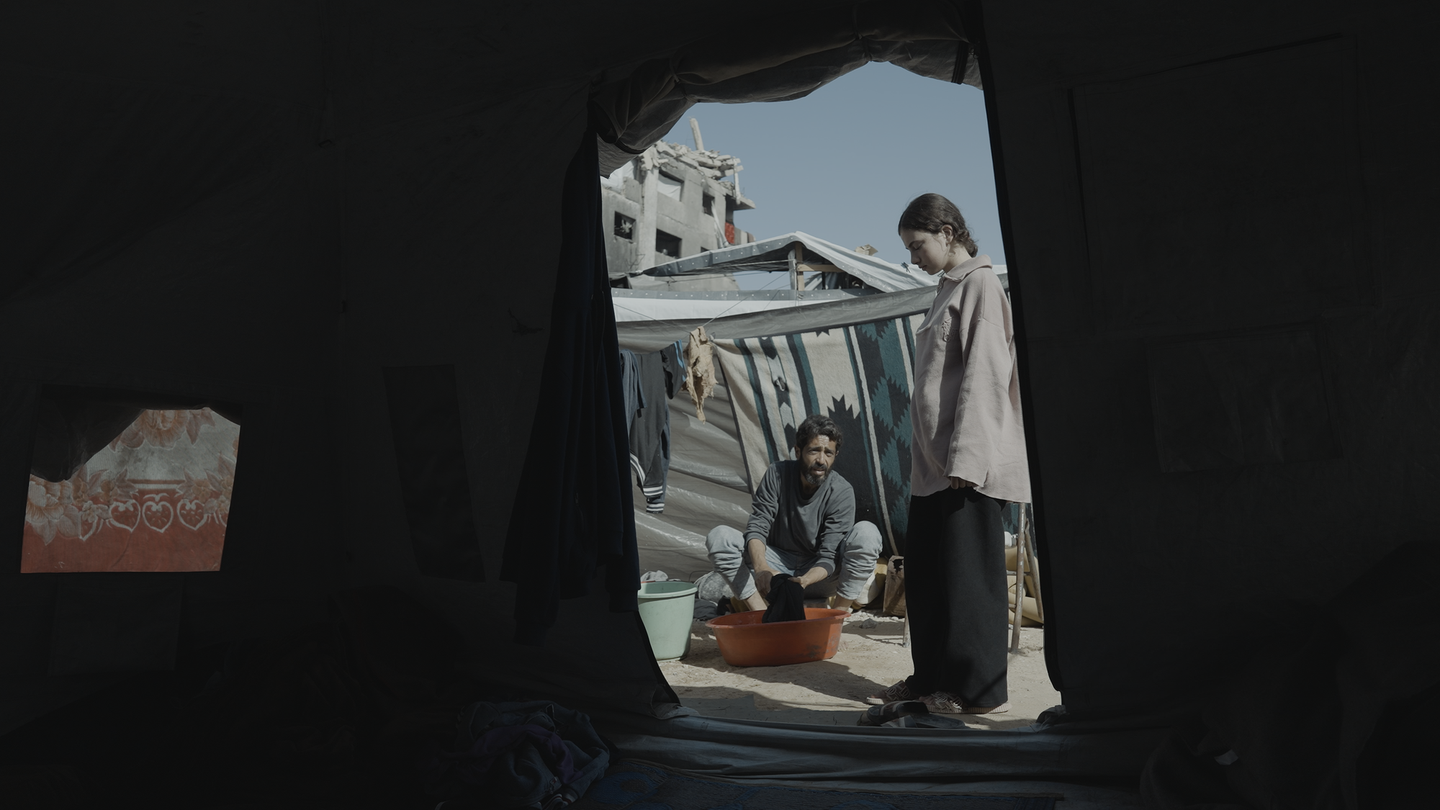
Thirteen in Gaza is confronting and moving. In the film, we follow 13-year old Raghad (Mary Ziyara), as what was left of her childhood disappears, slowly, quickly and heartbreakingly. She is living in a displacement camp with her father Abu Raghad (Firas Al-Masri), after losing her mother and siblings in a bombing. Amidst this violent displacement, Raghad has her first period, forced to experience this formative moment alone. Meanwhile, her father struggles to support her as he is pulled into the dark world of the exploitation of aid.
The film explores the world beyond the headlines: the complexity of coming of age under occupation; the constant grief; the internal community conflicts arising from scarcity; the harm and humiliation of being stripped of one’s dignity and privacy; and how those meant to protect us might let us down.
It is impossible (and unwarranted) to separate this film from the context under which it was made. As I watched, I couldn’t help but wonder how many of the surrounding moments were fictional and how many were real. The rubble surrounding the characters was real of course. But were the bombings featured real? Where do truth and fiction overlap and where do they diverge? You can’t help but think about the fact that these actors and crew are making this film under the very same conditions that they are depicting. I can only imagine the complex task of engaging with these themes, and the nuanced emotional experience that may arise from creating a film like this while continuing to live through a genocide.
This quote from the Director Hosam Abu Dan’s statement on the film stuck with me. He said:
“Thirteen in Gaza did not begin for me as an abstract cinematic idea. I live and work in Gaza, and I have directly experienced bombardment, displacement, interrupted access to water and electricity, food insecurity, and the daily fear of living in a closed and overcrowded environment. This was not a temporary event that could be observed from a distance.”
This speaks to the power and the feat of the film. How do you capture the impact of occupation while living under it? The intimate knowledge and ever-present experience that the cast and crew have of these conditions makes the film all the more impactful and moving. I am in awe of the feat accomplished here.
The film is notably absent of music for most of its run time; instead the sonic landscape of the film features the constant zanana (Palestinian Arabic slang term for the buzzing sound of Israeli drones), sounds of bombing in the distance, and the hum of constant chatter. It is unsettling and effective, immersing you in the daily experience of our characters. You can see how much this occupation and violence is a regular part of their day to day life. Bombs go off and the characters do not jump or react in fear. They continue about their own complex struggles, while the violence continues around them. The few times when music is used, it is all the more effective as the feelings it is meant to elicit - mourning, connection - stir you more profoundly in contrast to the ongoing soundscape of occupation.
Mary Ziyara is incredible as Raghad; she plays the quiet devastation of coming-of-age so beautifully. Throughout the film, Raghad’s innocence is stripped away from her in moments big and small. Her eyes are so expressive and though she is a character of few words, you can see the world of devastation in her eyes. Firas Al-Masri plays Raghad’s father with a restrained subtlety. You can tell that Abu Raghad is trying to do his best (very imperfectly so) amidst so much loss and grief. This doesn’t let him off the hook, but presents him as a character with a realistic complexity, faults and all. The father-daughter relationship depicted feels realistic in its nuance, tension, missteps, and underlying love.
The film is shot beautifully by Yousef Mashharawi (Director of Photography). There are many shots wherein Raghad is framed between tent sheets, in doorways, the window of a tent. This elicits the feeling that she is on the edge of discovery, stuck between what was and what will be, her childhood and what lies beyond. She is in the in-between, the unknown. She’s isolated. She feels alone. I viscerally felt Raghad’s nervous uncertainty, not quite wanting to step through the door (as what lies beyond is unknown and terrifying) but knowing she can’t turn back.
There are also moments where we see beautiful lingering shots of the sea, the waves rolling in. These are one of the moments in the film where we feel some respite, some hope for what could be, freedom, possibility. Memory of what once was. The roll of the waves felt representative of hope, rebirth, calm, connection. The possibilities are so close, yet so far. It reminds me of hearing how for so many Gazans how the sea is a space of respite and hope.
When covering the festival, I saw a video from director Hosam Abu Dan, on the day of the premiere of his film. He spoke of how the film was able to travel further than he and his team could, that this film could do what they could not. My heart broke for the fact that he could not experience an audience’s reaction to seeing this film for the first time. This stark contrast moved me and was another reminder of the injustice of living under occupation and the importance of witnessing films such as this.
As I watched, I wasn’t completely sure how I felt about the film and its plot. It’s quiet and slow moving, but this intentionality is all the more clear by the way the story wraps up. No spoilers here, but all I can say is that it sticks the landing. I went from uncertainty to feeling deeply moved. The film is confronting and heartrending. I encourage you to watch it and let it sit with you. Let yourself be moved as the waves of the sea.
Support our work
You can subscribe to the OBSCURAE newsletter for free, or become a paid Aficionado for £5/month to help fund independent coverage, contributor fees, site hosting, and admin costs.