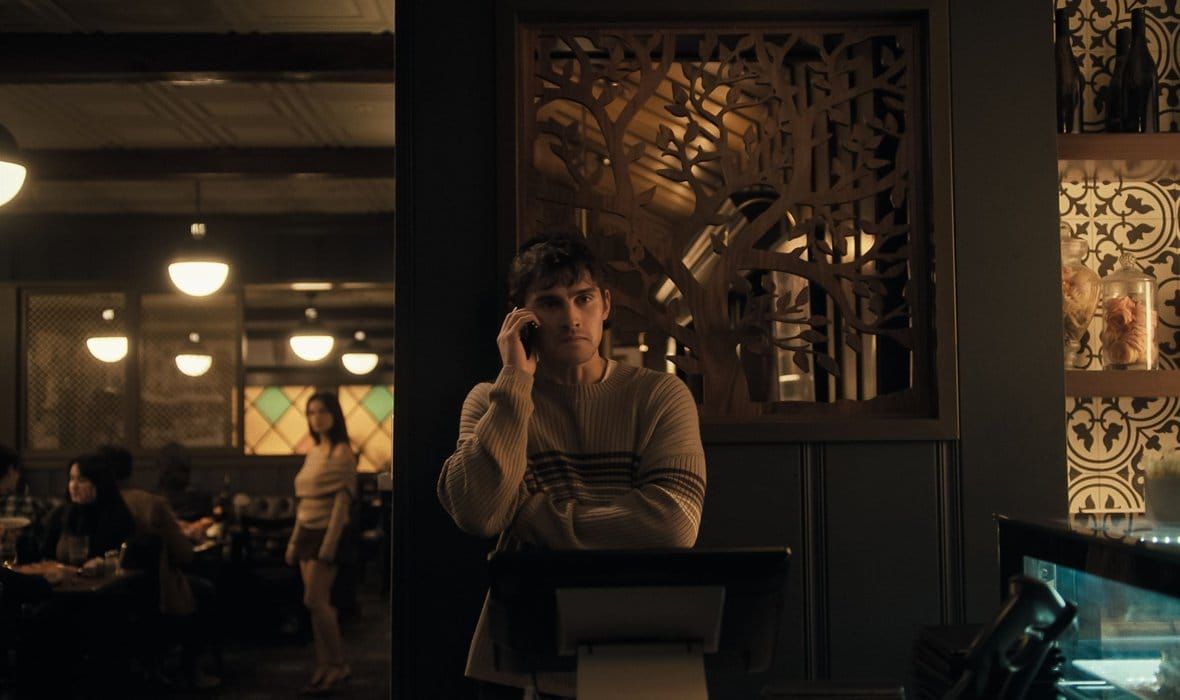
“Imagine describing a dog to someone who has never seen one before and then asking them to draw it. It will look similar, but the devil’s in the details.” - Clark (Chiwetel Ejiofor, Backrooms)
Somewhere, I imagine, in a glossy office in Los Angeles, Toronto, London, New York, or elsewhere in the world, studio executives are already trying to catch the lightning in a bottle that has already struck (twice!), asking themselves, “What is the next internet IP that can be what Backrooms is right now?”
Backrooms and Obsession are the two films on everyone’s minds, tongues, and feeds. Backrooms opened to a record-breaking box office weekend on May 29th, and as of June 3rd, has brought in over $100M in the American box office, a first in A24’s history.
At just 20 years old, Kane Parsons is now the youngest director to ever open a film at number one in North America.
Parsons is not alone in his move from YouTube to the silver screen nor the success of his cinematic debut. 26-year-old Curry Barker’s microbudget horror film Obsession became one of the year's surprise hits. On a budget of just $750k, as of June 3rd, Obsession has raked in an astounding $117M domestically in under three weeks in the cinemas.
The financial success of these films signals something unexpected and exciting: the arrival of a generation of filmmakers whose artistic sensibilities were shaped not necessarily by traditional film schools or studio systems, but by internet cultures and forums and– importantly– YouTube. A site where both Barker and Parsons (and many others like them) have amassed large followings and monetized their independently produced work.
Barker and Parsons are part of a growing wave of creators transforming internet-born horror into mainstream success. While their paths differ, they share something significant: they came of age during a period defined by economic precarity, political instability, climate change, and a seemingly endless succession of "unprecedented" global crises including the ongoing COVID-19 pandemic.
The horror genre has always reflected the anxieties of its historical moment. Throughout history, horror has served as a cultural pressure valve. The monsters that populate our stories rarely emerge from nowhere. They are often reflections of the fears already circulating beneath the surface of everyday life.
Consider the zombie: a figure that emerged from Haitian Vodou before being appropriated by white slave owners and eventually brought to Hollywood in films like White Zombie (1932). Across the decades, the zombie has continually evolved to embody different cultural fears. George A. Romero's Dawn of the Dead (1978) transformed zombies into a critique of consumer culture, while Danny Boyle's 28 Days Later (2002) reimagined them through the lens of viral contagion and public health crises. The zombies evolve, but their function remains unchanged: to transform anxieties into a physical embodiment of something we can see, fear, and fight.
The current moment of viral horror moment is similarly tied to the current historical threats.
Housing markets are increasingly unattainable. Stable employment is more elusive than ever, especially with the rise of AI. Climate reports grow more alarming each year. Algorithmic recommendation systems are designed to normalize and push people towards right-wing ideology. And globally, political leaders are incapable of responding meaningfully to large-scale crises whilst willfully continuing to create more for their own financial and power-tripping gains.
The result is a cultural landscape where uncertainty itself has become a defining part of everyday life for young people (not just young people of course, but certainly younger people en-masse).
This may explain why liminal spaces have become such a powerful visual language in Backrooms. These spaces evoke dread because they suspend us between borders and boundaries. The Backrooms are neither truly alive nor entirely dead (depending on how deep you go into Parson’s YouTube series lore). They feel familiar– they resemble spaces we are accustomed to navigating– but they are unsettling, even dangerous. They are memories distorted through repetition and misremembering.
In my review of Backrooms, I touched briefly on the idea of the unheimlich or the uncanny. For the scope of the review, I didn’t have the opportunity to talk about how the Backrooms are also related to the idea of the “abject,” a term that comes from Bulgarian-French philosopher Julia Kristeva in her book Powers of Horror (1980).
In it, she describes the abject as that which “disturbs identity, system, and order. What does not respect borders, positions, rules.” She notes that the abject is neither subject nor object, exists in the “scope of the impossible,” and it is a revolt of being.
The abject becomes a useful framework for thinking through liminal spaces, warped memory, and uncertain futures presented in Backrooms. I could write a whole other essay about this but I digress.
What’s important here is that liminal spaces mirror the experience of growing up amidst constant instability and entering adulthood through recessions, genocides, pandemics, billionaires building data centres in our backyards, non-stop climate emergencies, and neofascism.
The promises offered by previous generations (a stable career, affordable housing, predictable pathways to adulthood) are increasingly out of reach for each new generation. We’re still told they are the milestones we should be reaching for, when day-by-day, fewer of us can make them our reality.
We are inheriting a world suspended between a present that feels increasingly untenable and futures that no longer make coherent sense. In many ways, those futures are abject: they disturb the boundaries and assumptions that previous generations treated as stable.
Then we have Obsession, which taps into abject fears about distinguishing truth from fiction, in which toxic masculinity is shrouded in the body of a “good guy!” who appears safe on the surface but contains something much sinister underneath his collection of (admittedly) incredible knitwear.
For women, Obsession also offers a space to confront fears surrounding consent, bodily autonomy, and intimate violence. I would go so far as to argue that the film speaks to the fears of safety when it comes to dating in general.
In an era where many women are increasingly discussing experiences with seemingly progressive men who nevertheless reproduce harmful behaviours, the film's central threat is particularly recognizable.
It’s no wonder that “performative male contests” are taking TikTok by storm to show how a certain kind of man that presents as anti-racist, feminist, and woke, is more of an aesthetic than it is a lived value system.
I don’t share these insights to echo the seemingly endless rhetoric of nihilism going around right now. On the contrary, I strongly lean into hope, joy, kinship, resistance, and the belief that community, art, and acts of mutual aid can and will save us.
Instead, my goal is to point to the challenges and contradictions that millennials and Gen Z (and very soon Gen Alpha) must contend with. It is perhaps unsurprising that young filmmakers have transformed these conditions into horror that is resonating so much with mostly younger audiences that box office records are being broken each week.
What makes creators like Parsons and Barker particularly significant is not simply that they found success through YouTube. Rather, platforms like YouTube, Nebula, and MeanTV are digital ecosystems that have allowed emerging filmmakers to develop audiences outside traditional gatekeeping structures. This accessibility has created space for stories that might otherwise struggle to find support within conventional systems. It has also allowed filmmakers to experiment with new forms of storytelling shaped by the internet itself. After all, analog horror, Alternate Reality Games, found footage hybrids, and collaborative online narratives all emerged from digital communities before attracting mainstream attention.
In many ways, Backrooms and Obsession represent more than individual success stories. They demonstrate that audiences are hungry for horror that speaks directly to the uncertainties of contemporary life. Yes, they are entertaining and spooky and fun! But they are also helping audiences collectively process fears that otherwise feel overwhelmingly isolating when experienced alone.
This may ultimately be horror's most important function: at its best, the genre provides a safe space to confront the things that scare us most.
Horror transforms anxieties into stories, images, and experiences that can be shared with others. In doing so, horror reminds us that our fears are rarely ours alone and that our futures are collectively worth fighting for.